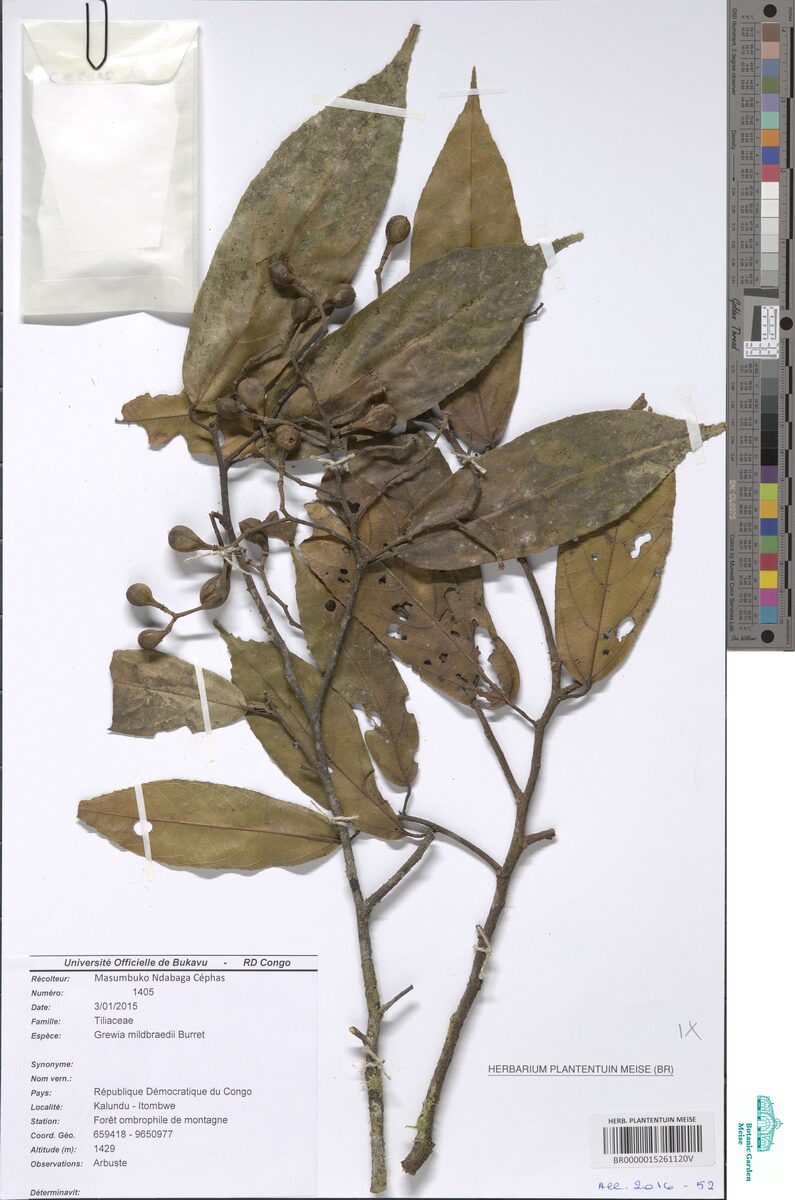
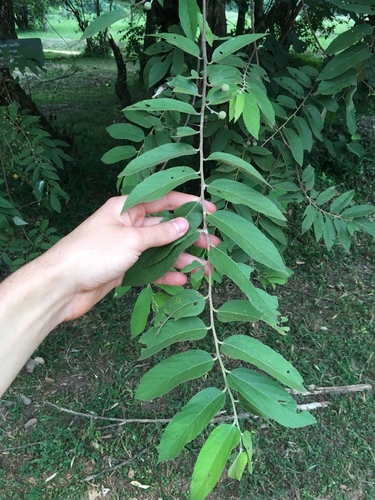
Pterygota alata
(Roxb.) R. Br.
Buddha’s Coconut
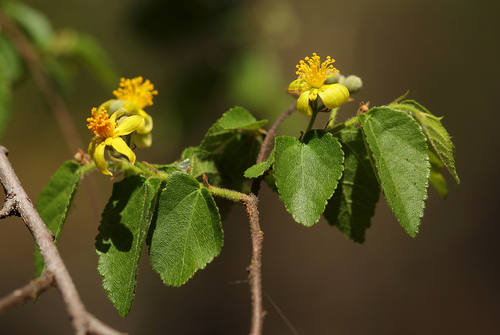
iNaturalist· cc-by
(c) Jayesh Patil, some rights reserved (CC BY)
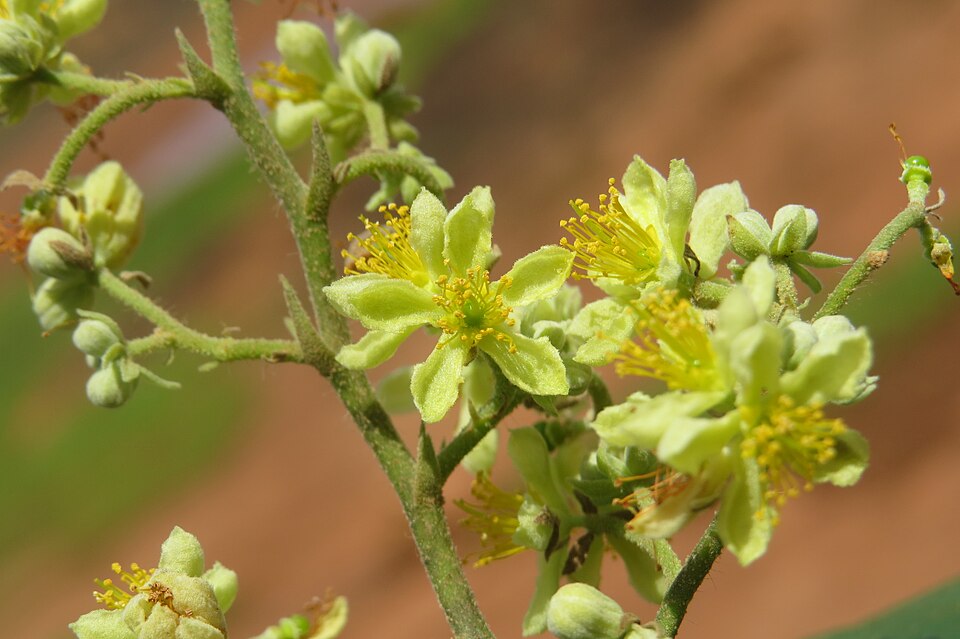
iNaturalist· cc-by
(c) Karthik Thrikkadeeri, some rights reserved (CC BY)
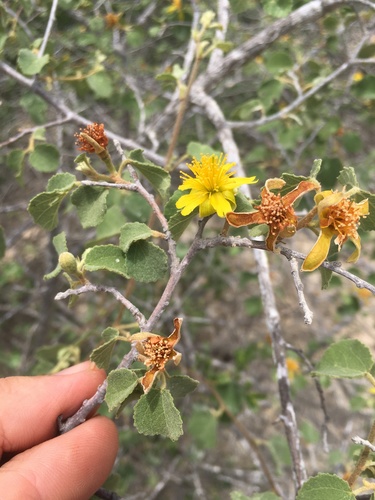
iNaturalist· cc-by-nc
(c) Rafidah Abdul Rahman, some rights reserved (CC BY-NC)
Summary
Source: WikipediaPterygota alata is a species of large deciduous tree with winged seeds and large, simple leaves belonging to the family Malvaceae. It is commonly found in tropical and subtropical regions of South and Southeast Asia, particularly in India, Bangladesh, Myanmar, and Thailand.
Description
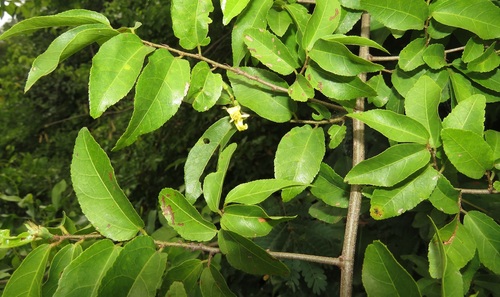
A large deciduous tree. It grows 15-30 m tall. The trunk is 70-80 cm across. The trunk is straight and with only small buttresses. The branches are short. The crown is oval or column shaped. The bark is smooth and grey. It has shallow cracks. The young parts have rusty coloured hairs. The leaves have long leaf stalks. They can be 5-10 cm long. The leaves are broadly oval and 10-25 cm long by 7-15 cm wide. They are heart shaped at the base. They are wavy at the edge. There are 5-7 veins from the base. The leaves are clustered near the ends of branches. The flowers are small and have an unpleasant smell. The flowers are 1.5 cm across. They are purple with red streaks. They are in short clusters with a rusty covering. The flower sepals are thick and fleshy. There are male, female and bisexual flowers on the same tree. The fruit is a round woody capsule. It is 12.5 cm across. It has a fine mealy covering over it. It has many seeds. There are 40 seeds. These are in 2 rows and have wings. The fruit splits open along one edge.
Edible Uses
The wood of Pterygota alata is lightweight and used for making furniture, plywood, packing materials, and boatbuilding. The tree is also valued for its ornamental appeal and is sometimes planted in parks and large gardens. Additionally, its seeds are rich in oil, which can be used for industrial and medicinal purposes. In some cultures the edible seeds are used as a substitute for opium.
Traditional Uses
The roasted seeds are eaten. The seeds also yield a fatty oil. CAUTION: The seeds cause itch and sleep.
This uses section is brief — help expand it
Medicinal Uses
The plant is used medicinally. The seed is used as a substitute for opium.
Distribution
A tropical plant. It grows in dense forest. In Vietnam it grows from 100 to 800 m altitude. It occurs on well drained clay soil or alluvial soil.
Where It Grows
Andamans, Asia, Bangladesh, Cambodia, China, East Indies, Himalayas, India, Indochina, Indonesia, Laos, Malaysia, Myanmar, Nepal, Northeastern India, Pakistan, SE Asia, Singapore, Thailand, Vietnam,
Cultivation
It can be grown from seed. It is possible to use cuttings or air-layering.
Other Uses
An oil obtained from the seed is used for lighting. A strong but coarse fibre is obtained from the bark. It is sometimes made into ropes, but Is less frequently used for this purpose than is that of Sterculia villosa. The heartwood is straw-coloured to light brown; it is not differentiated from the sapwood. The texture is moderately coarse and uneven due to the presence of abundant parenchyma; the pretty, silvergrain is straight to shallowly interlocked. The timber is light in weight, moderately hard, moderately heavy , moderately strong, non-durable under exposed conditions, being susceptible to both fungal and insect attacks. It is easy to resaw and cross-cut. Planing is easy and the planed surface is smooth. A low quality timber, it is suitable for light and temporary construction, packing crates, wooden pallets, plywood manufacture, ladies' shoe heels and perhaps as a source of short-fibred pulp
Production
The tree grows quickly. It can be lopped.
Notes
Also put in the family Sterculiaceae.
Synonyms
Also Known As
Anathondi, Bandha narikella, Bong bong, Buddha narical, Buddha narikel, Chan tompeang, Dieng-soh-lak, Dieng-soh-lakor, Haron, Khamari, Kodaittondi, Kodathani, Kok terak, Kolugida, Labshi, Leng-lep, Letkok, Nagasul, Narikel, Pahari, Pathondi, Phunberpui, Sin-kadet, Tattele mara, Taung-letkok, Tula
References (25)
- Ambasta S.P. (Ed.), 2000, The Useful Plants of India. CSIR India. p 504 (As Pterygota alata)
- Bajpai, O., et al, 2015, Tree species of the Himalayan Terai region of Uttar Pradesh, India: a checklist. Check List 11(4): 1718
- Burkill, I.H., 1966, A Dictionary of the Economic Products of the Malay Peninsula. Ministry of Agriculture and Cooperatives, Kuala Lumpur, Malaysia. Vol 2 (I-Z) p 2115 (As Sterculia alata)
- Burkill, I.H., 1966, A Dictionary of the Economic Products of the Malay Peninsula. Ministry of Agriculture and Cooperatives, Kuala Lumpur, Malaysia. Vol 2 (I-Z) p 1868 (As Pterygota alata)
- Davis, S.D., Heywood, V.H., & Hamilton, A.C. (eds), 1994, Centres of plant Diversity. WWF. Vol 1 or 2. p 139 (As Sterculia alata)
Show all 25 references Hide references
- Dobriyal, M. J. R. & Dobriyal, R., 2014, Non Wood Forest Produce an Option for Ethnic Food and Nutritional Security in India. Int. J. of Usuf. Mngt. 15(1):17-37
- Flora of Pakistan. www.eFloras.org
- Hedrick, U.P., 1919, (Ed.), Sturtevant's edible plants of the world. p 634 (As Sterculia alata)
- Kar, A., et al, 2013, Wild Edible Plant Resources used by the Mizos of Mizoram, India. Kathmandu University Journal of Science, Engineering and Technology. Vol. 9, No. 1, July, 2013, 106-126 (As Sterculia alata)
- Kar, A., & Borthakur, S. K., 2007, Wild vegetables sold in local markets of Karbi Anglong, Assam. Indian Journal of Traditional Knowledge. 6(1) January 2007, pp 169-172 (As Sterculia alata)
- Menninger, E.A., 1977, Edible Nuts of the World. Horticultural Books. Florida p 43 (As Sterculia alata)
- Menninger, E.A., 1977, Edible Nuts of the World. Horticultural Books. Florida p 42 (As Pterygota alata)
- Pasha, M. K. & Uddin, S. B., 2019, Minor Edible Fruits of Bangladesh. Bangladesh J. Plant Taxon. 26(2): 299–313
- Patiri, B. & Borah, A., 2007, Wild Edible Plants of Assam. Geethaki Publishers. p 15 (As Sterculia alata)
- Pham-Hoang Ho, 1999, An Illustrated Flora of Vietnam. Nha Xuat Ban Tre. p 504 (As Sterculia alata)
- Phon, P., 2000, Plants used in Cambodia. © Pauline Dy Phon, Phnom Penh, Cambodia. p 569 (As Sterculia alata)
- Pl. Coromandel 3:84, t. 287. 1820 (As Sterculia alata)
- Sawian, J. T., et al, 2007, Wild edible plants of Meghalaya, North-east India. Natural Product Radiance Vol. 6(5): p 421
- Singh, H.B., Arora R.K.,1978, Wild edible Plants of India. Indian Council of Agricultural Research, New Delhi. p 83 (As Sterculia alata)
- Sukarya, D. G., (Ed.) 2013, 3,500 Plant Species of the Botanic Gardens of Indonesia. LIPI p 481
- Swaminathan, M.S., and Kochnar, S.L., 2007, An Atlas of Major Flowering Trees in India. Macmillan. p 56 (As Pterygota alata)
- Thai Forestry Bulletin 23:62-108, 1995
- WATT p 1892 (As Pterygota alata)
- Wickens, G.E., 1995, Edible Nuts. FAO Non-wood forest products. FAO, Rome. p155 (As Pterygota alata)
- World Checklist of Useful Plant Species 2020. Royal Botanic Gardens, Kew