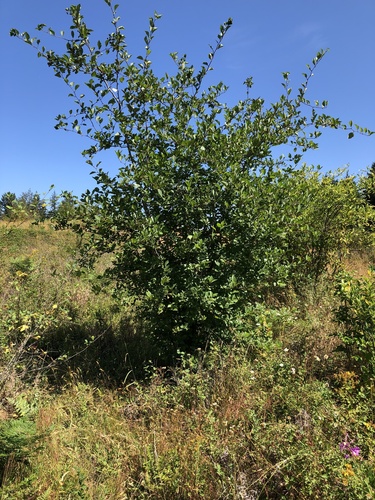
Spiraea salicifolia
L.
Bridewort, Willowleaf Meadowsweet, Spirea
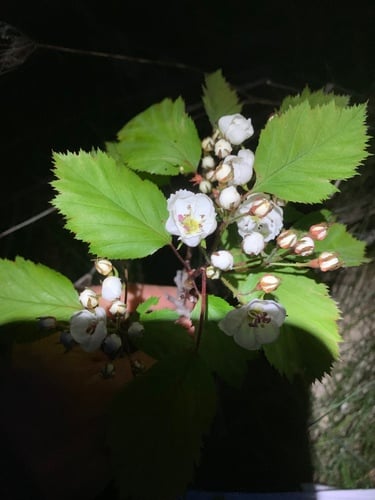
iNaturalist· cc-by-nc-nd
(c) autan, some rights reserved (CC BY-NC-ND)
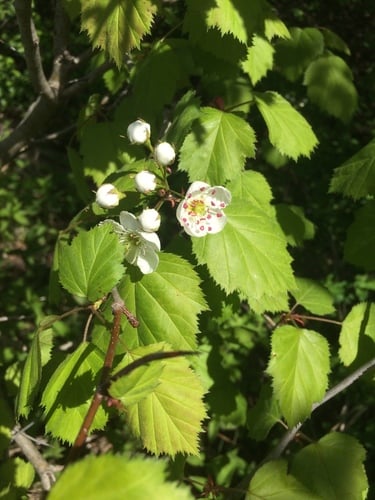
iNaturalist· cc-by-nc
(c) naturalisttt, some rights reserved (CC BY-NC), uploaded by naturalisttt
iNaturalist· cc-by-nc
(c) naturalisttt, some rights reserved (CC BY-NC), uploaded by naturalisttt
Summary
Source: WikipediaSpiraea salicifolia, the bridewort, willow-leaved meadowsweet, spice hardhack, or Aaron's beard, is a species of flowering plant in the family Rosaceae. A shrub, it is native to east-central Europe, Kazakhstan, all of Siberia, the Russian Far East, Mongolia, northern China, Korea, and Japan, and it has been widely introduced to the rest of Europe and to eastern North America. It has been cultivated since the 1500s for hedges and similar applications, but is not particularly well-behaved.
Description
A clump forming shrub. It grows 1.2-2 m tall. The leaves are oblong or sword shaped and 2.5-8 cm long. They have double teeth.
This description is brief — help expand it
Edible Uses
Young leaves are cooked and eaten; they are rich in vitamin C.
Medicinal Uses
The roots have been used to treat coughs and chest colds. Immature seeds have been used in the treatment of diarrhoea with blood.
Distribution
It is a temperate plant. It grows near river banks, damp grasslands and clearings between 200-900 m in north China.
Where It Grows
Asia, Australia, Austria, Balkans, Britain, Bulgaria, China, Czech, Europe, Hawaii, Hungary, Japan, Korea, Mongolia, North America, Poland, Romania, Russia,
Cultivation
Tolerates most soils, but prefers a good loamy soil, abundant moisture and full sunlight. Prefers a moist lime-free soil, plants quickly become chlorotic on chalk soils. A very cold hardy plant, tolerating temperatures down to about -25°c. Hybridizes freely with other members of this genus. A rampant suckering shrub, it quickly produces dense thickets. It is apt to get thin and poor unless divided up fairly regularly and replanted in fairly good soil.
Propagation
Sow seed as soon as it is ripe in a cold frame where possible. Stratification is likely required before germination, so stored seed should be sown in a cold frame as early in the year as received. Prick out seedlings into individual pots when large enough to handle and grow on in a cold frame for the first winter, then plant out in late spring or early summer the following year. Take half-ripe cuttings in July/August in a light sandy soil in a frame. Take cuttings of mature wood from the current season's growth, 15cm long, in October/November in an outdoor frame (September has also been reported as suitable). Divide suckers in early spring and plant directly into permanent positions.
Other Uses
The plant is used as a soil stabilizer for river and lakeside banks. It is also frequently planted in hedges.
Notes
There are about 100 Spiraea species.
References (7)
- Flora of China @ efloras.org Volume 9
- Hibbert, M., 2002, The Aussie Plant Finder 2002, Florilegium. p 293
- Kremer, B.P., 1995, Shrubs in the Wild and in Gardens. Barrons. p 155
- Plants for a Future database, The Field, Penpol, Lostwithiel, Cornwall, PL22 0NG, UK. http://www.scs.leeds.ac.uk/pfaf/
- Sp. pl. 1:489. 1753
Show all 7 references Hide references
- Staples, G.W. and Herbst, D.R., 2005, A tropical Garden Flora. Bishop Museum Press, Honolulu, Hawaii. p 482
- Williams, D., 2017, Ainu Ethnobiology. Contributions in Ethnobiology. Society of Ethnobiology. p 143