Torminalis glaberrima
(Gand.) Sennikov & Kurtto
Checkertree, Chequers, Wild Service tree, Maple service
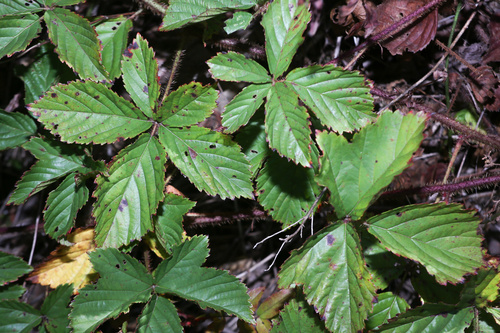
iNaturalist· cc-by-nc
(c) Jacques HALLOT, some rights reserved (CC BY-NC), uploaded by Jacques HALLOT
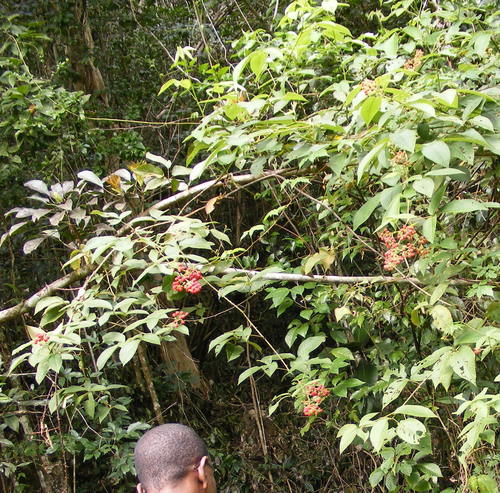
iNaturalist· cc-by-nc
(c) Steffen, some rights reserved (CC BY-NC)
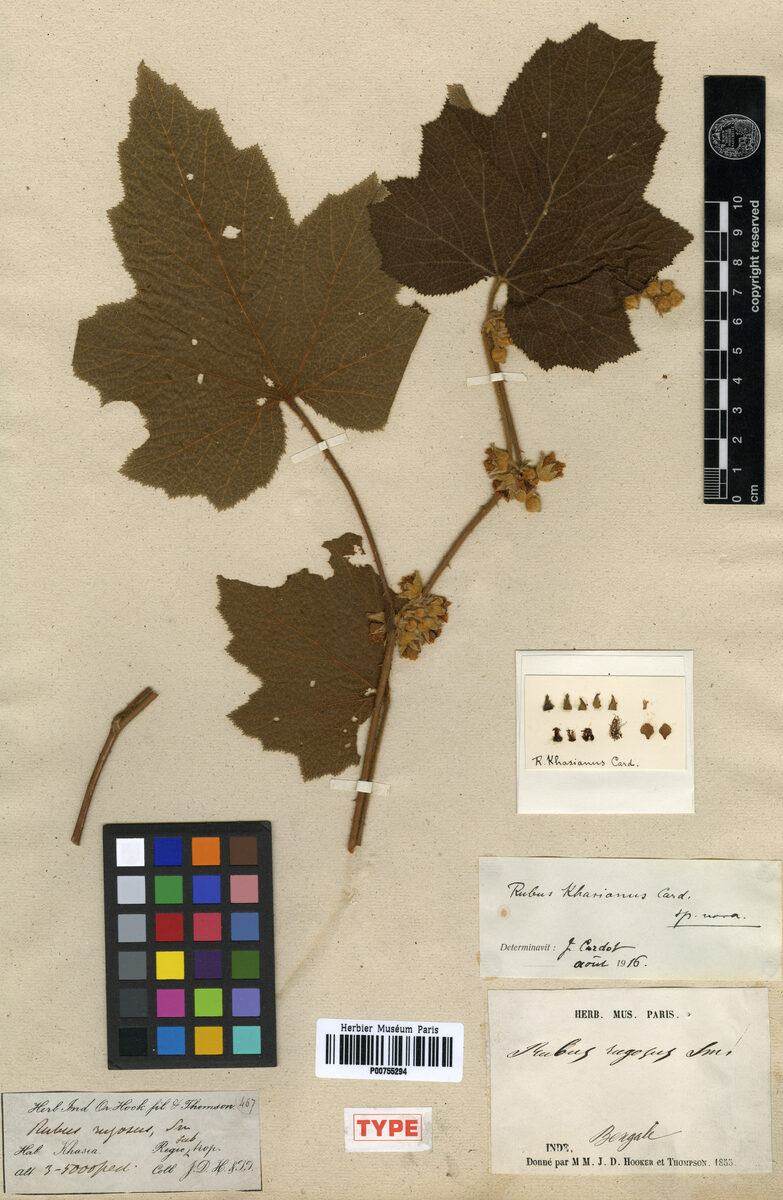
iNaturalist· cc-by-nc
(c) Steffen, some rights reserved (CC BY-NC)
Description
A spreading deciduous tree. It grows 15-20 m high. The bark is dark grey and broken into shallow cracks. The leaves are maple shaped. They are alternate and shiny on both sides. They are 10 cm long and almost 10 cm across. The leaves have several lobes. The bottom pair of lobes grow at right angles to the leaf stalk. The leaves turn purplish in autumn. The flowers are creamy-white and in rounded heads. The flowers are 1.2 cm across. The fruit are rounded and produced in clusters. They are a light, leathery brown with speckles. They are 1.2 cm across. Commonly listed as Sorbus torminalis
Edible Uses
The fruit are eaten after being subject to frost and can be processed into jellies, conserves, and wine.
Traditional Uses
The fruit are eaten after being subject to frost. It can be processed into jellies, conserves and wine.
This uses section is brief — help expand it
Medicinal Uses
The wild service tree is one of the most valuable hardwoods in Europe. The wood is fine-grained, very dense and has good bending strength. It was used in the past to make screws for winepresses, billiard cue sticks, musical instruments and turnery. Today, it is usually only used for decorative veneers. The fruit, sometimes called "chequers", are edible and taste similar to dates, although they are now rarely collected for food. They are usually too astringent to eat until they are over-ripe and bletted. They were traditionally known as a herbal remedy for colic. Before the introduction of hops, the fruit were used to flavour beer.
Distribution
It is a temperate plant. It is native to N. Africa, S.W. Asia and Europe. It suits hardiness zones 6-10.
Where It Grows
Africa, Albania, Algeria, Armenia, Asia, Australia, Austria, Azerbaijan, Balkans, Belgium, Bosnia, Britain, Bulgaria, Caucasus, Croatia, Cyprus, Czech, Denmark, Europe, France, Georgia, Germany, Greece, Himalayas, Hungary, Iran, Italy, Kosovo, Lebanon, Luxembourg, Mediterranean, Middle East, Morocco, North Africa, Poland, Portugal, Romania, Russia, San Marino, Slovakia, Slovenia, Spain, Switzerland, Turkey, Türkiye, Ukraine, Yugoslavia,
Cultivation
Seed do not germinate readily.
Production
Trees grow slowly.
Notes
There are about 75 Sorbus species. The fruit have been used as medicine.
Synonyms
Also Known As
Barkoca, Brek, Brekinja, Brekinya, Gilgusar, Pitlecin, Vadbarkoca
References (28)
- Arora, R. K., 2014, Diversity in Underutilized Plant Species - An Asia-Pacific Perspective. Bioversity International. p 87 (As Sorbus torminalis)
- Bodkin, F., 1991, Encyclopedia Botanica. Cornstalk publishing, p 940 (As Sorbus torminalis)
- Bussman, R. W., et al, 2016, A comparative ethnobotany of Khevsureti, Samtskhe-Javakheti, Tusheti, Svaneti, and Racha-Lechkhumi, Republic of Georgia (Sakartvelo), Caucasus. Journal of Ethnobiology and Ethnomedicine. (As Sorbus torminalis)
- Coombes, A.J., 2000, Trees. Dorling Kindersley Handbooks. p 282 (As Sorbus torminalis)
- Cundall, P., (ed.), 2004, Gardening Australia: flora: the gardener's bible. ABC Books. p 1358 (As Sorbus torminalis)
Show all 28 references Hide references
- Denes, A., et al, 2012, Wild plants used for food by Hungarian ethnic groups living in the Carpathian Basin. Acta Societatis Botanicorum Poloniae 81 (4): 381-396 (As Sorbus torminalis)
- Ertug, F., 2000, An Ethnobotanical Study in Central Anatolia (Turkey). Economic Botany Vol. 54. No. 2. pp. 155-182 (As Sorbus torminalis)
- Ertug, F, Yenen Bitkiler. Resimli Türkiye Florası -I- Flora of Turkey - Ethnobotany supplement (As Sorbus torminalis)
- Facciola, S., 1998, Cornucopia 2: a Source Book of Edible Plants. Kampong Publications, p 211 (As Sorbus torminalis)
- Flowerdew, B., 2000, Complete Fruit Book. Kyle Cathie Ltd., London. p 182 (As Sorbus torminalis)
- Glowinski, L., 1999, The Complete Book of Fruit Growing in Australia. Lothian. p 46 (As Sorbus torminalis)
- Harris, E & J., 1983, Field Guide to the Trees and Shrubs of Britain. Reader's Digest. p 142 (As Sorbus torminalis)
- Hedrick, U.P., 1919, (Ed.), Sturtevant's edible plants of the world. p 544 (As Pyrus torminalis)
- http://www.botanic-gardens-ljubljana.com/en/plants (As Sorbus torminalis)
- Irving, M., 2009, The Forager Handbook, A Guide to the Edible Plants of Britain. Ebury Press p 286 (As Sorbus torminalis)
- Mabey, R., 1973, Food for Free. A Guide to the edible wild plants of Britain, Collins. p 180 (As Sorbus torminalis)
- Maghradze, D. et al, Minor and Underutilised Fruits in Georgia and Their Wild Relatives. ISHS (As Sorbus torminalis)
- Nedelcheva A., 2013, An ethnobotanical study of wild edible plants in Bulgaria. EurAsian Journal of BioSciences 7, 77-94 (As Sorbus torminalis)
- Pardo-de-Santayana, M., et al, 2007, Traditional knowledge of wild edible plants used in the northwest of the Iberian Peninsula (Spain and Portugal): a comparative study. Journal of Ethnobiology and Ethnomedicine 2007, 3:27 (As Sorbus torminalis)
- Plants for a Future database, The Field, Penpol, Lostwithiel, Cornwall, PL22 0NG, UK. http://www.scs.leeds.ac.uk/pfaf/ (As Sorbus torminalis)
- Polat, R., et al, 2017, Survey of wild food plants for human consumption in Bingol, (Turkey). Indian Journal of Traditional Knowledge. Vol. 16(3) July 2017, pp. 378-384 (As Sorbus torminalis)
- Redzic, S. J., 2006, Wild Edible Plants and their Traditional Use in the Human Nutrition in Bosnia-Herzegovina. Ecology of Food and Nutrition, 45:189-232 (As Sorbus torminalis)
- Sfikas, G., 1984, Trees and shrubs of Greece. Efstathiadis Group. Athens. p 64 (As Sorbus torminalis)
- Stirp. austr. fasc. 2:45. 1763 (As Sorbus torminalis)
- Tardio, J., et al, Ethnobotanical review of wild edible plants in Spain. Botanical J. Linnean Soc. 152 (2006), 27-71 (As Sorbus torminalis)
- Uphof, (As Sorbus torminalis)
- USDA, ARS, National Genetic Resources Program. Germplasm Resources Information Network - (GRIN). [Online Database] National Germplasm Resources Laboratory, Beltsville, Maryland. Available: www.ars-grin.gov/cgi-bin/npgs/html/econ.pl (10 April 2000) (As Sorbus torminalis)
- World Checklist of Useful Plant Species 2020. Royal Botanic Gardens, Kew