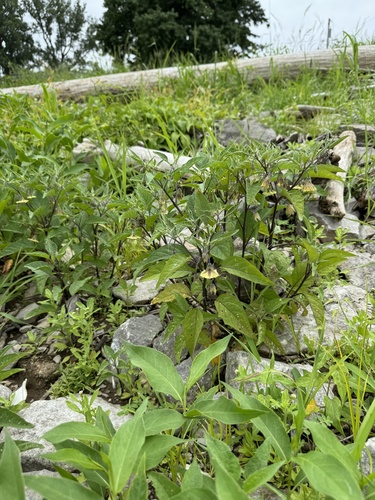
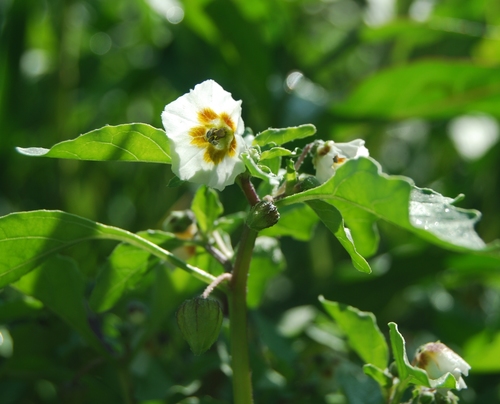
Solanum wendlandii
Hook. f.
Costa Rican Nightshade
iNaturalist· cc-by
(c) Daniel Mesa, some rights reserved (CC BY), uploaded by Daniel Mesa
iNaturalist· cc-by-nc
(c) Juan Carlos López Domínguez, some rights reserved (CC BY-NC)
iNaturalist· cc-by
(c) Ricard Busquets Reverte, some rights reserved (CC BY)
Summary
Source: WikipediaSolanum wendlandii, the giant potato creeper, potato vine, Costa Rican nightshade, divorce vine, or paradise flower, is a species of flowering plant in the family Solanaceae. It is native to Mexico, Central America, and northwest South America, and has been widely introduced as an ornamental to other tropical locales, including the Caribbean, Africa, Nepal, Java, and many islands in the Indian and Pacific Oceans. A robust vine reaching 15 ft (4.6 m), its long-lasting dark purple flowers eventually fade to white.
Description
An evergreen twining climber. It can climb 7 m high. The leaves are simple or with uneven lobes. The leaves can have small hooked prickles. The flowers rotate. They are star shaped and 5 cm across. They are violet. The petals are fused at the edges and have notches. The fruit are yellow and 10 cm long.
Edible Uses
The young spiny leaves and stems are boiled and eaten as a green vegetable.
Traditional Uses
CAUTION: The green fruit contain an alkaloid. The young spiny leaves and stems are boiled and eaten as a green.
This uses section is brief — help expand it
Known Hazards
The green fruit contain an alkaloid and should not be eaten.
Distribution
It is a tropical plant. It needs moderate moisture. It needs an average to fertile, well-drained soil. It does best in full sun. It suits hardiness zones 10-12.
Where It Grows
Africa, Asia, Australia, Central America, Colombia, Costa Rica*, Cuba, Dominican Republic, East Africa, El Salvador, Guatemala, Haiti, Hawaii, India, Jamaica, Malawi, Marquesas, Mexico, Mozambique, Nicaragua, North America, Pacific, Panama, Puerto Rico, South America, USA, Venezuela, Virgin Islands, West Indies, Zambia, Zimbabwe,
Cultivation
Plants are usually grown from cuttings.
Notes
There are about 1400 Solanum species.
Also Known As
Giant potato vine, Paradise-flower, Wendland's nightshade
References (17)
- Ambasta, S.P. (Ed.), 2000, The Useful Plants of India. CSIR India. p 583
- Bodkin, F., 1991, Encyclopedia Botanica. Cornstalk publishing, p 936
- Bot. Mag. 113: t. 6914. 1887
- Brickell, C. (Ed.), 1999, The Royal Horticultural Society A-Z Encyclopedia of Garden Plants. Convent Garden Books. p 965
- Cundall, P., (ed.), 2004, Gardening Australia: flora: the gardener's bible. ABC Books. p 1349
Show all 17 references Hide references
- Garcia-Serrano, C. R., & Del Monte, J. P., 2004, The Use of Tropical Forest (Agroecosystems and wild Plant harvesting) as a Source of Food in the Bribri and Cabecar Cultures in the Caribbean Coast of Costa Rica. Economic Botany 58(1) pp 58-71
- Hibbert, M., 2002, The Aussie Plant Finder 2002, Florilegium. p 292
- Hazlett, D. L., 1986, Ethnobotanical Observations from Cabecar and Guaymi Settlements in Central America. Economic Botany 40(3): 339-352
- Kermath, B. M., et al, 2014, Food Plants in the Americas: A survey of the domesticated, cultivated and wild plants used for Human food in North, Central and South America and the Caribbean. On line draft. p 827
- Llamas, K.A., 2003, Tropical Flowering Plants. Timber Press. p 353
- Lord, E.E., & Willis, J.H., 1999, Shrubs and Trees for Australian gardens. Lothian. p 338
- Martin, F.W. & Ruberte, R.M., 1979, Edible Leaves of the Tropics. Antillian College Press, Mayaguez, Puerto Rico. p 220
- Plants of Haiti Smithsonian Institute http://botany.si.edu/antilles/West Indies
- Staples, G.W. and Herbst, D.R., 2005, A tropical Garden Flora. Bishop Museum Press, Honolulu, Hawaii. p 539
- Turreira-Garcia, N., et al, 2015, Wild edible plant knowledge, distribution and transmission: a case study of the Achi Mayans of Guatemala. Journal of Ethnobiology and Ethnomedicine. 11:52
- White, F., Dowsett-Lemaire, F. and Chapman, J. D., 2001, Evergreen Forest Flora of Malawi. Kew. p 555
- Zuchowski W., 2007, Tropical Plants of Costa Rica. A Zona Tropical Publication, Comstock Publishing. p 102