Solanum melongena
L.
Eggplant, Brinjal, Aubergine
iNaturalist· cc-by-nc
(c) colinmorita, some rights reserved (CC BY-NC)
iNaturalist· cc-by-nc
(c) Noopur🍀, some rights reserved (CC BY-NC)
iNaturalist· cc-by-nc
(c) colinmorita, some rights reserved (CC BY-NC)
Summary
Source: WikipediaEggplant is a tender perennial reaching about 1 meter tall. It produces glossy fruit from August through October, with foliage from May to October. The plant requires full sun and thrives in well-drained loamy or sandy soil with neutral to slightly alkaline pH. It prefers consistently moist conditions and tolerates heavy clay soils.
Description
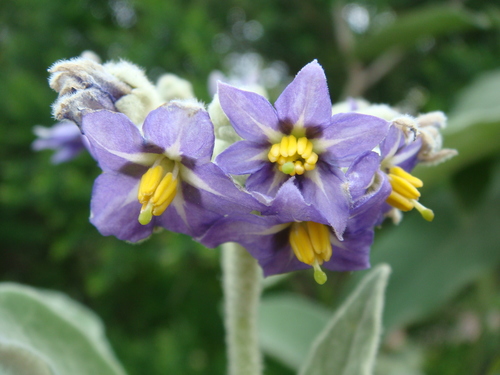
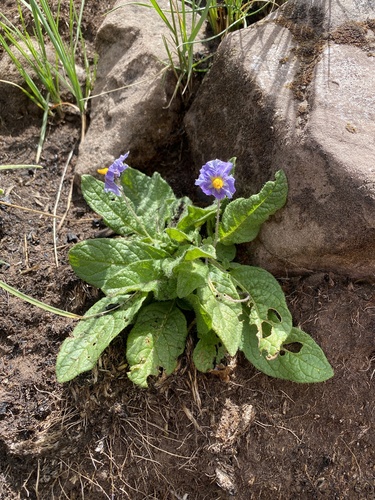
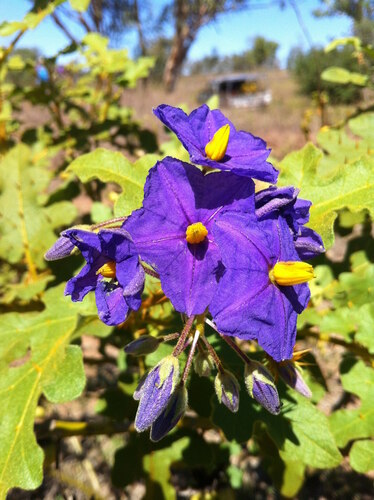
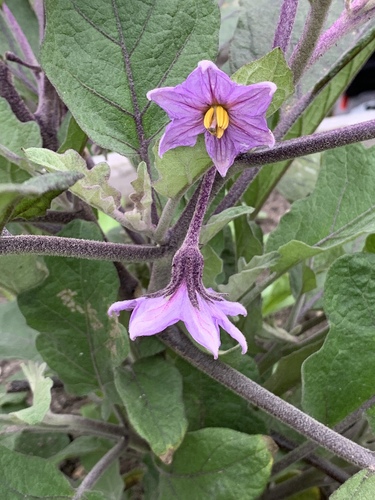
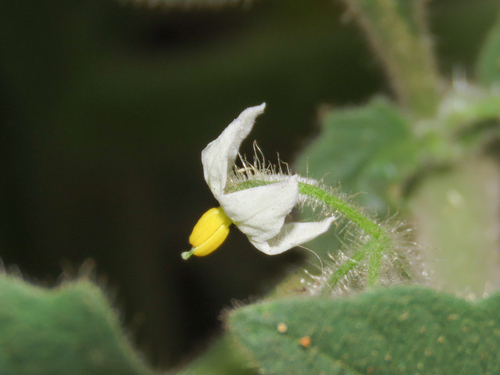
A perennial shrubby herb up to 1 m tall. It is often grown as an annual. It has a deep taproot and branched side roots. The stem is thick and covered with many woolly hairs. The plant has many branches. Often the plant is spiny. The leaves are large, alternate and simple. They are angular and unequal near the stalk. Leaves can be 20 cm long and wavy along the edge. Leaves are covered with hairs. Flowers are bluish red and 5 cm across. They are either solitary or in small groups opposite the leaves. They have 5 large woolly lobes which continue to surround the base of the fruit. Fruit are white, blue, green or purple. The fruit colour and shape vary. Sometimes the fruit is spiny. Often the fruit are 10 to 20 cm long and 5-8 cm wide. Numerous kidney shaped seeds are in the flesh of the berry. There are many cultivated varieties.
Edible Uses
The fruit can be baked, stewed, or added to soups and curries — it should not be eaten raw. It is considered very nutritious, being a good source of vitamin C and potassium, and can reach up to 20cm long in cultivated varieties. The leaves are used mixed with rice bran and salt in which daikon radish roots have been pickled, though caution is advised given the plant's noted toxicity.
Traditional Uses
Fruit are mostly fried then eaten. They can also be grilled, baked, stuffed and stewed. They are used in curries. The fruit are also dried and stored. The leaves although edible are hairy and not good flavour. They are mixed with rice bran and salt in which Japanese radishes are pickled.
Medicinal Uses
The aubergine is valued both as a food and a medicinal plant. The fruit helps lower blood cholesterol levels and is useful as part of a diet for managing high blood pressure; it is also antihaemorrhoidal and hypotensive. It is used as an antidote to poisonous mushroom ingestion. Bruised with vinegar, the fruit is applied as a poultice for cracked nipples, abscesses, and haemorrhoids. The leaves are narcotic and a decoction of them is applied externally to discharging sores and to treat internal haemorrhages; they can also be made into a soothing, emollient poultice for burns, abscesses, cold sores, and similar conditions. Aubergine leaves are toxic and should only be used externally. The ashes of the peduncle are used in treating intestinal haemorrhages, piles, and toothache. A decoction of the root is astringent.
Known Hazards
All green parts of the plant are poisonous. Although providing many well-known foods for people, including the potato, tomato, pepper and aubergine, most species in this genus also contain toxic alkaloids. Whilst these alkaloids can make the plant useful in treaing a range of medical conditions, they can also cause problems such as nausea, vomiting, salivation, drowsiness, abdominal pain, diarrhoea, weakness and respiratory depression. Unless there are specific entries with information on edible uses, it would be unwise to ingest any part of this plant.
Distribution
A tropical plant. A plant of the warm tropics. Plants grow from sea level up to 2200 m altitude in the tropics. It suits wet climates but does well in dry climates with irrigation. It needs a long warm growing period. A daily mean temperature of 20-30°C is most suitable. They are frost tender. They need a rich, friable, well tilled soil. In the subtropics they can be grown as a summer crop. In Nepal plants grow to 1500 m altitude. It suits hardiness zones 9-12.
Where It Grows
Africa, Albania, Andorra, Angola, Antigua and Barbuda, Asia, Australia, Austria, Balkans, Bangladesh, Benin, Botswana, Brazil, British Indian Ocean Terr., BIOT, Burkina Faso, Burundi, Cambodia, Cameroon, Canada, Cape Verde, Caucasus, Central Africa, Central African Republic, CAR, Central Asia, Chad, China, Colombia, Comoros, Congo DR, Cook Islands, Costa Rica, Côte d'Ivoire, Cuba, Djibouti, Dominican Republic, East Africa, East Timor, Ecuador, Egypt, Equatorial Guinea, Eswatini, Ethiopia, Europe, Fiji, France, FSM, Gabon, Gambia, Georgia, Germany, Ghana, Greece, Guam, Guinea, Guinée, Guinea-Bissau, Guyana, Haiti, Hawaii, Himalayas, India*, Indochina, Indonesia, Iraq, Italy, Ivory Coast, Japan, Jordan, Kazakhstan, Kenya, Kiribati, Korea, Kyrgyzstan, Laos, Liberia, Macedonia, Madagascar, Malawi, Malaysia, Mali, Malta, Marquesas, Mauritania, Mauritius, Mediterranean, Mexico, Micronesia, Middle East, Moldova, Monaco, Mozambique, Myanmar, Namibia, Nauru, Nepal, Niger, Nigeria, North Africa, North America, Northeastern India, Pacific, Pakistan, Papua New Guinea, PNG, Peru, Philippines, Pohnpei, Rotuma, Rwanda, Sao Tome and Principe, SE Asia, Senegal, Serbia, Seychelles, Sierra Leone, Sikkim, Singapore, Slovenia, Somalia, Solomon Islands, South Africa, Southern Africa, South America, South Sudan, Spain, Sri Lanka, St. Vincent and Grenadines, Sudan, Suriname, Swaziland, Switzerland, Syria, Tanzania, Thailand, Timor-Leste, Togo, Tonga, Turkey, Türkiye, Tuvalu, Uganda, Ukraine, Uruguay, USA, Uzbekistan, Vanuatu, Vietnam, Wallis & Futuna, West Africa, West Indies, West Timor, Zambia, Zimbabwe,
Cultivation
Requires a very warm, sheltered sunny position, though it succeeds in most soils. Requires plenty of moisture, though the soil should be well-drained. Requires a pH in the range 5.5 to 6.8. The aubergine is often cultivated, especially in tropical areas, for its edible fruit, there are many named varieties. The plant is not frost-hardy, though it can be grown as an annual in temperate zones. It can, however, be difficult to ripen the fruit from outdoor grown plants in cooler temperate climates such as Britain. In this country they are more commonly grown in a warm or cool greenhouse or in a frame. A steady temperature of 25 - 30°c is required during the growing season for the best production of flowers and fruit. A short-lived perennial plant, it is usually cultivated as an annual. Plants should be restricted to no more than 4 fruits to make sure they reach a good size and ripen properly. Plants are rarely bothered by pests or diseases. Slugs, snails and caterpillars love this plant. Aubergines grow well with beans, tarragon and thyme. Aromatic plants such as lavender, tansy, marigolds or wormwood help to keep aphids at bay. Grows badly with potatoes, onions and garlic.
Propagation
Sow seed in early spring in a warm greenhouse maintained at a minimum of 15°C. Prick seedlings out into individual pots once large enough to handle and grow them on quickly. If planting outdoors, do so only after the last expected frosts.
Other Uses
None known
Production
Fruit are ready for harvest after 3 months. They continue to yield for 3-4 months.
Other Information
It is a commercially cultivated vegetable. Occasionally seen in most areas of Papua New Guinea.
Notes
There are about 1400 Solanum species. It possibly has anti-cancer properties.
Nutrition
| Part | Moisture | kJ | kcal | Protein | Vit A | Vit C | Iron | Zinc |
|---|---|---|---|---|---|---|---|---|
| Leaves | 86.4 | 198 | 47 | 4.6 | 280 | — | 3.4 | 0.6 |
| Fruit | 91.8 | 117 | 28 | 0.83 | 6 | 1.3 | 0.4 | 0.2 |
| Fruit - fresh | 93.4 | 62 | 15 | 0.7 | 50 | 5 | 0.4 | 0.3 |
Synonyms
Also Known As
Afufa, Ai gua, Ai kwa, Badanekayi, Badanjan, Baigan, Baigani, Baigun, Baingan, Baingar, Baingano, Bartaku, Batanse, Baklazhan, Begun, Berenjena, Berinjela, Bhanta, Bhantaki, Boulanger, Bringanya, Bunzu, Chirivanga, Dodda badane, Egipalanti, Ekkplant, Eruvanga, Gaji, Ga sebe, Gauta, Gbo agbitsa, Gbolo, Hingoli, Igba-aja, Igbo, Jajčevec, Jati bengani, Jubloks, Jukutam, Kaji, Kathirikai, Kattarikkai, Khayan, Khayan-sat, K poni-gojo, Kuli-begun, Lahopipi, Litnga-shaba, Ma khuea, Magringala, Mahoti hinpoli, Mak-hku, Makhua terung, Ma-kobokobo, Manta, Mbolongu, Melensaano, Mendautuk-chi, Mettavangu, Mpilinganya, Nasu, Nasubi, Ngai gwa, Niruvanga, Ntoropo, Paigana, Panthao, Qie, Ringni, Sebe atorokpo, Shaba, Skwash, Ta-gau, Talong, Te baigan, Terong, Terung, Tionh, Trab veng, Umutoryi, Vambatu, Vangachettu, Vangi, Vangun, Vankaya, Vantak, Vartaku vatigama, Vataun, Vatigana, Vazhuthana, Vengni, Volbual, Yalo
References (99)
- Abbiw, D.K., 1990, Useful Plants of Ghana. West African uses of wild and cultivated plants. Intermediate Technology Publications and the Royal Botanic Gardens, Kew. p 38
- Akinola, R., et al, 2020, A Review of Indigenous Food Crops in Africa and the Implications for more Sustainable and Healthy Food Systems. Sustainability 2020, 12, 3493;
- Ali, A. M. S., 2005, Homegardens in Smallholder Farming Systems: Examples from Bangladesh. Human Ecology, Vol. 33, No. 2 pp. 245-270
- Ambasta, S.P. (Ed.), 2000, The Useful Plants of India. CSIR India. p 581
- Anderson, E. F., 1993, Plants and people of the Golden Triangle. Dioscorides Press. p 221
Show all 99 references Hide references
- Balkrishna, A., et al, 2022, Indigenous Uses of Plants among Forest-dependent Communities of Seijosa, Arunachal Pradesh. International Journal of Economic Plants 2022, 9(1):064-080
- Bernholt, H. et al, 2009, Plant species richness and diversity in urban and peri-urban gardens of Niamey, Niger. Agroforestry Systems 77:159-179
- Bianchini, F., Corbetta, F., and Pistoia, M., 1975, Fruits of the Earth. Cassell. p 92
- Bodner, C. C. and Gereau, R. E., 1988, A Contribution to Bontoc Ethnobotany. Economic Botany, 43(2): 307-369
- Burkill, H. M., 1985, The useful plants of west tropical Africa, Vol. 5. Kew.
- Burkill, I. H., 1966, A Dictionary of the Economic Products of the Malay Peninsula. Ministry of Agriculture and Cooperatives, Kuala Lumpur, Malaysia. Vol 2 (I-Z) p 2081
- Bussman, R. W., et al, 2016, A comparative ethnobotany of Khevsureti, Samtskhe-Javakheti, Tusheti, Svaneti, and Racha-Lechkhumi, Republic of Georgia (Sakartvelo), Caucasus. Journal of Ethnobiology and Ethnomedicine.
- Bussman, R. W. et al, 2017, Ethnobotany of Samtskhe-Javakheti, Sakartvelo (Republic of Georgia), Caucasus. Indian Journal of Traditional Knowledge Vol. 16(1) pp 7-24
- Bussman, R. W., et al, 2021, Unity in diversity—food plants and fungi of Sakartvelo (Republic of Georgia), Caucasus. Journal of Ethnobiology and Ethnomedicine (2021) 17:72 p 15
- Cheifetz, A., (ed), 1999, 500 popular vegetables, herbs, fruits and nuts for Australian Gardeners. Random House p 97
- Chin, H. F., 1999, Malaysian Vegetables in Colour. Tropical Press. p 43
- Ching, L. S. & Mohamed, S., 2001, Alpha-Tocopherol Content in 62 Edible Tropical Plants. J. Agric. Food Chem. 2001, 49, 3101−3105
- Choudhury, B., 1979, Eggplant, in Simmonds, N.W., (ed), Crop Plant Evolution. Longmans. London. p 278
- Cobley, L.S. (rev. Steele, W.M.) 2nd Ed., 1976, An Introduction to the Botany of Tropical Crops. Longmans. p 142
- Creasy, R., 2000, The Edible Asian Garden. Periplus p 41
- Cundall, P., (ed.), 2004, Gardening Australia: flora: the gardener's bible. ABC Books. p 1347
- D'Ambrosio, U., & Puri, R. K., 2016, Foodways in transition: food plants, diet and local perceptions of change in a Costa Rican Ngäbe community. Journal of Ethnobiology and Ethnomedicine (2016) 12:3 p 27
- Facciola, S., 1998, Cornucopia 2: a Source Book of Edible Plants. Kampong Publications, p 237
- FAO, 1988, Traditional Food Plants, FAO Food and Nutrition Paper 42. FAO Rome p 450
- Flowerdew, B., 2000, Complete Fruit Book. Kyle Cathie Ltd., London. p 108
- Fongnzossie Fedoung, E., et al, 2020, Wild edible plants and mushrooms of the Bamenda Highlands in Cameroon: ethnobotanical assessment and potentials for enhancing food security. Journal of Ethnobiology and Ethnomedicine 16:12
- Foo, J.T.S.(ed), 1996, A Guide to Common Vegetables. Singapore Science Foundation. p 137
- Fowler, D. G., 2007, Zambian Plants: Their Vernacular Names and Uses. Kew. p 61
- French, B.R., 1986, Food Plants of Papua New Guinea, A Compendium. Asia Pacific Science Foundation p 148
- French, B.R., 2010, Food Plants of Solomon Islands. A Compendium. Food Plants International Inc. p 156
- Furusawa, T., et al, 2014, Interaction between forest biodiversity and people's used of forest resources in Roviana, Solomon Islands: implications for biocultural conservation under socioeconomic changes. Journal of Ethnobiology and Ethnomedicine, 10:10
- Gangte, H. E., et al, 2013, Wild Edible Plants used by the Zou Tribe in Manipur, India. International Journal of Scientific and Research Publications, Volume 3, Issue 5
- Gbile, Z. O. and Adesina, S. K., 1988, Nigerian Solanum Species of Economic Importance. Annals of the Missouri Botanical Garden, Vol. 75, No. 3. p 864
- Grubben, G. J. H. and Denton, O. A. (eds), 2004, Plant Resources of Tropical Africa 2. Vegetables. PROTA, Wageningen, Netherlands. p 488
- Guite, C., 2016, Study of wild edible plants associated with the Paite Tribe of Manipur, India. International Journal of Current Research. Vol. 8, Issue 11, pp. 40927-40932
- Hadfield, J., 2001, The A-Z of Vegetable Gardening in South Africa. Struik p 106
- Hedrick, U.P., 1919, (Ed.), Sturtevant's edible plants of the world. p 614
- http://www.botanic-gardens-ljubljana.com/en/plants
- Hu, Shiu-ying, 2005, Food Plants of China. The Chinese University Press. p 666
- Jardin, C., 1970, List of Foods Used In Africa, FAO Nutrition Information Document Series No 2.p 103
- Kahlon, L. K. & Singh, R., 2019, Traditional knowledge & Dynamics of edible plants of primitive tribal group ‘Paudi Bhuyan’ with changing demography migration patterns in Northern Odisha. Indian Journal of Traditional Knowledge Vol 18(1), pp 7-15
- Kays, S. J., and Dias, J. C. S., 1995, Common Names of Commercially Cultivated Vegetables of the World in 15 languages. Economic Botany, Vol. 49, No. 2, pp. 115-152
- Kiple, K.F. & Ornelas, K.C., (eds), 2000, The Cambridge World History of Food. CUP p 1770
- Kohila, A. & Kensa, V. M., 2019, Survey of Wild Edible Plants of Dhanakarkulam Panchayath, Tirunelveli District, Tamil Nadu, India. Kong. Res. J. 6(2): 20-27, 2019
- Kumar, A., et al, 2012, Ethnobotanical Edible Plant Biodiversity of Lepcha Tribes. Indian Forester, 138 (9):798-803
- Latham, P., 2004, Useful Plants of Bas-Congo province. Salvation Army & DFID p 260
- Lazarides, M. & Hince, B., 1993, Handbook of Economic Plants of Australia, CSIRO. p 222
- Lembogi Biologi Nasional, 1980, Sayur-sayuran. Balai Pustaka, Jakarta. p 108
- Long, C., 2005, Swaziland's Flora - siSwati names and Uses http://www.sntc.org.sz/flora/
- Macmillan, H.F. (Revised Barlow, H.S., et al), 1991, Tropical Planting and Gardening. Sixth edition. Malayan Nature Society. Kuala Lumpur. p 347
- Manandhar, N.P., 2002, Plants and People of Nepal. Timber Press. Portland, Oregon. p 431
- Martin, F.W. & Ruberte, R.M., 1979, Edible Leaves of the Tropics. Antillian College Press, Mayaguez, Puerto Rico. p 46, 220
- Medhi, P. & Borthakur, S. K., 2012, Phytoresources from North Cachur Hills of Assam -3: Edible plants sold at Hflong market. Indian Journal or Natural Products and Resources. 3(1) pp 84-109
- Mertz, O., Lykke, A. M., and Reenberg, A., 2001, Importance and Seasonality of Vegetable Consumption and Marketing in Burkina Faso. Economic Botany, 55(2):276-289
- Murakami, A. et al, 2014, Screening for the In Vitro Anti-tumor-promoting Activities of Edible Plants from Malaysia. Bioscience, Biotechnology, and Biochemistry, 64:1, 9-16.
- Murtem, G. & Chaudhrey, P., 2016, An ethnobotanical note on wild edible plants of Upper Eastern Himalaya, India. Brazilian Journal of Biological Sciences, 2016, v. 3, no. 5, p. 63-81
- Norrington, L., & Campbell, C., 2001, Tropical Food Gardens. Bloomings Books. p 29
- Ochse, J. J. et al, 1931, Vegetables of the Dutch East Indies. Asher reprint. p 680
- Oke, O. L., 1965, Chemical Studies of some Nigerian vegetables. Expl. Agric. 1:125-129
- Omawale, 1973, Guyana's edible plants. Guyana University, Georgetown p 83
- Owen, S., 1993, Indonesian Food and Cookery, INDIRA reprints. p 86
- Peekel, P.G., 1984, (Translation E.E.Henty), Flora of the Bismarck Archipelago for Naturalists, Division of Botany, Lae, PNG. p 496, 497
- Phon, P., 2000, Plants used in Cambodia. © Pauline Dy Phon, Phnom Penh, Cambodia. p 562
- Plants for a Future database, The Field, Penpol, Lostwithiel, Cornwall, PL22 0NG, UK. http://www.scs.leeds.ac.uk/pfaf/
- Plants of Haiti Smithsonian Institute http://botany.si.edu/antilles/West Indies
- Purseglove, J.W., 1968, Tropical Crops Dicotyledons, Longmans. p 556
- Rajapaksha, U., 1998, Traditional Food Plants in Sri Lanka. HARTI, Sri Lanka. p 480
- Rashid, H. E., 1977, Geography of Bangladesh. Westview. p 273
- Roa, J. A. G. & Boada, D. S. G., 2018, Fundación para el Fortalecimiento de la Fruticultura y Plantas Alimenticias no Convencionales en Colombia.
- Ruiters-Welcome, A. K., 2019, Food plants of southern Africa. Ph.D. thesis. Univ. of Johannesburg p 104
- Samuels, J., 2015, Biodiversity of Food Species of the Solanaceae Family: A Preliminary Taxonomic Inventory of Subfamily Solanoideae. Resources 2015, 4. 277-322
- Sharma, B.B., 2005, Growing fruits and vegetables. Publications Division. Ministry of Information and broadcasting. India. p 218
- Small, E., 2009, Top 100 Food Plants. The world's most important culinary crops. NRC Research Press. p 254
- Solomon, C., 2001, Encyclopedia of Asian Food. New Holland. p 130
- Sp. pl. 1:186. 1753
- Staples, G.W. and Herbst, D.R., 2005, A tropical Garden Flora. Bishop Museum Press, Honolulu, Hawaii. p 538
- Sukenti, K., et al, 2016, Ethnobotanical study on local cuisine of the Sasak tribe in Lombok Island, Indonesia. Journal of Ethnic Foods. 3 (2016) 189-200 p 198
- Swaziland's Flora Database http://www.sntc.org.sz/flora
- Terra, G.J.A., 1973, Tropical Vegetables. Communication 54e Royal Tropical Institute, Amsterdam, p 73, 75
- Thaman, R.R., 1976, The Tongan Agricultural System, University of the South Pacific, Suva, Fiji. p 424
- Thaman, R. R., 1987, Plants of Kiribati: A listing and analysis of vernacular names. Atoll Research Bulletin No. 296
- Thaman, R. R., et al, 1994, The Flora of Nauru. Atoll Research Bulletin No. 392. Smithsonian Institute p 39
- Thaman, R. R, 2016, The flora of Tuvalu. Atoll Research Bulletin No. 611. Smithsonian Institute p 115
- Tindall, H.D., & Williams, J.T., 1977, Tropical Vegetables and their Genetic Resources, International Board for Plant Genetic Resources, Rome, p 34
- Tindall, H.D., 1983, Vegetables in the Tropics, Macmillan p 365
- Topp, J. M. W., 1988, An Annotated Check List of the Flora of Diego Garcia, British Ocean Territory. Atoll Research Bulletin No. 313
- USDA, ARS, National Genetic Resources Program. Germplasm Resources Information Network - (GRIN). [Online Database] National Germplasm Resources Laboratory, Beltsville, Maryland. Available: www.ars-grin.gov/cgi-bin/npgs/html/econ.pl (10 April 2000)
- van Wyk, B., 2005, Food Plants of the World. An illustrated guide. Timber press. p 346
- Vickery, M.L. and Vickery, B., 1979, Plant Products of Tropical Africa, Macmillan. p 45
- Vlkova, M., et al, 2015, Edible Plants Sold on Marginal Rural Markets in Fergana Valley, Southern Kyrgyzstan. Bulgarian Journal of Agricultural Science, 21 (No 2) 2015, 243–250
- Walter, A. & Lebot, V., 2007, Gardens of Oceania. ACIAR Monograph No. 122. p 291
- Welcome, A. K. & Van Wyk, B.-E., 2019, An inventory and analysis of the food plants of southern Africa. South African Journal of Botany 122 (2019) 136–179
- Wiersema, J. H. & Leon, B., 2013, World Economic Plants. A Standard Reference CRC Press. 2nd Ed. p 645
- Wild edible plants of Himachal Pradesh
- Williamson, J., 2005, Useful Plants of Malawi. 3rd. Edition. Mdadzi Book Trust. p 228
- Wiriadinata, H., 1995, Ethnobotany of Economic Plants in the Baliem Valley, Jayawijaya, Irian Jaya, Indonesian Institute of Science, Bogor, Indonesia
- Woodward, P., 2000, Asian Herbs and Vegetables. Hyland House. p 123
- World Checklist of Useful Plant Species 2020. Royal Botanic Gardens, Kew
- Zeven, A. C. & de West, J. M. J., 1982, Dictionary of cultivated plants and their regions of diversity. Wageningen. p 79