Solanum muricatum
Aiton
Pepino dulce, Melon-pear, Peruvian pepino, Pepino
iNaturalist· cc-by-sa
(c) Carlos Vieira, some rights reserved (CC BY-SA)
iNaturalist· cc-by-nc
(c) Kasten, some rights reserved (CC BY-NC)
iNaturalist· cc-by-nc-nd
(c) Lili Hartounian, some rights reserved (CC BY-NC-ND), uploaded by Lili Hartounian
Summary
Source: WikipediaSolanum muricatum is a species of evergreen shrub native to South America and grown for its sweet edible fruit. It is known as pepino dulce ("sweet cucumber" in English, in order to differentiate it from cucumber which is also called "pepino" in Spanish) or simply pepino. The pepino dulce fruit resembles a melon (Cucumis melo) in color, and its flavor recalls a succulent mixture of honeydew and cucumber, and thus it is also sometimes called pepino melon or melon pear. Another common name, tree melon, is more often used for the papaya (Carica papaya) though the pepino dulce plant generally does not look much like a tree; it looks more like a ground cover, trailing plant. The present species is, however, a close relative of other nightshades cultivated for their fruit, including the tomato (S. lycopersicum) and the eggplant/aubergine (S. melongena), which its own fruit closely resembles. The fruit is common in markets in Colombia, Chile, Bolivia, Peru and Kenya, but less often overseas because it is quite sensitive to handling and does not travel well. Attempts to produce commercial cultivars and to export the fruit have been made in New Zealand, Turkey, Mauritius and Chile.
Description
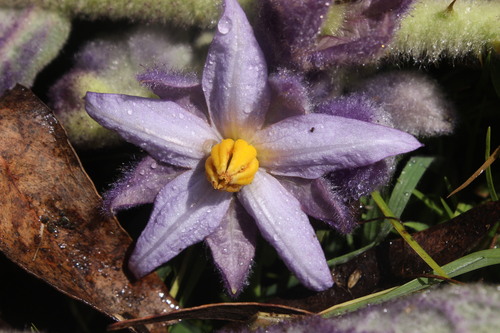
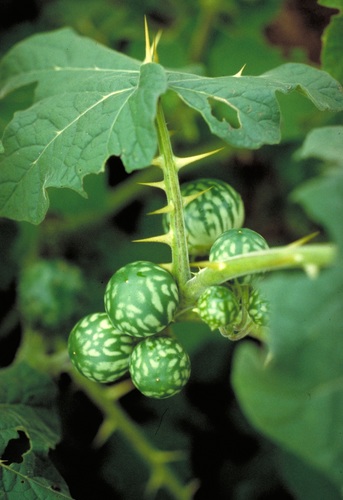
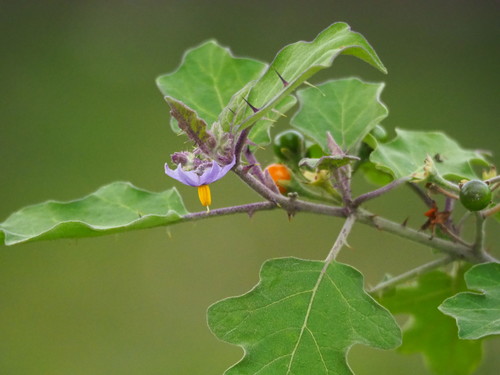
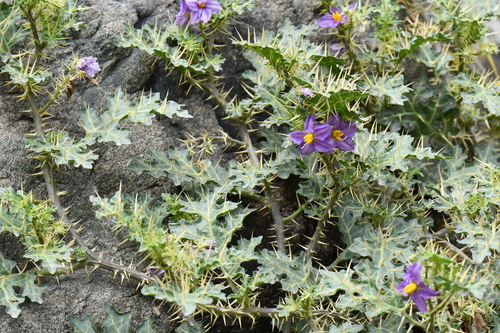
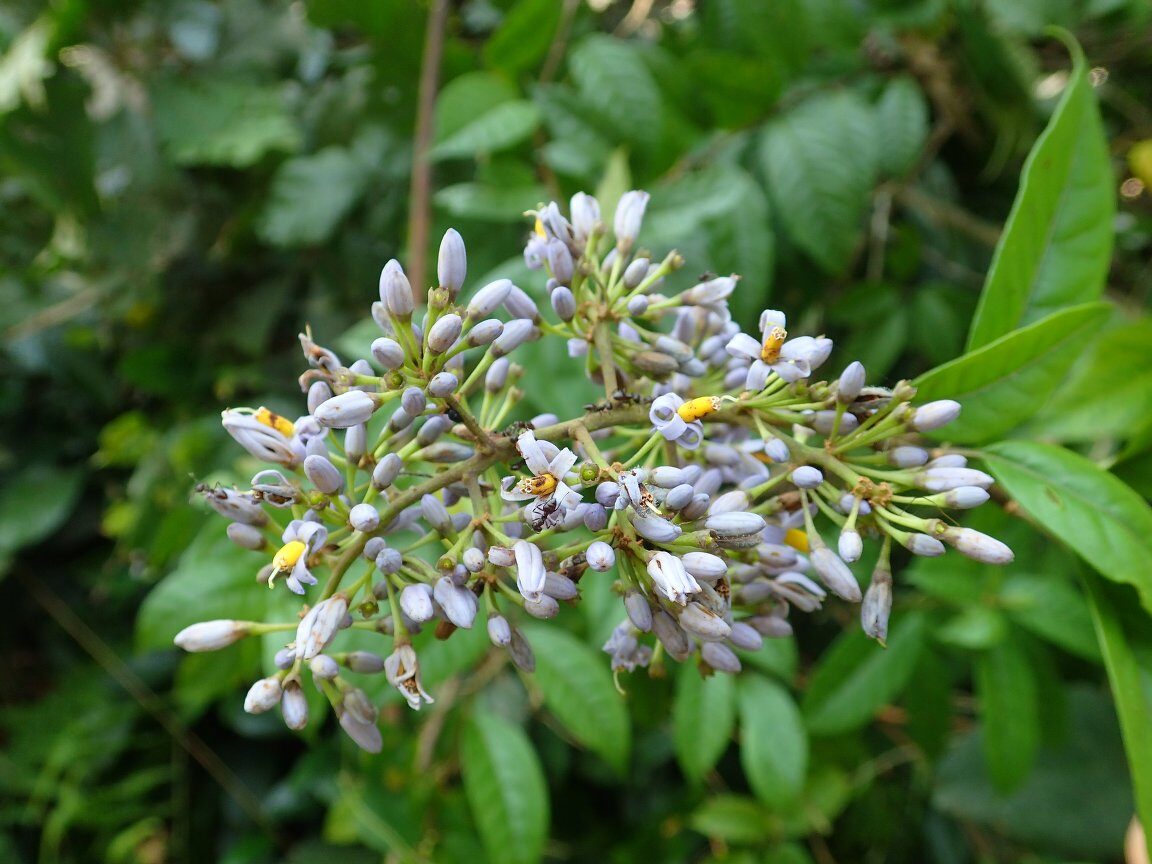
A small herb or small shrub. It grows to about 1 m high and spreads 1-2 m. It has a woody base a fibrous roots. The leaves are bright green with small hairs. The leaves can vary in shape. The flowers are blue or purple. Fruit shape can vary from small and oblong to heart shaped. The number of seeds also varies. The fruit can be green or with purple stripes. Fruit are often 5-12 cm long and oval.
Edible Uses
The fruit is eaten raw and offers a juicy, sweet, aromatic flavour often compared to honeydew melon, though the skin of some varieties tastes unpleasant. It contains 35mg of vitamin C per 100g, 7% carbohydrates, and 92% water. Fruit should be harvested just before it is fully ripe and will keep for several weeks at room temperature. Individual fruits measure approximately 10cm long and 6cm wide.
Traditional Uses
Fruit can be eaten fresh or used in drinks. The taste is similar to a cantaloupe. They can be made into sauces, jams and preserves. Young fruit are cooked as a vegetable.
Medicinal Uses
None known
Known Hazards
Although no specific mention of toxicity has been seen for this species, it belongs to a genus where many if not all the members have poisonous leaves and sometimes also the unripe fruits.
Distribution
A tropical plant. It suits the tropical highlands. It grows in the temperate Andes region. It grows up to 3200 m altitude in these regions and down to 500 m. It does best in a warm frost free environment. It will survive temperatures of -2°C for short periods. It does not suit hot dry areas. The plants will not set fruit until night temperatures are above 18°C. It does best in a free draining soil. A neutral pH 6.5-7.5 is best. Hobart Botanical Gardens. It suits hardiness zones 9-12.
Where It Grows
Africa, Andes*, Asia, Australia, Bolivia, Brazil, Chile, Colombia, Cuba, East Africa, Ecuador, Hawaii, Malaysia, Mexico, New Zealand, North America, Pacific, Peru, SE Asia, Slovenia, South America*, Tasmania, USA, West Indies, Zimbabwe,
Cultivation
Succeeds in most well-drained soils in a sunny position. If the soil is too fertile fruit production will suffer due to excess vegetative growth. Requires a pH above 6 in order to avoid disorders such as manganese toxicity or iron deficiency. Frequently cultivated for its edible fruit in S. America, there are some named varieties. Yields of 40 - 60 tonnes per hectare have been achieved. Plants are not very hardy in Britain, being cut to the ground by fairly light frosts. Seedlings show no resistance to frost, established plants are cut back at -3°c. In a warm position and given a good mulch however, the roots can survive the winter and regrow from the base in the spring. Cuttings are exceedingly easy and these can be overwintered in a greenhouse to provide fresh plants for the following year. Plants do not appear to have a sensitivity to day-length. Plants can set fruit parthenocarpically (without fertilization or seed being formed) but self-fertilization or insect fertilization greatly encourages fruiting. High temperatures, particularly above 30°c, at flowering time can cause the flowers to abort.
Propagation
Sow seed in early spring in a warm greenhouse. Prick seedlings out into individual pots when large enough to handle and grow them on under glass for at least their first winter. Plant out into permanent positions in late spring or early summer, after the last expected frosts, with some cold protection for at least the first winter outdoors. Alternatively, take half-ripe cuttings in July or August in a frame — this is very easy. Overwinter cuttings in a greenhouse and plant out after the last expected frosts.
Other Uses
None known
Production
Plants normally fruit in 9-12 months. Although fruit can form without pollination, a heavier crop occurs with self or cross pollination. The fruit matures in 30 - 80 days after pollination. Fruit should be picked when ripe to get the best flavour and sweetness. Fruit bruise easily so need careful handling. Fruit can be 500 g to 1 kg each.
Other Information
It is a commercially cultivated vegetable.
Notes
There are about 1400 Solanum species. It has a good iodine content.
Nutrition
| Part | Moisture | kJ | kcal | Protein | Vit A | Vit C | Iron | Zinc |
|---|---|---|---|---|---|---|---|---|
| Fruit | 93.4 | 93 | 22 | 0.6 | 180 | 31 | 0.1 | — |
Synonyms
Also Known As
Cachum, Kachuma, Kachun, Melon-pear, Melon pera, Melon-shrub, Pear melon, Pepino melon, Pepino-doce, Xachum
References (38)
- Arora, R. K., 2014, Diversity in Underutilized Plant Species - An Asia-Pacific Perspective. Bioversity International. p 86
- Castillo, R. O., 1995, Plant Genetic Resources in the Andes: Impact, Conservation, and Management. Crop Science 35:355-360
- Correll, D. S., 1967, Flora of Peru. Vol. 8 Part V-B No. 2. Field Museum Natural History. Chicago. p 278
- Cundall, P., (ed.), 2004, Gardening Australia: flora: the gardener's bible. ABC Books. p 1347
- Darley, J.J., 1993, Know and Enjoy Tropical Fruit. P & S Publishers. p 122
Show all 38 references Hide references
- Facciola, S., 1998, Cornucopia 2: a Source Book of Edible Plants. Kampong Publications, p 237
- Hedrick, U.P., 1919, (Ed.), Sturtevant's edible plants of the world. p 619
- Hermandez Bermejo, J.E., and Leon, J. (Eds.), 1994, Neglected Crops. 1492 from a different perspective. FAO Plant Production and Protection Series No 26. FAO, Rome. p17, 181
- Hibbert, M., 2002, The Aussie Plant Finder 2002, Florilegium. p 292
- Hort. kew. 1:250. 1789
- http://www.botanic-gardens-ljubljana.com/en/plants
- John, L., & Stevenson, V., 1979, The Complete Book of Fruit. Angus & Robertson p 289
- Kays, S. J., and Dias, J. C. S., 1995, Common Names of Commercially Cultivated Vegetables of the World in 15 languages. Economic Botany, Vol. 49, No. 2, pp. 115-152
- Kermath, B. M., et al, 2014, Food Plants in the Americas: A survey of the domesticated, cultivated and wild plants used for Human food in North, Central and South America and the Caribbean. On line draft. p 821
- Kew Plants of the World Online
- Kiple, K.F. & Ornelas, K.C., (eds), 2000, The Cambridge World History of Food. CUP p 1832
- Lorenzi, H., Bacher, L., Lacerda, M. & Sartori, S., 2006, Brazilian Fruits & Cultivated Exotics. Sao Paulo, Instituto Plantarum de Estuados da Flora Ltda. p 624
- Macbride. J. F., 1949, Flora of Peru. Malpighiaceae. Field Museum Natural History. Chicago. p 948
- Martin, F. W., et al, 1987, Perennial Edible Fruits of the Tropics. USDA Handbook 642 p 62
- Miguel, E., et al, 1989, A checklist of the cultivated plants of Cuba. Kulturpflanze 37. 1989, 211-357
- NTBG herbarium "edible"
- Plants for a Future database, The Field, Penpol, Lostwithiel, Cornwall, PL22 0NG, UK. http://www.scs.leeds.ac.uk/pfaf/
- Purseglove, J.W., 1968, Tropical Crops Dicotyledons, Longmans. p 556
- Recher, P, 2001, Fruit Spirit Botanical Gardens Plant Index. www.nrg.com.au/~recher/ seedlist.html p 3
- Roa, J. A. G. & Boada, D. S. G., 2018, Fundación para el Fortalecimiento de la Fruticultura y Plantas Alimenticias no Convencionales en Colombia.
- Samuels, J., 2015, Biodiversity of Food Species of the Solanaceae Family: A Preliminary Taxonomic Inventory of Subfamily Solanoideae. Resources 2015, 4. 277-322
- Segura, S., et al, 2018, The edible fruit species in Mexico. Genet Resour Crop Evol (2018) 65:1767–1793
- Smith, P.M., 1979, Solanums, in Simmonds, N.W., (ed), Crop Plant Evolution. Longmans. London. p 322
- Staples, G.W. and Herbst, D.R., 2005, A tropical Garden Flora. Bishop Museum Press, Honolulu, Hawaii. p 539
- Tankard, G., 1990, Tropical fruit. An Australian Guide to Growing and using exotic fruit. Viking p 84
- Tapia, M. E., The role of under-utilised plant species with regard to increased food security and improved health of poor poeople, in mountain regions. IIAP-PNUD/Peru
- Terra, G.J.A., 1973, Tropical Vegetables. Communication 54e Royal Tropical Institute, Amsterdam, p 75
- Tindall, H.D., 1983, Vegetables in the Tropics, Macmillan p 369
- Torre, de la, L., et al, 2008, Enciclopedia de las Plantas Útiles del Ecuador. Herbario QCA. Pontificia Universidad Católica del Ecuador. p 593
- USDA, ARS, National Genetic Resources Program. Germplasm Resources Information Network - (GRIN). [Online Database] National Germplasm Resources Laboratory, Beltsville, Maryland. Available: www.ars-grin.gov/cgi-bin/npgs/html/econ.pl (10 April 2000)
- van Wyk, B., 2005, Food Plants of the World. An illustrated guide. Timber press. p 348
- Wiersema, J. H. & Leon, B., 2013, World Economic Plants. A Standard Reference CRC Press. 2nd Ed. p 646
- World Checklist of Useful Plant Species 2020. Royal Botanic Gardens, Kew