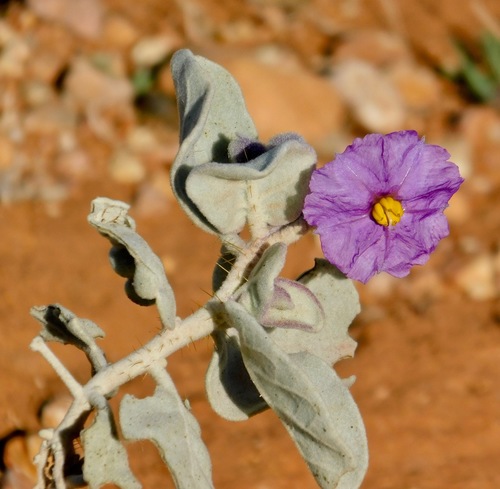
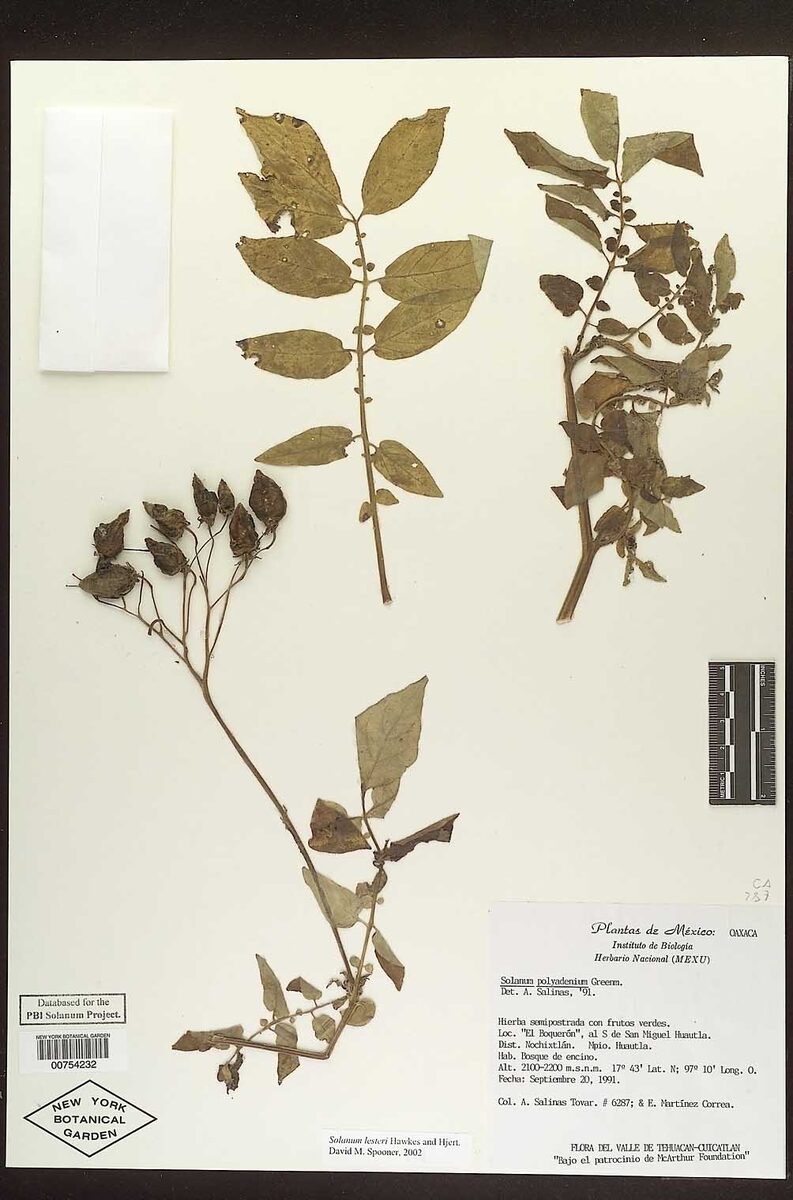
Solanum ellipticum
R. Br.
Desert raisin, Potato bush, Velvet potato bush, Wild gooseberry, Ararnt
iNaturalist· cc-by-nc
(c) Gordon Claridge, some rights reserved (CC BY-NC), uploaded by Gordon Claridge
iNaturalist· cc-by-nc
(c) Tony Bean, some rights reserved (CC BY-NC), uploaded by Tony Bean
iNaturalist· cc-by-nc
(c) Gordon Claridge, some rights reserved (CC BY-NC), uploaded by Gordon Claridge
Summary
Source: WikipediaSolanum ellipticum is known as potato bush and under the more ambiguous name of "bush tomato". The Arrernte name of merne awele-awele might refer to this species or to the similar S. quadriloculatum. Native to Australia, the potato bush is a small fruiting shrub in the family Solanaceae. Solanum ellipticum was described by F. von Mueller. The plant named thus by J.M. de Conceição Vellozo is actually S. cylindricum. It a small fast-growing waxy-looking shrub that grows next to creeks. It fruits prolifically the year after fire or good rains. Its fruit have a pungent smell, and the plant can be smelled from some distance away when the fruit are ripe. Like the other "bush tomatoes", S. ellipticum fruit are edible raw or cooked. Solanum ellipticum used to (and in some treatments still does) include S. quadriloculatum as variety duribaccalis, but generally these two species of "bush tomatoes" are considered distinct nowadays. Similarly, the former variety horridum is now S. senticosum, the S. echinatum of Robert Brown was sometimes treated as var. pannifolium, and S. esuriale was included in S. ellipticum as form inermis. A few now-invalid names for S. ellipticum also exist; mostly they refer to potatobush plants believed to be distinct forms or varieties but today not considered to be taxonomically distinct: Solanum ellipticum f. albiflora Domin (lapsus) Solanum ellipticum f. albiflorum Domin Solanum ellipticum var. chillagoense Domin Solanum ellipticum var. mollibaccalis J.M.Black Solanum lithophilum F.Muell. Solanum cleistogamum Symon
Description
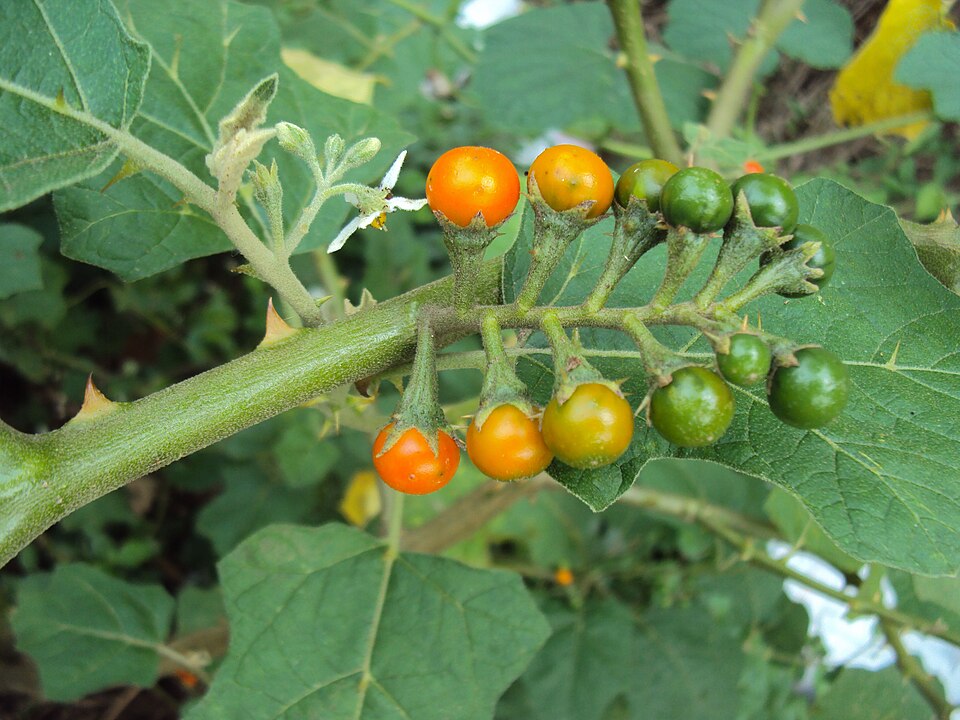
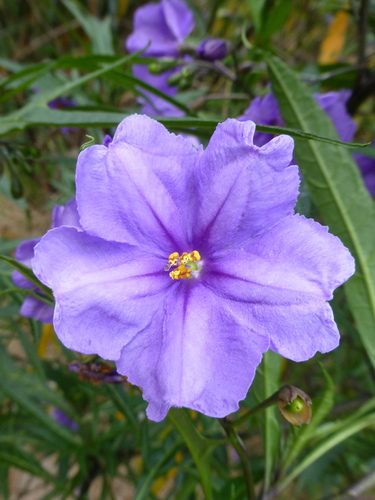
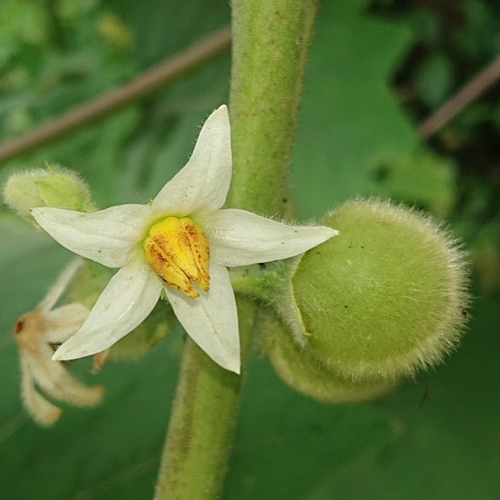
A prickly herb. It keeps growing from year to year and develops woody stems. It grows 0.9-2 m high. It spreads 0.9-2 m wide. The plant is covered with felt like hairs. The stems have fine, sharp, yellow prickles. These are 6 mm long. The leaves are oval shaped. The flowers are purple. They occur in groups or 3-7. The fruit is round and 1.5-2 cm across. These are yellow-green and turn purple when ripe. There are 2 compartments on the fruit.
Edible Uses
The ripe fruit can be eaten raw or cooked.
Traditional Uses
The ripe fruit are cooked and eaten. They are also eaten raw.
This uses section is brief — help expand it
Known Hazards
Although providing many well-known foods for people, including the potato, tomato, pepper and aubergine, most species in this genus also contain toxic alkaloids. Whilst these alkaloids can make the plant useful in treaing a range of medical conditions, they can also cause problems such as nausea, vomiting, salivation, drowsiness, abdominal pain, diarrhoea, weakness and respiratory depression. Unless there are specific entries with information on edible uses, it would be unwise to ingest any part of this plant.
Distribution
A tropical plant. It is native to inland Australia. It can grow in arid places. It suits hardiness zones 9-11.
Where It Grows
Australia*,
Cultivation
A plant mainly of the warm temperate to subtropical zones, just entering the tropics in northern Australia. Prefers a position in full sun. Plants are drought tolerant - top growth dies off during extended dry periods but the plant resprouts after good rains.
Propagation
Seed - the flesh of the fruit must be completely removed before sowing because it contains germination inhibitors. Sow in trays in a nursery. Prick out the seedlings into individual pots when they are large enough to handle and grow them on fast. Plant them out when 10cm or more tall. Cuttings of half-ripe wood. Very easy, the cuttings root within a couple of weeks. Division
Notes
There are about 1400 Solanum species.
Nutrition
| Part | Moisture | kJ | kcal | Protein | Vit A | Vit C | Iron | Zinc |
|---|---|---|---|---|---|---|---|---|
| Fruit | 86 | 202 | 48 | 2.6 | — | — | 0.4 | — |
Synonyms
Also Known As
Dulwarwarun, Kulypurpa, Tawal-tawalpa, Ululka, Wangki, Wunki
References (21)
- Bindon, P., 1996, Useful Bush Plants. Western Australian Museum. p 232
- Cherikoff V. & Isaacs, J., The Bush Food Handbook. How to gather, grow, process and cook Australian Wild Foods. Ti Tree Press, Australia p 120, 191
- Cooper, W. and Cooper, W., 2004, Fruits of the Australian Tropical Rainforest. Nokomis Editions, Victoria, Australia. p 521
- Cribb, A.B. & J.W., 1976, Wild Food in Australia, Fontana. p 75
- Cundall, P., (ed.), 2004, Gardening Australia: flora: the gardener's bible. ABC Books. p 1346
Show all 21 references Hide references
- Green, J., (Ed.), 2003, Anmatyerr Plant Stories. AID Press. p 2
- Hardwick, G., 2001, Economically Useful Plants for Northern Australia: Master Species List. Crusader eBooks.
- Hunter, J.T., 2017, Is there a relationship between contemporary high Aboriginal plant resource locations and mapped vegetation communities? Cunninghamia 17:27-34. The Royal Botanic Garden Sydney. ISSN 2200 - 405X
- Lang, P. J., et al, 1986, Anangu Pitjantjatjara Lands Biological Survey. p 42
- Latz, P.K., 1996, Bushfires and Bushtucker: Aboriginal plant use in Central Australia. IAD Press Alice Springs p 276
- Lazarides, M. & Hince, B., 1993, Handbook of Economic Plants of Australia, CSIRO. p 222
- Low, T., 1992, Bush Tucker. Australia’s Wild Food Harvest. Angus & Robertson. p 66
- Paczkowska, G . & Chapman, A.R., 2000, The Western Australian Flora. A Descriptive Calatogue. Western Australian Herbarium. p 537
- Prodr. 446. 1810
- Samuels, J., 2015, Biodiversity of Food Species of the Solanaceae Family: A Preliminary Taxonomic Inventory of Subfamily Solanoideae. Resources 2015, 4. 277-322
- Smith, N. M., 1991, Ethnobotanical Field Notes from the Northern Territory, Australia, J. Adelaide Bot. Gard. 14(1): 1-65
- Smith, P.M., 1979, Solanums, in Simmonds, N.W., (ed), Crop Plant Evolution. Longmans. London. p 322
- Townsend, K., 1999, Field Guide to Plants of the Dry Tropics. Society for Growing Australian Plants, Townsville Branch Inc. p 172
- Ulian, T., et al, 2020, Unlocking plant resources to support food security and promote sustainable agriculture. Plants, People, Planet. 2020;2:421–445.
- Urban, A., 1990, Wildflowers of Inland Australia. Portside editions. p 170
- Wightman, Glenn et al. 1992, Mudburra Ethnobotany: Aboriginal Plant Use from Kulumindini (Elliott) Northern Australia. Northern Territory Botanical Bulletin No 14. Parks and Wildlife Commission of the Northern Territory. p 30