Acacia mangium
Willd.
Hickory Wattle, Brown sandalwood
iNaturalist· cc-by-nc
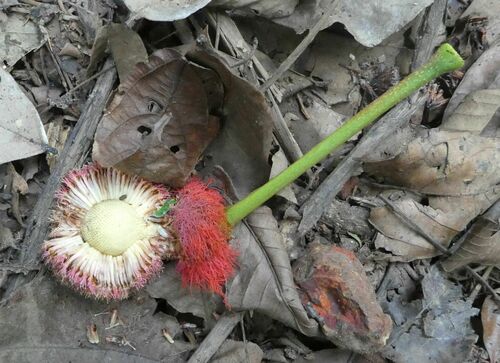
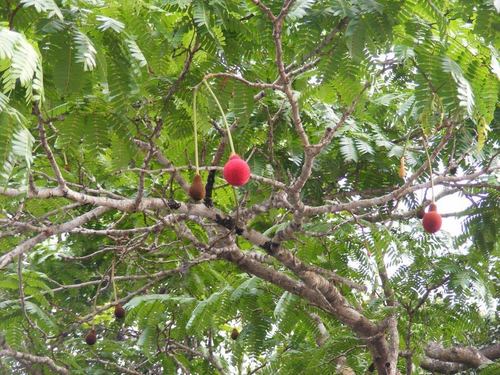
(c) Paul Dickson, some rights reserved (CC BY-NC), uploaded by Paul Dickson
iNaturalist· cc-by-nc
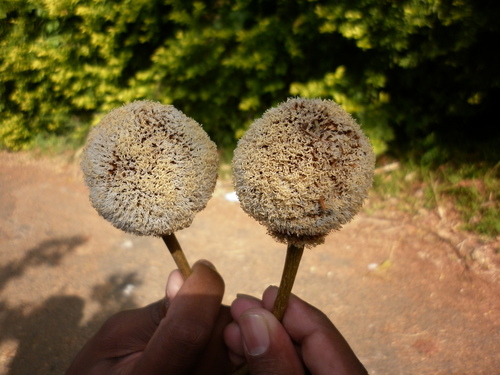
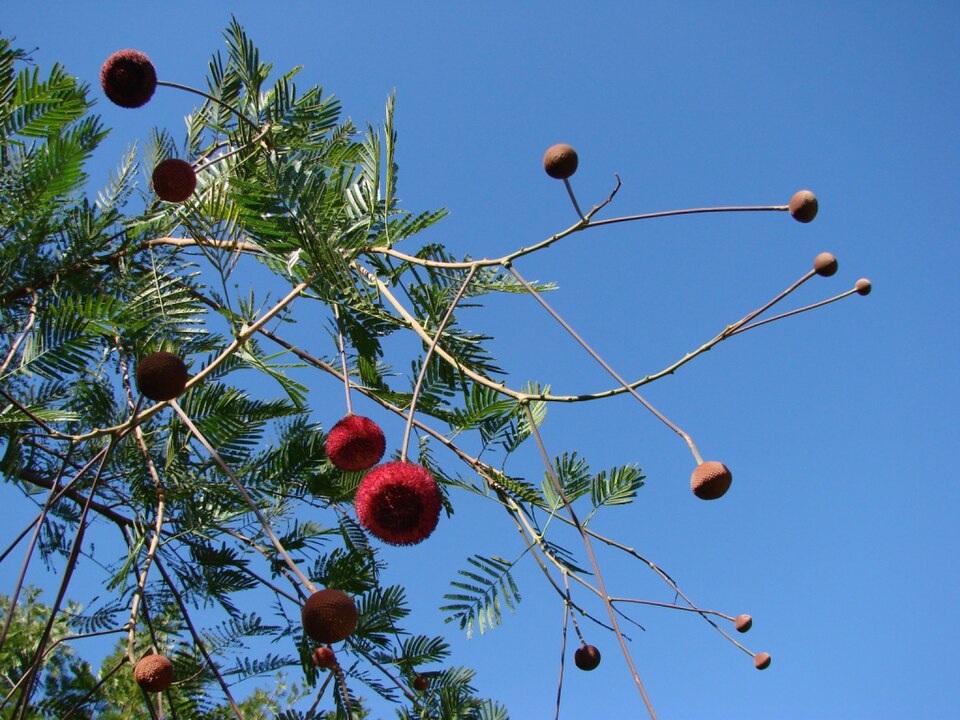
(c) Andry.A.R, some rights reserved (CC BY-NC), uploaded by Andry.A.R
iNaturalist· cc-by-nc-sa
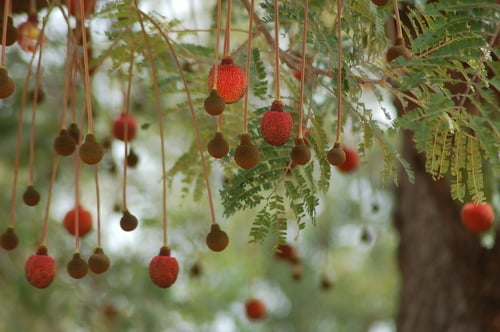
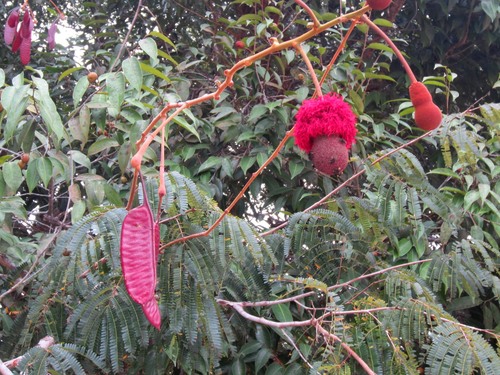
(c) Scot Nelson, some rights reserved (CC BY-NC-SA)
Summary
Source: WikipediaAcacia mangium is a species of flowering tree in the pea family, Fabaceae, that is native to northeastern Queensland in Australia, the Western Province of Papua New Guinea, Papua, and the eastern Maluku Islands. Common names include black wattle, hickory wattle, mangium, and forest mangrove. Its uses include environmental management and wood. It was first described in 1806 by Carl Ludwig Willdenow, who described it as living in the Moluccas.
Description
A shrub or small tree. It grows 5 m tall. There are prickles along the stem. The leaves are twice divided and there are 8-18 pairs of pinnae. There are up to 50 pairs of pinnules on each pinnae. The flowers are yellow. They are in large clusters at the ends of branches. The pods are flattened.
Edible Uses
The roots of young plants are eaten, and the seeds can be germinated and cooked as a vegetable.
Traditional Uses
The roots of young plants are eaten. The seeds can be germinated and cooked as a vegetable.
This uses section is brief — help expand it
Medicinal Uses
The bark of all Acacia species contains greater or lesser quantities of tannins and are astringent. Astringents are often used medicinally - taken internally, for example. they are used in the treatment of diarrhoea and dysentery, and can also be helpful in cases of internal bleeding. Applied externally, often as a wash, they are used to treat wounds and other skin problems, haemorrhoids, perspiring feet, some eye problems, as a mouth wash etc. Many Acacia trees also yield greater or lesser quantities of a gum from the trunk and stems. This is sometimes taken internally in the treatment of diarrhoea and haemorrhoids.
Known Hazards
The seed of many Acacia species, including this one, is edible and highly nutritious, and can be eaten safely as a fairly major part of the diet. Not all species are edible, however, and some can contain moderate levels of toxins. Especially when harvesting from the wild, especial care should be taken to ensure correct identification of any plants harvested for food. Especially in times of drought, many Acacia species can concentrate high levels of the toxin Hydrogen cyanide in their foliage, making them dangerous for herbivores to eat.
Distribution
A tropical plant. A native of Queensland Australia. It occurs across SE Asia to Malaysia. It prefers medium to heavy soils. It needs a protected shady position. It is drought resistant and can tolerate waterlogging. It is probably damaged by frost. It suits high rainfall areas. It grows up to 195 m altitude. It suits hardiness zones 11-12.
Where It Grows
Asia, Australia, Bangladesh, Colombia, Hawaii, Indochina, Indonesia, Laos, Pacific, Papua New Guinea, PNG, Malaysia, SE Asia, Solomon Islands, West Timor,
Cultivation
It is grown from seed. The seed need to be treated to break the hard seed coat. Normally this is by putting the seeds in very hot water and letting the water cool down overnight then planting the seeds immediately. Seed are normally produced October to November.
Propagation
Seed - pre-treatment is necessary to break the hard seed coat. To encourage uniform germination, seed should be scarified either by submerging in boiled water that is allowed to cool for 24 hours, or by soaking in sulphuric acid for 10-30 minutes followed by soaking in cool water for 24 hours. The visibly swollen seeds should be sown immediately. Germination, which is normally around 60 - 80&, usually starts after one day and continues for 10 - 15 days. Young seedlings are potted up when large enough to handle, and can be planted out when 25cm tall, usually after about 16 weeks. The seed can retain its viability for several years when stored at room temperature in a dark place in a sealed container. Air-layering. Single-node stem cuttings 4 - 5 cm long and 0.5 - 1.5 cm in diameter, leaving 0.5 - 1 phyllodes. The application of indole-butyric acid or rooting powder enables 65-75% rooting; rooting is reported to be slow. Grafting
Other Uses
The tree has high tannin content (18-39%), justifying commercial exploitation of tannins. Bark harvested for its tannins should only be taken from mature stems, and only when the sap is rising at the beginning of the growing season - which is when the tannin content is highest and the bark is most easily removed from the wood. The heartwood is yellow-brown, sometimes with olive-brown streaks; it is clearly demarcated from the cream-coloured sapwood. The texture is medium; the grain straight. The wood is light in weight; hard to soft; of low durability being susceptible to dry wood borers and termites and moderately susceptible to fungi. It seasons rapidly but with a high risk of distortion and checking; once dried it is stable in service. The wood works well with ordinary tools; nailing and screwing are poor; gluing is best carried out with phenol resins. It is suitable for construction, boat building, furniture and cabinet making, particleboard, plywood, veneer and fenceposts. The tree is widely grown to provide pulp for the paper industry. The pulp is readily bleached to high brightness levels and is excellent for papermaking. The neutral sulphite semi-chemical pulping of Acacia mangium gives yields of 61 - 75%. The wood is used for fuel. With a calorific value of 4,800-4,900 kcal/kg, the tree provides good quality charcoal and is suitable for the manufacture of charcoal briquettes and artificial carbon. The tree is planted primarily for site rehabilitation. Its quick growth and dense shade make it an effective tool in reforesting Imperata grass swards and reducing fire risk. Its ability to grow well on infertile soils, especially those low in phosphorus, make it a favourite for rehabilitation of mine spoils and eroded sites. Seedlings and cuttings are planted as initial shade for cocoa in the nurseries or on-farm. Because of its nitrogen-fixing abilities, it is also used in rehabilitating old cocoa farms or on improved fallows intended for cocoa cultivation.
Production
(Seed are commonly eaten by native animals making seed collection hard.) The tree is fast growing.
Other Information
The root is used as food in Australia but it is not known if it is used for food in Papua New Guinea.
Notes
There are about 1,350 Acacia species. Over 1,000 occur in Australia. Also as Mimosaceae.
Synonyms
Also Known As
Biar, Broadleaf salwood, Forest mangrove, Mangge hutan, Mangium, Sabah salwood, Tongke hutan
References (21)
- Bodkin, F., 1991, Encyclopedia Botanica. Cornstalk publishing, p 25
- Cherikoff V. & Isaacs, J., The Bush Food Handbook. How to gather, grow, process and cook Australian Wild Foods. Ti Tree Press, Australia p 47
- Cooper, W. and Cooper, W., 2004, Fruits of the Australian Tropical Rainforest. Nokomis Editions, Victoria, Australia. p 303
- Cundall, P., (ed.), 2004, Gardening Australia: flora: the gardener's bible. ABC Books. p 77
- Doran, J.C., & Turnbull, J.W. (Eds), 1997, Australian Trees and Shrubs: species for land rehabilitation and farm plantings in the tropics. ACIAR Monograph No 24. p 178
Show all 21 references Hide references
- Dunlop, C.R., Leach, G.J. & Cowie, I.D., 1995, Flora of the Darwin Region. Vol 2. Northern Territory Botanical Bulletin No 20. p 13
- Elliot, W.R., & Jones, D.L., 1982, Encyclopedia of Australian Plants suitable for cultivation. Vol 2. Lothian. p 81
- Etherington, K., & Imwold, D., (Eds), 2001, Botanica's Trees & Shrubs. The illustrated A-Z of over 8500 trees and shrubs. Random House, Australia. p 54
- Hnatiuk, R. J. 1990. Census of Australian vascular plants. Australian Flora and Fauna Series No. 11.
- Jackes, B.R., 2001, Plants of the Tropics. Rainforest to Heath. An Identification Guide. James Cook University. p 64
- Jones D, L, 1986, Ornamental Rainforest Plants in Australia, Reed Books, p 147
- Latham, P. & Mbuta, A. K., 2017, Plants of Kongo Central Province, Democratic Republic of Congo. 3rd ed p 14
- Roa, J. A. G. & Boada, D. S. G., 2018, Fundación para el Fortalecimiento de la Fruticultura y Plantas Alimenticias no Convencionales en Colombia.
- Soerianegara, I. & R. H. M. J. Lemmens, eds. 1993. Timber trees: Major commercial timbers. In: Plant Resources of South-East Asia (PROSEA) 5(1):48, 58.
- Sp. pl. 4(2):1053. 1806
- Sukarya, D. G., (Ed.) 2013, 3,500 Plant Species of the Botanic Gardens of Indonesia. LIPI p 99
- Townsend, K., 1994, Across the Top. Gardening with Australian Plants in the tropics. Society for Growing Australian Plants, Townsville Branch Inc. p 60
- USDA, ARS, National Genetic Resources Program. Germplasm Resources Information Network - (GRIN). [Online Database] National Germplasm Resources Laboratory, Beltsville, Maryland. Available: www.ars-grin.gov/cgi-bin/npgs/html/econ.pl (10 April 2000)
- Wiersema, J. H. & Leon, B., 2013, World Economic Plants. A Standard Reference CFC Press. 2nd Ed. p 6
- World Checklist of Useful Plant Species 2020. Royal Botanic Gardens, Kew
- www.worldagroforestrycentre.org/sea/products/afdbases/af Verdcourt, B., 1979, Manual of New Guinea Legumes. Botany Bulletin No 11, Division of Botany, Lae, Papua New Guinea. p 170