Acacia maitlandii
F. Muell.
Maitland’s wattle
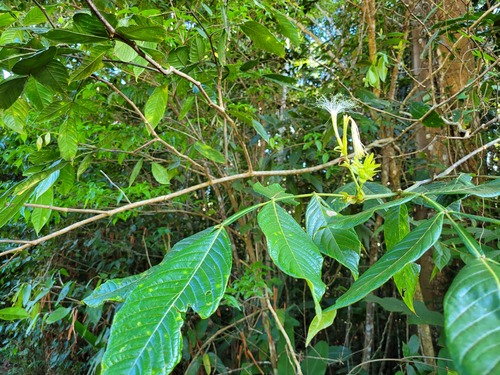
iNaturalist· cc-by-nc
(c) @WA_Botanist, some rights reserved (CC BY-NC), uploaded by @WA_Botanist
iNaturalist· cc-by-nc
(c) Bailey Field, some rights reserved (CC BY-NC), uploaded by Bailey Field
iNaturalist· cc-by-nc
(c) Tim Karnasuta, some rights reserved (CC BY-NC), uploaded by Tim Karnasuta
Summary
Source: WikipediaAcacia maitlandii, also known as Maitland's wattle, is a perennial tree native to Australia.
Description
A shrub or small tree. It grows 5 m tall. There are prickles along the stem. The leaves are twice divided and there are 8-18 pairs of pinnae. There are up to 50 pairs of pinnules on each pinnae. The flowers are yellow. They are in large clusters at the ends of branches. The pods are flattened.
Edible Uses
The species is used to make boomerangs and spearthrowers, and the gum produced is edible. The tree is called Garrga in the languages of the Yindjibarndi and Ngarluma people. The seeds have been identified, analysed, and monitored, as a 'wild harvested Australian indigenous food', by Food Standards Australia New Zealand. The product is found to be very high in fats, over half by weight.
Traditional Uses
The seed is eaten. It is ground to make flour then cooked. Grubs in the roots are eaten.
This uses section is brief — help expand it
Medicinal Uses
The bark of all Acacia species contains greater or lesser quantities of tannins and are astringent. Astringents are often used medicinally - taken internally, for example. they are used in the treatment of diarrhoea and dysentery, and can also be helpful in cases of internal bleeding. Applied externally, often as a wash, they are used to treat wounds and other skin problems, haemorrhoids, perspiring feet, some eye problems, as a mouth wash etc. Many Acacia trees also yield greater or lesser quantities of a gum from the trunk and stems. This is sometimes taken internally in the treatment of diarrhoea and haemorrhoids.
Known Hazards
The seed of many Acacia species, including this one, is edible and highly nutritious, and can be eaten safely as a fairly major part of the diet. Not all species are edible, however, and some can contain moderate levels of toxins. Especially when harvesting from the wild, especial care should be taken to ensure correct identification of any plants harvested for food. Especially in times of drought, many Acacia species can concentrate high levels of the toxin Hydrogen cyanide in their foliage, making them dangerous for herbivores to eat.
Distribution
It is a tropical plant. It occurs in inland Australia. It grows in sandy soils. It needs a sunny position. It can tolerate fire. It can grow in arid places.
Where It Grows
Australia*,
Cultivation
It can be grown from seed or cuttings.
Propagation
The seed of most, if not all, members of this genus has a hard seedcoat and may benefit from scarification before sowing to speed up germination. This can usually be done by pouring a small amount of nearly boiling water on the seeds (being careful not to cook them!) and then soaking them for 12 - 24 hours in warm water. By this time they should have imbibed moisture and swollen - if they have not, then carefully make a nick in the seedcoat (being careful not to damage the embryo) and soak for a further 12 hours before sowing. Acacia seeds that have matured fully on the bush and have been properly dried have a hard seed coat and can be stored in closed containers without deterioration for 5 - 10 years or more in dry conditions at ambient temperatures. It is best to remove the aril, which attracts weevils and can lead to moulds forming. The arils are easilyremoved by placing the seeds in water and rubbing them between the hands, then drying the seeds and winnowing them.
Production
The pods mature in October to November.
Notes
There are about 1,350 Acacia species. Over 1,000 occur in Australia. Also as Mimosaceae.
Nutrition
| Part | Moisture | kJ | kcal | Protein | Vit A | Vit C | Iron | Zinc |
|---|---|---|---|---|---|---|---|---|
| Seed | 6.1 | 1505 | 360 | 28.5 | — | — | — | — |
Synonyms
Also Known As
Ilupa-lupa, Lwepe-lwepe, Jumpinhkar
References (12)
- Cancilla, D., 2018, Ethnobotanical and Ethnozoological Values Desktop Assessment - Eliwana Project. p 9
- Cherikoff V. & Isaacs, J., The Bush Food Handbook. How to gather, grow, process and cook Australian Wild Foods. Ti Tree Press, Australia p 42, 188
- Elliot, W.R., & Jones, D.L., 1982, Encyclopedia of Australian Plants suitable for cultivation. Vol 2. Lothian. p 81
- Fragm. 3:46. 1862
- Latz, P., 1996, Bushfires and Bushtucker. IAD. p 107
Show all 12 references Hide references
- Lazarides, M. & Hince, B., 1993, Handbook of Economic Plants of Australia, CSIRO. p 4
- Lister, P.R., P. Holford, T. Haigh, and D.A. Morrison, 1996, Acacia in Australia: Ethnobotany and potential food crop. p. 228-236. In: J. Janick (ed.), Progress in new crops. ASHS Press, Alexandria, VA.
- Paczkowska, G . & Chapman, A.R., 2000, The Western Australian Flora. A Descriptive Catalogue. Western Australian Herbarium. p 315
- Pennock, A., et al, Australian Dry-zone Acacias for Human Food: Proceedings of a Workshop.
- Urban, A., 1990, Wildflowers of Inland Australia. Portside editions. p 72
- Wheeler, J.R.(ed.), 1992, Flora of the Kimberley Region. CALM, Western Australian Herbarium, p 314
- World Checklist of Useful Plant Species 2020. Royal Botanic Gardens, Kew