Scytosiphon lomentaria
(Lyngbye) Link
Leather tube, Beanweed
iNaturalist· cc-by-nc
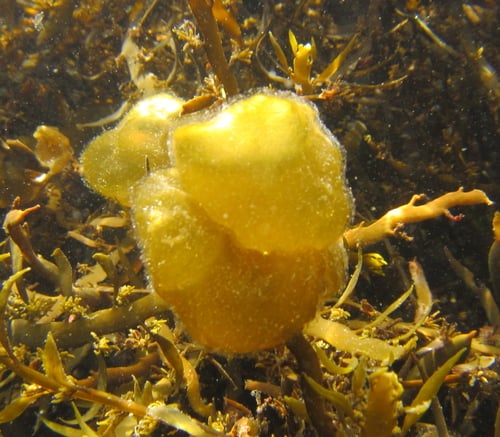
(c) Frédéric ANDRE, some rights reserved (CC BY-NC), uploaded by Frédéric ANDRE
iNaturalist· cc-by-nc
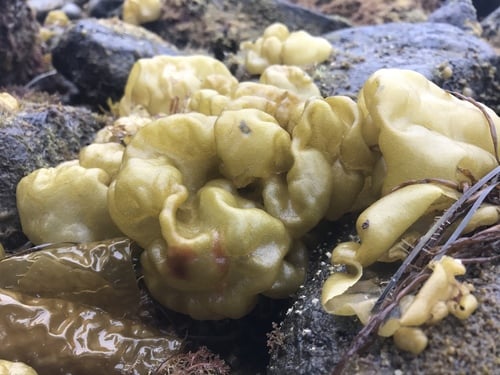
(c) wilfredj, some rights reserved (CC BY-NC)
iNaturalist· cc-by
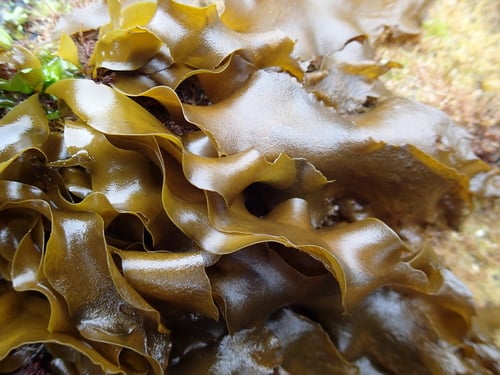
(c) Jacqui Geux, some rights reserved (CC BY), uploaded by Jacqui Geux
Summary
Source: WikipediaScytosiphon lomentaria is a littoral brown seaweed with an irregularly lobed many filamentous form. It is a member of the Phaeophyceae in the order Ectocarpales and grows attached to shells and stones in rock-pools and in near-shore waters. The attachment to the substrate is by a small disc shaped holdfast.
Description
A seaweed. It has a holdfast from which several unbranched tubes arise. The tubes can be constricted or twisted. It grows 4 m long. It is hollow and has constrictions along it.
Edible Uses
The seaweed is eaten in soup or fried with fish or pork, and can be used fresh or dried.
Traditional Uses
It is eaten in soup. It is also fried with fish or pork. It can be used fresh or dried.
This uses section is brief — help expand it
Distribution
It is a temperate plant. It grows in cooler climates. It grows on lower inter-tidal zones. It grows on sheltered shores.
Where It Grows
Africa, Alaska, Algeria, Antarctica, Arctic, Argentina, Asia, Australia, Azores, Balkans, Baltic, Belgium, Bermuda, Brazil, Britain, Bulgaria, Canada, Canary Islands, Chile, China, Corsica, Denmark, Egypt, Europe, France, Greece, Greenland, Iceland, Ireland, Italy, Japan, Korea, Libya, Macquarie Island, Mediterranean, Mexico, Namibia, Netherlands, North Africa, North America, Norway, Peru, Portugal, Romania, Russia, Scandinavia, South Africa, Southern Africa, South America, Spain, Sweden, Taiwan, Tasmania, Tunisia, Turkey, Türkiye, Uruguay, USA,
Synonyms
Also Known As
Kayamonori, Korvsnore, Mugiwara-nori, Sugara
References (10)
- Cribb, A.B., 1996, Seaweeds of Queensland A Naturalist's Guide. The Queensland Naturalists' Club Handbook No. 2. p 61
- Dashorst, G.R.M., and Jessop, J.P., 1998, Plants of the Adelaide Plains & Hills. Botanic Gardens of Adelaide and State Herbarium. p 18
- Fuhrer, B.A. et al, 1981, Seaweeds of Australia. Reed. p 65
- http://www.seavegetables.com
- Hu, Shiu-ying, 2005, Food Plants of China. The Chinese University Press. p 259 (As Scytosiphon lomentarius J. Agardh)
Show all 10 references Hide references
- Kiple, K.F. & Ornelas, K.C., (eds), 2000, The Cambridge World History of Food. CUP p 236
- Surey-Gent, S. & Morris G., 1987, Seaweed. A User's Guide. Whirret Books. London. p 38, 128
- Tseng, C.K., 1983, Common seaweeds of China. Beijing.
- Xia, B., and Abbott, I.A., 1987, Edible seaweeds of China and their place in the Chinese diet. Economic Botany 41:341-53
- Zemke-White, W. L. & Ohno, M., 1999, World seaweed utilisation: An end-of-century summary. Journal of Applied Phycology 11: 369-376