Colpomenia sinuosa
(Mertens ex Roth) Derbes & Solier
Honey algae
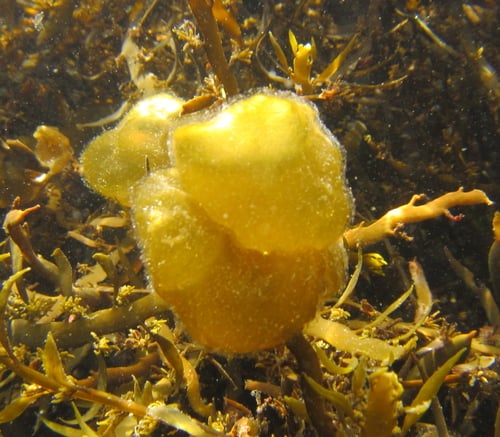
iNaturalist· cc-by-nc
(c) seavivs, some rights reserved (CC BY-NC), uploaded by seavivs
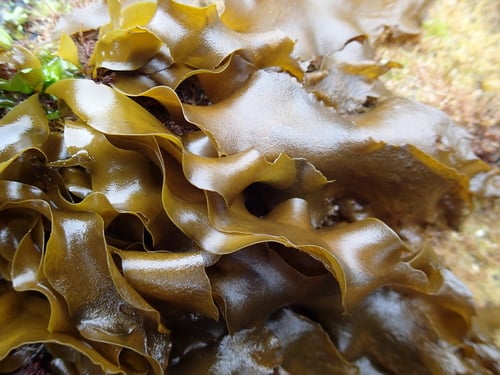
iNaturalist· cc-by-nc
(c) Lucy Smiechura, some rights reserved (CC BY-NC)
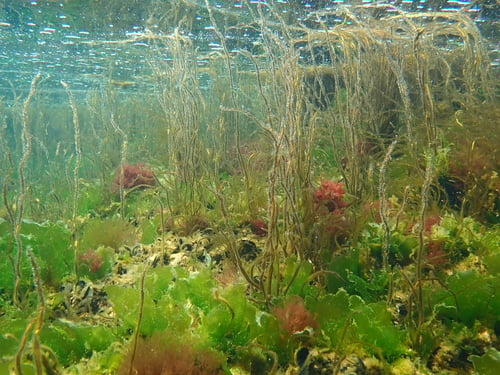
iNaturalist· cc-by
(c) Saryu Mae 前 朝琉, some rights reserved (CC BY)
Summary
Source: WikipediaColpomenia sinuosa, commonly named the oyster thief or sinuous ballweed, is a brown algae species in the genus Colpomenia. It is the type species of its genus and is widespread in tropical to temperate zones around the world. It is superficially similar to the Colpomenia peregrina species and in older texts, such as Knight and Parke (1931), C. peregrina is referred to as C. sinuosa. Colpomenia sinuosa contains the C6-C4-C6 phenolic compound colpol.
Description
A seaweed. It is golden brown and round and hollow. It has a smooth to irregular surface. It can be 10 cm wide.
This description is brief — help expand it
Edible Uses
The fronds can be chopped and added to stir-fried dishes, soups, and stews.
Traditional Uses
It can be chopped and added to stir fried dishes. It can also be used in soups and stews.
This uses section is brief — help expand it
Distribution
It grows in tidal pools. It grows largest in sheltered areas.
Where It Grows
Africa, Algeria, Antarctica, Asia, Australia, Bahrain, Bangladesh, Brazil, Canary Islands, Cape Verde, Central Africa, Central America, Chile, China, Costa Rica, Côte d'Ivoire, East Africa, Egypt, Equatorial Guinea, Ethiopia, Europe, Fiji, France, French Polynesia, Gabon, Ghana, Greece, Guam, Guinea-Bissau, Hawaii, India, Indochina, Indonesia, Iran, Ireland, Israel, Italy, Ivory Coast, Jamaica, Japan, Jordan, Kerguelen, Korea, Kuwait, Libya, Madagascar, Malaysia, Mauritania, Mauritius, Mediterranean, Mexico, Micronesia, Mediterranean, Middle East, Morocco, Mozambique, Namibia, New Caledonia, New Zealand, North Africa, North America, Oman, Pacific, Pakistan, Panama, Peru, Philippines, Portugal, Puerto Rico, Qatar, Sao Tome and Principe, Saudi Arabia, SE Asia, Senegal, Seychelles, Sierra Leone, Singapore, Solomon Islands, Somalia, South Africa, Southern Africa, South America, Spain, Sri Lanka, Sudan, Taiwan, Tanzania, Togo, Trinidad, Tunisia, Turkey, Türkiye, Uruguay, USA, Venezuela, Vietnam, West Africa, West Indies, Yemen,
Notes
There are about 11 Colpomenia species.
Synonyms
References (8)
- Bonney, N., 2012, Edible Wild Native Plants for Southern Australia. p 100
- Cherry, P., et al, 2019, Risks and benefits of consuming edible seaweeds. Nutrition ReviewsVR Vol. 77(5):307–329
- Heiba, H. I. et al, 1997 Fatty acid composition of twelve algae from the coastal zones of Qatar. Plant Foods for Human Nutrition 51:27-34
- Novaczek, I., 2001, A Guide to the Common Edible and Medicinal Plants of the Pacific Islands. SPC. p 1
- Pereira, L., Edible Seaweeds of the World. CRC Press.
Show all 8 references Hide references
- Wang, Wei-Lung and Chiang, Young-Meng, 1994, Potential Economic Seaweeds of Hengchun Peninsula, Taiwan, Economic Botany, Vol. 48, No. 2, pp. 182-189
- www.algaebase.org
- Zemke-White, W. L. & Ohno, M., 1999, World seaweed utilisation: An end-of-century summary. Journal of Applied Phycology 11: 369-376