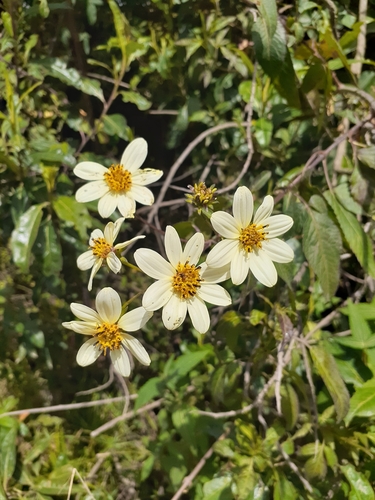
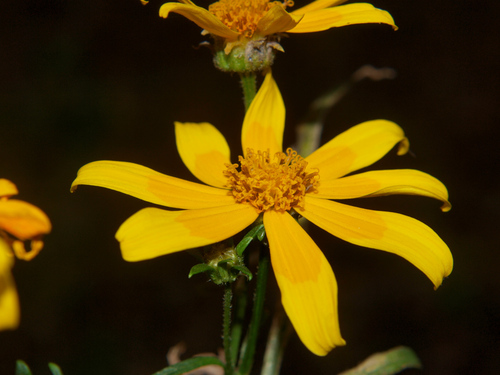
Scorzonera divaricata
Turcz.
iNaturalist· cc-by-nc
(c) Alexandru Pintilioaie, some rights reserved (CC BY-NC)
iNaturalist· cc-by-nc
(c) Alexandru Pintilioaie, some rights reserved (CC BY-NC)
iNaturalist· cc-by-nc
(c) Alexandru Pintilioaie, some rights reserved (CC BY-NC)
Summary
Source: WikipediaScorzonera divaricata is a perennial herb with hermaphroditic flowers pollinated by insects. It grows well in light sandy, medium loamy, and heavy clay soils with good drainage. This species prefers mildly acidic, neutral, or basic soil pH and requires full sun. It adapts to both dry and moist soil conditions.
Description
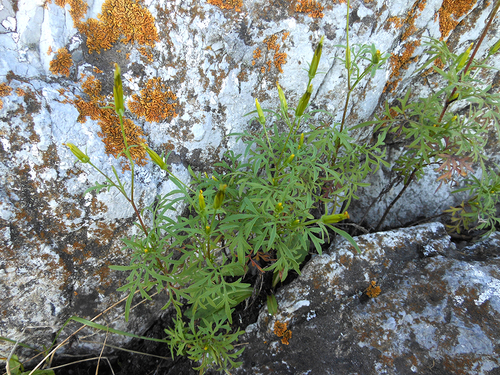
A herb or small shrub. It keeps growing from year to year. It grows 20-40 cm tall. The top of the root stock is branched and has the residue or leaf sheaths. There can be several stems. They are greyish green. They are frequently branched. The leaves on the stem are narrow and 2-10 mm long by 1-3 mm wide. There is usually a hook at the end.
Edible Uses
The root is edible cooked, and the leaves can also be cooked and eaten.
Traditional Uses
The woody tuberous roots and leaves are eaten as a vegetable.
This uses section is brief — help expand it
Medicinal Uses
None known.
Distribution
It is a temperate plant. In north China it grows in dry riverbeds and lowland sand dunes between 500-2,000 m above sea level.
Where It Grows
Asia, China, Himalayas, India, Manchuria, Mongolia,
Cultivation
We have very little information on this species and do not know if it will be hardy in Britain, though judging by its native range it should succeed outdoors in most parts of the country. There is some confusion over the correct name for this species, this name might be no more than a synonym for S. virgata. See which lists S. divaricate. Hook.f. (a different author to the one we are using) as a synonym of S. virgata. The following notes are based on the general needs of the genus. Succeeds in any soil in sun or light shade.
Propagation
Sow seed in spring in a greenhouse, pricking out seedlings into relatively deep pots as soon as they are large enough to handle, to accommodate the taproot. If growth is strong, plant out in early summer; otherwise overwinter in the greenhouse and plant out in late spring the following year. Divide in autumn or as growth begins in spring. Larger divisions can go straight into permanent positions. Smaller divisions are best potted up and grown on in a lightly shaded cold frame, then planted out once well established in summer.
Other Uses
A latex obtained by macerating the root is used to produce high-grade rubber.
References (5)
- Ambasta S.P. (Ed.), 2000, The Useful Plants of India. CSIR India. p 562
- Bull. Soc. Imp. Naturalistes Moscou 5:200. 1832
- Plants for a Future database, The Field, Penpol, Lostwithiel, Cornwall, PL22 0NG, UK. http://www.scs.leeds.ac.uk/pfaf/
- Singh, H.B., Arora R.K.,1978, Wild edible Plants of India. Indian Council of Agricultural Research, New Delhi. p 37
- Urgamal, M., Oyuntsetseg, B., Nyambayar, D. & Dulamsuren, Ch. 2014. Conspectus of the vascular plants of Mongolia. (Editors: Sanchir, Ch. & Jamsran, Ts.). Ulaanbaatar, Mongolia. “Admon“ Press. 334pp. (p. 199-230).