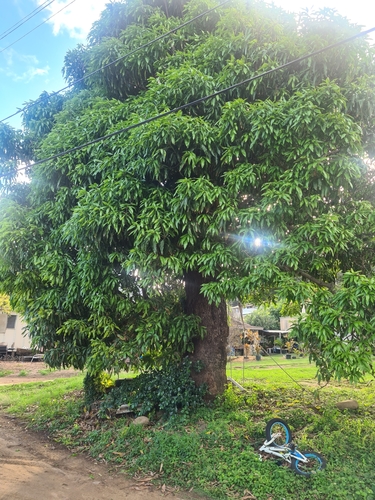
Schinus terebinthifolia
Raddi
Broad-leafed pepper tree
iNaturalist· cc-by-nc
(c) koala, some rights reserved (CC BY-NC)
iNaturalist· cc-by-nc
(c) koala, some rights reserved (CC BY-NC)
iNaturalist· cc-by-nc
(c) koala, some rights reserved (CC BY-NC)
Description
A shrub or small tree. It grows 7 m high. The branches do not hang down. The leaves are divided into 5-9 leaflets. The central stalk of the leaf has slight wings. It has broader leaflets than the pepper tree. The leaflets are opposite and without stalks. They are oval and 3-8 cm long by 1-2.5 cm wide. The leaflet at the end is slightly larger than the others. The flowering stalk is at the end or in the axils of the upper leaves. It is 5-11 cm long. There are 5 sepals which are triangle shaped and 1 mm long. The petals are white and 2 mm long. The fruit is round and 4-5 mm across. It is red and glossy.
Edible Uses
Seed - a peppery flavour. A popular alternative spice, it is used to flavour Cajun and Nouvelle cuisines. Some caution is advised - see notes above on toxicity.
Traditional Uses
The berries are used for flavouring. CAUTION: They should not be eaten in large amounts.
This uses section is brief — help expand it
Medicinal Uses
The aromatic plant is considered astringent and tonic. A gum resin obtained from the plant is applied externally in the treatment of cornea diseases, tumours and leprosy. The bark is antineuralgic, depurative and febrifuge. It is used in the treatment of the coughing up of blood and afflictions of the uterus. Triterpenoid acids are found in the leaves, fruit and bark. An essential oil in the plant is predominantly gamma-terpinene. It has antimicrobial properties.
Known Hazards
Like many other species in the family Anacardiaceae, Brazilian pepper has an aromatic sap that can cause skin reactions (similar to poison ivy burns) in some sensitive people, although the reaction is usually weaker than that induced by touch of the closely related Lithraea molleoides, known in Brazil as "wild" aroeira (aroeira brava). Conversely, S. terebinthifolia is commonly known as "tame" aroeira (aroeira mansa). In a paper on triterpenes, the ingested fruits are noted to have a “paralyzing effect” on birds. The narcotic and toxic effects on birds and other wildlife has also been noted by others, e.g., Bureau of Aquatic Plant Management. The AMA Handbook of Poisonous and Injurious Plants reports that the triterpenes found in the fruits can result in irritation of the throat, gastroenteritis, diarrhea, and vomiting. Like most other members of the Anacardiaceae, Brazilian pepper contains active alkenyl phenols, e.g. urushiol and cardol, which can cause contact dermatitis and inflammation in sensitive individuals. Contact with the “sap” from a cut or bruised tree can result in rash, lesions, oozing sores, severe itching, welts, and reddening and swelling (especially of the eyes). The burning of S. terebinthifolia releases many airborne irritants, affecting the skin, eyes, and lungs. It is said to have a "mace-like" effect upon nearby people and burning is highly inadvisable.
Distribution
It is native to Brazil. A tropical and subtropical plant. It grows in the Andean deserts in Peru. It can grow in arid places. It suits hardiness zones 9-12.
Where It Grows
Africa, Algeria, Angola, Argentina, Asia, Australia, Bahamas, Bermuda, Bolivia, Botswana, Brazil*, Caribbean, Central Africa, Chile, China, Colombia, Cuba, Dominican Republic, East Africa, Ecuador, Egypt, Eswatini, Europe, Guam, Hawaii, India, Indonesia, Israel, Jamaica, Kenya, Marquesas, Mauritius, Mediterranean, Mexico, Middle East, Mozambique, New Zealand, North Africa, Pacific, Pakistan, Papua New Guinea, PNG, Paraguay, Peru, Portugal, Puerto Rico, New Caledonia, Norfolk Island, North Africa, North America, Paraguay, Reunion, SE Asia, Seychelles, Sierra Leone, Slovenia, South America, South Africa, Southern Africa, South America, Spain, St Helena, Swaziland, Tanzania, Uganda, United Arab Emirates, UAE, Uruguay, USA, Venezuela, Virgin Islands, West Africa, West Indies, Zimbabwe,
Cultivation
Plants can be grown by seed. They can also be grafted.
Propagation
Seed - best sown as soon as it is ripe in a sunny position in a nursery seedbed. A germination rate of above 50% can be expected, with the seed sprouting within 10 - 15 days.
Other Uses
A resin called 'Balsamo de misiones' is obtained from the trunk. The tree (bark?) is a source of tannins. Essential oils extracted from the seeds have pesticidal activity against the housefly (Musca domestica). The wood is a dark yellow, turning red on exposure. It is moderately heavy, very dense, hard, soft to work with, with excellent mechanical properties and of high natural durability. It is ideal for making fine furniture, for which it is highly valued in Brazil. The wood is used for fuel and to make charcoal. The tree has been used to stabilize sand dunes on the Brazilian Atlantic coast, and is also sometimes grown as a hedge. The tree has a high ecological plasticity, a short life cycle and very rapid growth; it is therefore recommended for the restoration of degraded areas and especially gallery forests.
Production
The fruit are pickled in brine or dried.
Other Information
They are cultivated commercially in Reunion.
Notes
There are about 30 Schinus species. It has become a weed in some locations. It can be invasive.
Nutrition
| Part | Moisture | kJ | kcal | Protein | Vit A | Vit C | Iron | Zinc |
|---|---|---|---|---|---|---|---|---|
| Fruit | 56.9 | 693 | 164 | 2.9 | — | 0.5 | 0.9 | 1.3 |
Synonyms
Also Known As
Aroeira, Aroeira-periquita, Aroeira-pimenteira, Aroeura-vermelha, Brazilian pepper tree, Brazilski poprovec, Christmas berry, Filfil areed, Hawai-ian Holly, Mexican pepper, Nani-o-hilo, Pimenta-do-reino-de-arvore, Pink peppercorns, Pohon merica brasil, Red peppercorns, Wilelaiki
References (49)
- Ambasta S.P. (Ed.), 2000, The Useful Plants of India. CSIR India. p 556
- Barwick, M., 2004, Tropical and Subtropical Trees. A Worldwide Encyclopedic Guide. Thames and Hudson p 368
- Bioversity New World Fruits Database
- Blamey, M and Grey-Wilson, C., 2005, Wild flowers of the Mediterranean. A & C Black London. p 128
- Bodkin, F., 1991, Encyclopedia Botanica. Cornstalk publishing, p 914
Show all 49 references Hide references
- Bortolotto, I. M., et al, 2018, Lista preliminar das plantas alimenticias nativas de Mato Grosso do Sul, Brasil. Iheringia, Serie Botanica, Porto Alegre, 73 (supl.):101-116
- Brack, P., et al, 2020, Frutas nativas do Rio Grande do Sul, Brasil: riqueza e potencial alimentício. Native fruits of Rio Grande do Sul, Brazil: richness and potential as food. Rodriguésia 71: e03102018.
- Brazil: Biodiversity for Food and Nutrition. http://www.b4fn.org/countries/brazil/
- Brickell, C. (Ed.), 1999, The Royal Horticultural Society A-Z Encyclopedia of Garden Plants. Convent Garden Books. p 942
- Burkill, H. M., 1985, The useful plants of west tropical Africa, Vol. 1. Kew.
- Coradin, L. et al (Eds), 2011, Especies Nativas da Flora Brasileira de Valor Economico Atual ou Potencial. Brasilia MMA. p 226
- Cundall, P., (ed.), 2004, Gardening Australia: flora: the gardener's bible. ABC Books. p 1322
- Dharani, N., 2002, Field Guide to common Trees & Shrubs of East Africa. Struik. p 156
- Facciola, S., 1998, Cornucopia 2: a Source Book of Edible Plants. Kampong Publications, p 10
- Flora of Australia Volume 49, Oceanic Islands 1, Australian Government Publishing Service, Canberra. (1994) p 245
- Flora of Pakistan. www.eFloras.org
- Grandtner, M. M. & Chevrette, J., 2013, Dictionary of Trees, Volume 2: South America: Nomenclature, Taxonomy and Ecology. Academic Press p 593
- Hall, N. et al, 1972, The Use of Trees and Shrubs in the Dry Country of Australia, AGPS, Canberra. p 208
- Hibbert, M., 2002, The Aussie Plant Finder 2002, Florilegium. p 288
- http://www.botanic-gardens-ljubljana.com/en/plants
- Hunter, D., et al, 2019, The potential of neglected and underutilized species for improving diets and nutrition. Planta (2019) 250:709-729
- Hussey, B.M.J., Keighery, G.J., Cousens, R.D., Dodd, J., Lloyd, S.G., 1997, Western Weeds. A guide to the weeds of Western Australia. Plant Protection Society of Western Australia. p 80
- INFOODSUpdatedFGU-list.xls
- Kermath, B. M., et al, 2014, Food Plants in the Americas: A survey of the domesticated, cultivated and wild plants used for Human food in North, Central and South America and the Caribbean. On line draft. p 789
- Kinupp, V. F., 2007, Plantas alimenticias nao-convencionais da regiao metropolitana de Porto Alegre, RS, Brazil p 59
- Kinupp, V. F. & Bergman, I., 2008, Protein and minerals of native species, potential vegetables and fruits. Cienc.Tecnol. Aliment. Vol. 28 No. 4 Campinas Oct/Dec.
- Lamoureux, C.H., 1976, Trailside Plants of Hawaii's National Parks. Hawaii Natural History Association. p 40
- Lazarides, M. & Hince, B., 1993, Handbook of Economic Plants of Australia, CSIRO. p 212
- Llamas, K.A., 2003, Tropical Flowering Plants. Timber Press. p 60
- Long, C., 2005, Swaziland's Flora - siSwati names and Uses http://www.sntc.org.sz/flora/
- Lord, E.E., & Willis, J.H., 1999, Shrubs and Trees for Australian gardens. Lothian. p 72
- Low, T., 1992, Bush Tucker. Australia’s Wild Food Harvest. Angus & Robertson. p 185
- Marinelli, J. (Ed), 2004, Plant. DK. p 468
- Melzer, R. & Plumb, J., 2011, Plants of Capricornia. Belgamba, Rockhampton. p 534
- Mem. Mat. Fis. Soc. Ital. Sci. Modena, Pt. Mem. Fis. 18:399. 1820
- Paczkowska, G. & Chapman, A.R., 2000, The Western Australian Flora. A Descriptive Catalogue. Western Australian Herbarium. p 145
- Palgrave, K.C., 1996, Trees of Southern Africa. Struik Publishers. p 464
- Royal Botanic Gardens, Kew (1999). Survey of Economic Plants for Arid and Semi-Arid Lands (SEPASAL) database. Published on the Internet; http://www.rbgkew.org.uk/ceb/sepasal/internet [Accessed 28th March 2011]
- Schuler, S., (Ed.), 1977, Simon & Schuster's Guide to Trees. Simon & Schuster. No. 169
- Smith, N., Mori, S.A., et al, 2004, Flowering Plants of the Neotropics. Princeton. p 16
- Smith, N., Mori, S.A., et al, 2004, Flowering Plants of the Neotropics. Princeton. Plate 2 (Photo)
- Solomon, C., 2001, Encyclopedia of Asian Food. New Holland. p 278
- Staples, G.W. and Herbst, D.R., 2005, A tropical Garden Flora. Bishop Museum Press, Honolulu, Hawaii. p 106 (Drawing)
- Sukarya, D. G., (Ed.) 2013, 3,500 Plant Species of the Botanic Gardens of Indonesia. LIPI p 500
- Swaziland's Flora Database http://www.sntc.org.sz/flora
- Wiersema, J. H. & Leon, B., 2013, World Economic Plants. A Standard Reference CRC Press. 2nd Ed. p 618
- World Checklist of Useful Plant Species 2020. Royal Botanic Gardens, Kew
- www.colecionandofrutas.org
- www.worldagroforestrycentre.org/treedb/