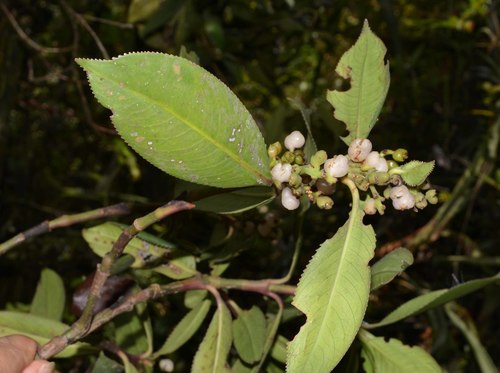
Sarcandra glabra
(Thunb.) Nakai
Tea scent, Japanese ardisia
iNaturalist· cc-by-nc
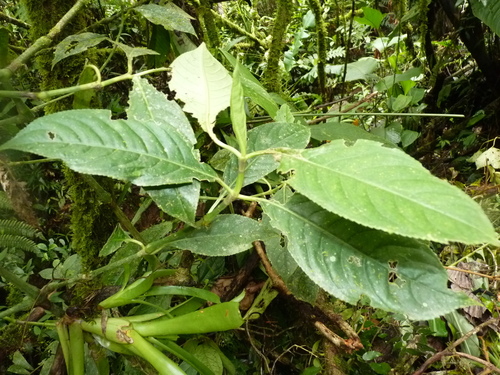
(c) mei862419, some rights reserved (CC BY-NC)
iNaturalist· cc-by-nc-nd
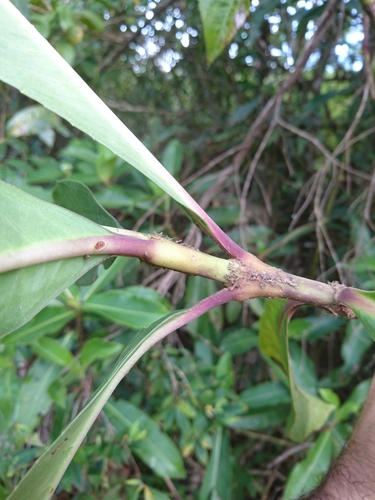
(c) Sunnetchan, some rights reserved (CC BY-NC-ND), uploaded by Sunnetchan
iNaturalist· cc-by-nc
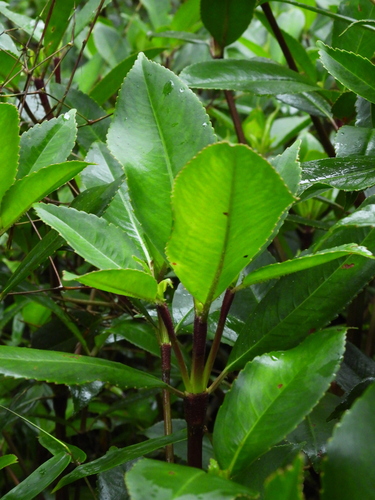
(c) ytt, some rights reserved (CC BY-NC), uploaded by ytt
Summary
Source: WikipediaSarcandra glabra is a herb native to Southeast Asia. It is also known as herba sarcandrae or glabrous sarcandra herb. Other common names include the nine-knotted flower and the bone-knitted lotus. Aromatic oils may be extracted from the leaves. This extract has been shown in mice to reduce immunologic attenuation due to stress.
Description
A small shrub 50-150 cm tall. It is half woody. The leaves are simple and opposite. They are 6-13 cm long by 2-5 cm wide. There are teeth along the edge. The flowering shoots are in the axils of leaves and hav scale like leaves. The fruit are bright red. They are 5-6 mm across. There is one seed.
Edible Uses
The leaves are used for scenting tea. The fruit is edible, and the seeds are dried, roasted, and used as a sesame seed substitute.
Traditional Uses
It is used for scenting tea. The seeds are dried, roasted and used as a sesame seed substitute.
This uses section is brief — help expand it
Medicinal Uses
An infusion is used to treat headache.
Distribution
A tropical plant. It grows in forests, thickets, valleys, ravines, slopes, roadsides, trailsides, grasslands, swamps, streamsides, sandy soil; near sea level to 2000 m altitude in China. In XTBG Yunnan.
Where It Grows
Asia, Cambodia, China, Hawaii, Himalayas, India, Indochina, Indonesia, Japan (including Ryukyu Islands), Korea, Laos, Malaysia, Northeastern India, Pacific, Philippines, SE Asia, Slovenia, Sri Lanka, Taiwan, Thailand, USA, Vietnam,
Notes
There are 2 Sarcandra species.
Synonyms
Also Known As
Apot, Atukan, Cao shan hu, Herba sarkandra, 'itda, Itda, Marlberry, Senryo, Tupu tal
References (16)
- Bodner, C. C. and Gereau, R. E., 1988, A Contribution to Bontoc Ethnobotany. Economic Botany, 43(2): 307-369
- Burkill, I.H., 1966, A Dictionary of the Economic Products of the Malay Peninsula. Ministry of Agriculture and Cooperatives, Kuala Lumpur, Malaysia. Vol 1 (A-H) p 535 (As Chloranthus brachystachys)
- Facciola, S., 1998, Cornucopia 2: a Source Book of Edible Plants. Kampong Publications, p 78 (As Chloranthus brachystachys)
- Facciola, S., 1998, Cornucopia 2: a Source Book of Edible Plants. Kampong Publications, p 78
- Fl. sylv. kor. 18:17, t. 2. 1930
Show all 16 references Hide references
- Heywood, V.H., Brummitt, R.K., Culham, A., and Seberg, O. 2007, Flowering Plant Families of the World. Royal Botanical Gardens, Kew. p 98
- http://www.botanic-gardens-ljubljana.com/en/plants
- Martin, F.W. & Ruberte, R.M., 1979, Edible Leaves of the Tropics. Antillian College Press, Mayaguez, Puerto Rico. p 107 (As Chloranthus brachystachys)
- Murtem, G. & Chaudhrey, P., 2016, An ethnobotanical note on wild edible plants of Upper Eastern Himalaya, India. Brazilian Journal of Biological Sciences, 2016, v. 3, no. 5, p. 63-81 (As Chloranthus glaber)
- Pham-Hoang Ho, 1999, An Illustrated Flora of Vietnam. Nha Xuat Ban Tre. p 287
- Reid, L. A. & Madulid, D., 1972, Some comments on Bontoc Ethnobotany. Philippine Journal of Linguistics (As Chloranthus glaber)
- Staples, G.W. and Herbst, D.R., 2005, A tropical Garden Flora. Bishop Museum Press, Honolulu, Hawaii. p 235
- Sukarya, D. G., (Ed.) 2013, 3,500 Plant Species of the Botanic Gardens of Indonesia. LIPI p 709
- Tanaka,
- Wiersema, J. H. & Leon, B., 2013, World Economic Plants. A Standard Reference CRC Press. 2nd Ed. p 613
- Xia Nianhe; Joël Jérémie, CHLORANTHACEAE Flora of China.