Santalum album
L.
Indian sandalwood, White sandalwood
iNaturalist· cc0
no rights reserved, uploaded by 葉子
iNaturalist· cc-by
(c) Kevin Faccenda, some rights reserved (CC BY)
iNaturalist· cc-by
(c) Kevin Faccenda, some rights reserved (CC BY)
Summary
Source: WikipediaSantalum album is a small tropical tree, and the traditional source of sandalwood oil. It is native to Indonesia (Java and the Lesser Sunda Islands), the Philippines, and Western Australia. It is commonly known as the white sandalwood or Indian sandalwood. It was one of the plants exploited by Austronesian arboriculture and it was introduced by Austronesian sailors to Mainland Southeast Asia, South Asia and East Asia, during the ancient spice trade, becoming naturalized in South India by at least 1300 BCE. It was greatly valued for its fragrance, and is considered sacred in some religions like Hinduism. The high value of the species has caused over-exploitation, to the point where the wild population is vulnerable to extinction. Indian sandalwood still commands high prices for its essential oil owing to its high alpha-santalol content, but the lack of sizable trees has essentially eliminated its former use for fine woodworking. The plant is long-lived, but harvest is only viable after many years.
Description
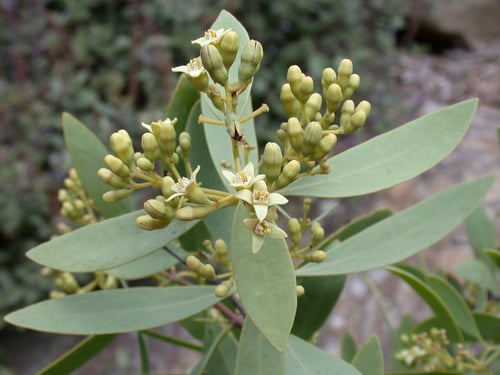
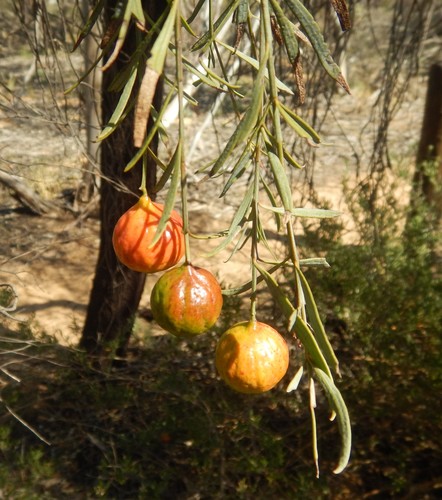
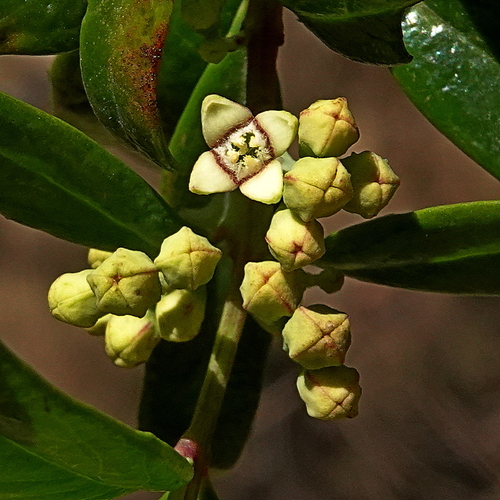
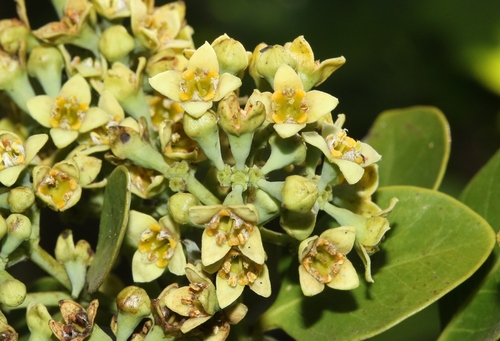
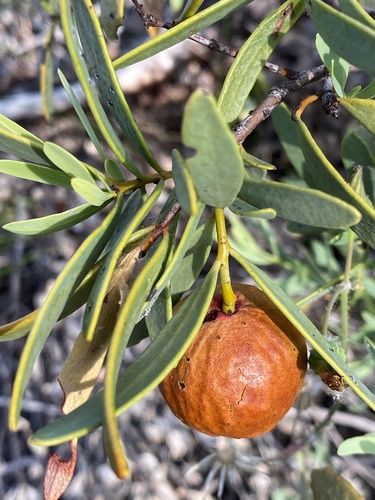
A shrub or small tree. It grows to 3 m high. The leaves are opposite and smooth. They are oval and 2.5-7 cm long by 1.5-4 cm wide. They are light green above and paler underneath. The stalk is about 1 cm long and has a groove. The flowers are small and red or green. They are about 0.5 cm long. The fruit are smooth and round. They are fleshy with a stone inside. The fruit are 0.7-1 cm across. They are shiny red to black when ripe. There is a single seed inside. It normally feeds on the roots of nearby plants for some of its nutrients. It cannot grow on the roots of the Mango family.
Edible Uses
The ripe fruit is edible. Sandalwood essence flavors syrups, and an essential oil from the heartwood and roots is used as flavoring in commercial chewing gum, bakery products, ice cream, and candy. The bark is sometimes chewed as a betel nut substitute.
Traditional Uses
The bark is sometimes chewed instead of betel nuts. Sandalwood essence adds a flavour to syrups. An essential oil from the heartwood and roots is used as flavouring in commercial chewing gum, bakery products, ice cream and candy. The fruit is edible when ripe.
Medicinal Uses
Sandalwood oil consists of about 80% α-santalol and β-santolol, predominantly the former, which are sesquiterpenes. Attempts to synthesise these date to 1947 by Givaudan in Switzerland. The resulting isobornyl cyclohexanol can be distinguished from santolol, but is much cheaper. Since then other synthetic sandalwood oils have been used in laundry detergents and textiles. Three of the terpene synthase genes producing components employed in host defense are present in S. album.
Distribution
A tropical plant. It is native to India. It grows in dry rocky mountain slopes. It is a tropical plant. It suits seasonally dry regions. It grows on dunes near the coast. It cannot tolerate frost. Bombay. In XTBG Yunnan.
Where It Grows
Africa, Asia, Australia, Central America, China, Cuba, East Timor, Fiji, Hawaii, India, Indochina, Indonesia, Kenya, Malaysia, Marquesas, Myanmar, Pacific, SE Asia, Sri Lanka, Thailand, Timor-Leste, USA, West Indies, West Timor,
Cultivation
Plants can be grown from fresh seed. They can take 2 months to germinate. The seedlings need to attach to a host plant about one month are germination. They can be grown from root cuttings.
Propagation
Seed - pre-soak in a solution of 1:9 bleach to water and germinate in a free-draining but moisture retentive sterile medium such as vermiculite at 16 - 20c. Pot on when the roots are about 4cm long, placing each plant in a free-draining compost together with a potential host plant. Most natural seedlings of sandal are found growing in the middle of thorny bushes, where the birds have dropped the seeds. Artificial propagation is easily done by directly dibbling freshly collected ripe seeds in worked up soil patches, with the onset of the monsoon, in the middle of the nurse bushes or in protected patches. Fresh seed has a dormancy period of 2 months. Manual scarification or gibberellic acid can break this. They germinate in about 8 - 14 days, with a germination rate of 70%. Lantana camara, commonly found growing in scrub forests in areas suitable for sandal, acts as a good nurse to the seedlings in the early stages. Planting of container-raised seedlings or branch cuttings is also successful; trees are raised with a host plant, for example Cajanus cajan, Senna siamea, Terminalia, Lagerstroemia, Anogeissus, Dalbergia, Pongamia, Albizia and Acacia species. Seeds can be sown in polythene bags along with the sandal seeds and watering is once a day. Sandal seedlings attain a height of 15 - 20 cm by planting time and are planted out in the field along with the host plant. Seedling growth is rapid with 20 - 30 cm obtained at the end of the 1st year and 60-70 cm at the end of the 2nd year. Root suckers are produced when roots are exposed or injured. The nursery phase to raise sturdy 30 cm plants is usually 8 months. Primary host species are grown alongside the seedlings in each pot. S. album has been propagated vegetatively by tissue culture, branch cuttings and cleft grafting. Direct sowing in the fields is used in some situations. Secondary host species should be well established on the planting site before planting. Acacia, Casuarina, Paraserianthes and Sesbania spp are amongst a wide range of successful hosts.
Other Uses
Sandalwood oil, steam distilled from the heartwood, roots, branches etc is an indispensable aromatic material in perfumery, where its outstanding fixative properties and excellent tenacity, blending ability and highly attractive fragrance have made it a basic component of countless perfumes, cosmetics and toiletries. It blends well with other essential oils such as patchouli, vetiver, geranium and musk. It is also used in soap making and medicines. All parts of the plant contain these essential oils - which comprise at least 90% sesquiterpene alcohols. The roots contain the greatest quantity of oil, with around 6 - 10%, and hence are more valuable; the heartwood yields 4 - 8%; the leaves about 4%; the branches 2 - 4%; and the bark around 2%. An essential oil is also obtained by acid hydrolysis of distilled sandalwood chips and sawdust. This oil differs in scent and appearance from true sandalwood oil. Powder from the heartwood, mixed with gum arabic and saltpetre and often with other aromatic materials, is used to make incense sticks. It is also burnt as perfumes in houses and temples, or is ground into a paste and used as a cosmetic. It is put in sachets and placed in linen cupboards etc for scenting clothes. Finely ground sandalwood, mixed with water, is rubbed on the body for its cooling effect. A compound extracted from the bark exhibits hormone activity in insects, disrupting their development. It also has a chemosterilant effect, but is not used commercially. The bark contains about 12 - 14% tannin and has good potential in the tanning industry. The seeds yield a red drying oil that is mainly used as a lamp oil and can be used in the manufacture of paint. The fresh leaves yield a pale yellow wax. It has a melting point of 30°c and contains 75% non-saponifiable compounds. The wood, which weighs 870 kg/cubic m, is heavy, hard, durable and strong, but difficult to split. It is not attacked by termites. Odourless when freshly cut, it becomes strongly aromatic as it seasons. Its close grained heartwood is much used for ornamental and carving work. Formerly, in China the most expensive coffins were made of sandalwood, while in India it was the preferred wood for funeral pyres. Even today it is customary to add at least a single piece of sandalwood. When supplies became scarce, sandalwood from Australian Santalum species was used for such purposes. Larger pieces of heartwood are now mostly used for wood sculptures and carvings. The wood has been used as a fuel but is generally considered too valuable for this purpose. It is traditionally burnt at Buddhist funerals and is also ground into a powder to make the paste used in Hindu caste marks. Santalum album is considered in Indian to be a practical agroforestry species. It is sometimes grown as an ornamental and as a low-branching wind-break, whilst its leaves provide green manure.
Production
It is slow growing.
Other Information
It is cultivated.
Nutrition
| Part | Moisture | kJ | kcal | Protein | Vit A | Vit C | Iron | Zinc |
|---|---|---|---|---|---|---|---|---|
| Kernel | 2.5 | — | — | 23.8 | — | — | — | — |
Synonyms
Also Known As
Agarugandha, Ai-kameli, Ananditam, Bavanna, Bhandrasri, Cendana, Chandan, Chandana, Chandanamu, Chandanapuchettu, Chondono, Etemukiaro, Gandha-chakoda, Gandha, Gandhataruvu, Gondassaro, Kulavuri, Mawk-san-ku, Peetchandan, Safed-chandan, Sandal, Sandaman, Santagu, Sriganda, Srigandhamu, Srikhanda, Sufaid-chandan, Sukhad, Sukhet, Talia-parnam, Tellagandhapu-chettu, Ulocidam, White saunders, Yellow sandalwood
References (29)
- Ambasta, S.P. (Ed.), 2000, The Useful Plants of India. CSIR India. p 546
- Barwick, M., 2004, Tropical and Subtropical Trees. A Worldwide Encyclopedic Guide. Thames and Hudson p 362
- Bodkin, F., 1991, Encyclopedia Botanica. Cornstalk publishing, p 908
- Bremness, L., 1994, Herbs. Collins Eyewitness Handbooks. Harper Collins. p 83
- Brock, J., 1993, Native Plants of Northern Australia, Reed. p 295
Show all 29 references Hide references
- Burkill, I.H., 1966, A Dictionary of the Economic Products of the Malay Peninsula. Ministry of Agriculture and Cooperatives, Kuala Lumpur, Malaysia. Vol 2 (I-Z) p 1987
- Cowie, I, 2006, A Survey of Flora and vegetation of the proposed Jaco-Tutuala-Lore National Park. Timor-Lests (East Timor) www.territorystories.nt/gov.au p 52
- Doran, J.C., & Turnbull, J.W. (Eds), 1997, Australian Trees and Shrubs: species for land rehabilitation and farm plantings in the tropics. ACIAR Monograph No 24. p 334
- Facciola, S., 1998, Cornucopia 2: a Source Book of Edible Plants. Kampong Publications, p 224
- Friday, J. B., 2005, Forestry and Agroforestry Trees of East Timor. http://www.ctahr.hawaii.edu/forestry/data/Timor/Timor trees.html
- GAMMIE,
- Lazarides, M. & Hince, B., 1993, Handbook of Economic Plants of Australia, CSIRO. p 211
- Macklin, J. & Parnell, J., 2002, An account of the Santalaceae of Thailand. Thai For. Bull. 30:75-115
- Mulherin, J., 1994, Spices and natural flavourings. Tiger Books, London. p 17
- PROSEA
- Rajasab, A. H. et al, 2004, Documentation of folk knowledge on edible wild plants of North Karnataka. Indian Journal of Traditional Knowledge. Vol 3(4) pp 419-429
- Recher, P, 2001, Fruit Spirit Botanical Gardens Plant Index. www.nrg.com.au/~recher/ seedlist.html p 7
- Sahni, K.C., 2000, The Book of Indian Trees. Bombay Natural History Society. Oxford. p 144
- Singh, H.B., Arora R.K.,1978, Wild edible Plants of India. Indian Council of Agricultural Research, New Delhi. p 79
- Sp. pl. 1:349. 1753
- Staples, G.W. and Herbst, D.R., 2005, A tropical Garden Flora. Bishop Museum Press, Honolulu, Hawaii. p 511
- Sukarya, D. G., (Ed.) 2013, 3,500 Plant Species of the Botanic Gardens of Indonesia. LIPI p 494
- Swaminathan, M.S., and Kochnar, S.L., 2007, An Atlas of major Flowering Trees in India. Macmillan. p 231
- WATT,
- Wiersema, J. H. & Leon, B., 2013, World Economic Plants. A Standard Reference CRC Press. 2nd Ed. p 613
- World Checklist of Useful Plant Species 2020. Royal Botanic Gardens, Kew
- www.worldagroforestrycentre.org/treedb/
- Yasukawa, K., Medicinal and Edible Plants as Cancer Preventive Agents. Drug Discovery Research in Pharmacognosy. p185 www.intechopen.com
- Zeven, A. C. & de West, J. M. J., 1982, Dictionary of cultivated plants and their regions of diversity. Wageningen. p 63