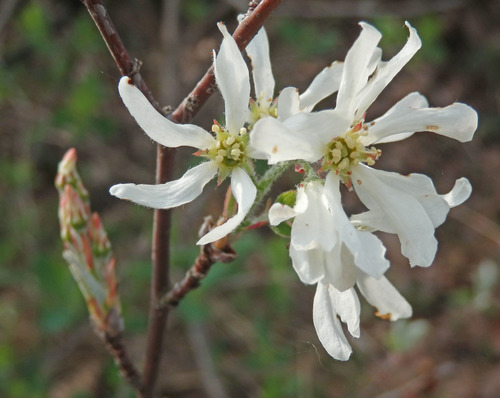
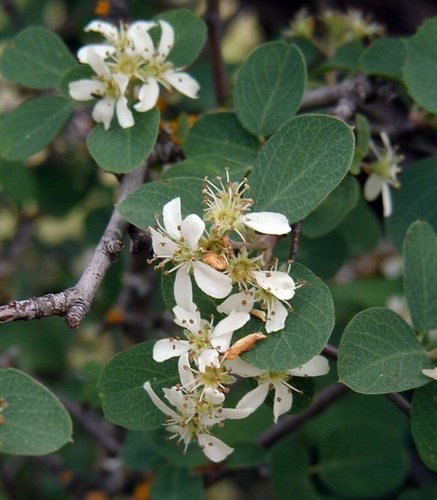
Sanguisorba officinalis
L.
Great Burnet, Garden burnet, Salad burnet
iNaturalist· cc-by-nc
(c) Vladimir Bryukhov, some rights reserved (CC BY-NC), uploaded by Vladimir Bryukhov
iNaturalist· cc-by-nc
(c) Игорь Поспелов, some rights reserved (CC BY-NC)
iNaturalist· cc-by-nc
(c) Игорь Поспелов, some rights reserved (CC BY-NC)
Summary
Source: WikipediaSanguisorba officinalis, commonly known as great burnet, is a plant in the family Rosaceae, subfamily Rosoideae. It is native throughout the cooler regions of the Northern Hemisphere in Europe, northern Asia, and northern North America. Sanguisorba officinalis is an important food plant for the European large blue butterflies Phengaris nausithous and P. teleius.
Description
A shrub. It grows 75-90 cm tall. It spreads 60-90 cm wide. It forms clumps. It keeps growing from year to year. The stem is erect, naked and has grooves. It branches near the top. The leaves are medium green. They occur in rings near the base of the plant and are divided into leaflets along the stalk. There are 13 oblong to oval leaflets. These have teeth along the edge. The flowers are deep red or purple. They are in dense heads at the top of the plant.
Edible Uses
Young leaves and flower buds can be eaten raw or cooked, and are best harvested in spring before the plant comes into flower. They have a cucumber flavour and work well in salads or as a potherb. Fresh or dried leaves can also be brewed as a tea substitute.
Traditional Uses
The young leaves are boiled and eaten with oil and salt. They are parboiled and eaten fried, oil-roasted, added to soups or preserved in salt. The leaves are used as a substitute for tea. The root and stems are steamed and dried and used for making Mongolian tea. They are also used for brewing. The seeds are used in the preparation of vinegar.
Medicinal Uses
Great burnet is used primarily for its astringent properties to slow or stop blood flow, both internally and externally. Modern Chinese research has found that the whole herb heals burns more effectively than isolated tannins alone. An ointment made from the root and petroleum jelly has shown marked improvement in eczema patients. The leaves are astringent, refrigerant, styptic, and tonic, used in treating fevers and bleeding; for this purpose the plant is kept from flowering, with leaves harvested in July and dried for later use. The root is anodyne, astringent, diuretic, febrifuge, haemostatic, tonic, and vulnerary, used to treat peptic ulcers, haematuria, menorrhagia, bloody stool, dysentery, diarrhoea, haemorrhoids, and burns. Roots are harvested in autumn as the leaves die down and dried for later use. While all parts of the plant are astringent, the root is the most potent. Great burnet is considered an excellent internal remedy for abnormal discharges including diarrhoea, dysentery, and leucorrhoea, and is applied externally to burns, scalds, sores, and skin diseases. This species was ranked 19th out of 250 plants in a Chinese survey of potential anti-fertility plants.
Known Hazards
Best avoided during pregnancy in view of the lack of information about toxicity. Suggested that the herb may interact with the group of allopathic medications known as fluoroquinolones.
Distribution
It is a temperate plant. It grows best in moist, well-drained soils. It needs a protected sunny position. It is resistant to frost but sensitive to drought. In China it grows in damp places from sea level to 3,000 m above sea level. It suits hardiness zones 4-8. In Inner Mongolia. In Sichuan and Yunnan.
Where It Grows
Alaska, Albania, Asia, Australia, Balkans, Belarus, Belgium, Bosnia, Britain, Bulgaria, Canada, Caucasus, Central Asia, China, Czech Republic, Europe, Finland, France, Germany, Greece, Hungary, Iceland, Indochina, Iran, Ireland, Italy, Japan, Kazakhstan, Korea, Kyrgyzstan, Luxembourg, Macedonia, Manchuria, Mongolia, Netherlands, North America, Norway, Peru, Poland, Romania, Russia, SE Asia, Siberi, Slovenia, Spain, Sweden, Switzerland, Taiwan, Tasmania, Tibet, Turkey, Türkiye, Ukraine, USA, Vietnam, Yugoslavia,
Cultivation
Succeeds in ordinary garden soil. Prefers a good moist soil that does not dry out in the summer, in sun or partial shade. Plants grow tolerably well in very poor soils and likes a dry chalky soil. This species is hardy to about -25°c.
Propagation
Sow seed in spring or autumn in a cold frame. Once large enough to handle, prick seedlings into individual pots and plant out as soon as they reach a reasonable size. Seed can also be sown in situ in early spring. Divide plants in spring or autumn.
Other Uses
The roots contain tannin.
Other Information
It is a cultivated food plant.
Notes
There are about 18 Sanguisorba species.
Synonyms
Also Known As
Burnet bloodwort, Dinjica, Gurenljigen, Krvara, Oipul, Sudu, Sudun chai, Suji, Suji chai, Zdravilna strašnica
References (28)
- Aipeisova S.A., et al, 2019, Wild useful herbs of Aktobe Region (Western Kazakhstan). Ukrainian Journal of Ecology, 9(3), 329-331
- Bodkin, F., 1991, Encyclopedia Botanica. Cornstalk publishing, p 907
- Brickell, C. (Ed.), 1999, The Royal Horticultural Society A-Z Encyclopedia of Garden Plants. Convent Garden Books. p 931
- Cerne, M., 1992, Wild Plants from Slovenia used as Vegetables. Acta Horticulturae 318
- Chen, B. & Qiu, Z., Consumer's Attitudes towards Edible Wild Plants, Ishikawa Prefecture, Japan. p 24 www.hindawi.com/journals/ijfr/aip/872413.pdf
Show all 28 references Hide references
- Cundall, P., (ed.), 2004, Gardening Australia: flora: the gardener's bible. ABC Books. p 1309
- Facciola, S., 1998, Cornucopia 2: a Source Book of Edible Plants. Kampong Publications, p 210
- Flora of China @ efloras.org Volume 9
- Hibbert, M., 2002, The Aussie Plant Finder 2002, Florilegium. p 286
- https://en.wikipedia.org/wiki/List of wild edible plants in Mongolian cuisine
- http://www.botanic-gardens-ljubljana.com/en/plants
- Hu, Shiu-ying, 2005, Food Plants of China. The Chinese University Press. p 462
- Jackes, D. A., 2007, Edible Forest Gardens
- Kermath, B. M., et al, 2014, Food Plants in the Americas: A survey of the domesticated, cultivated and wild plants used for Human food in North, Central and South America and the Caribbean. On line draft. p 784
- Khasbagan, Yeruhan and Zhao Hui, 2011, Study on Traditional Knowledge of Wild Edible Plants Used by the Mongolians in Xilingol Typical Steppe Area. Plant Diversity and Resources. 33(2): 239-246
- Kew Plants of the World Online
- Morton,
- Pham-Hoang Ho, 1999, An Illustrated Flora of Vietnam. Nha Xuat Ban Tre. p 800
- Plants for a Future database, The Field, Penpol, Lostwithiel, Cornwall, PL22 0NG, UK. http://www.scs.leeds.ac.uk/pfaf/
- READ,
- Redzic, S. J., 2006, Wild Edible Plants and their Traditional Use in the Human Nutrition in Bosnia-Herzegovina. Ecology of Food and Nutrition, 45:189-232
- Simkova, K. et al, 2014, Ethnobotanical review of wild edible plants used in the Czech Republic. Journal of Applied Botany and Food Quality 88, 49-67
- Song, M., et al, 2013, Traditional knowledge of wild edible plants in Jeju Island, Korea. Indian Journal of Traditional Knowledge. 12(2) pp 177-194
- Sp. pl. 1:116. 1753
- Tanaka,
- Wiersema, J. H. & Leon, B., 2013, World Economic Plants. A Standard Reference CRC Press. 2nd Ed. p 612
- Wujisguleng, W., & Khasbagen. K., 2010, An integrated assessment of wild vegetable resources in Inner Mongolian Autonomous Region, China. Journal or Ethnobiology and Ethnomedicine 6:34
- Zhang, Y., et al, Yunatov’s Records of Wild Edible Plant Used by the Mongols in Mongolia During 1940- 1951: Ethnobotanical Arrangements and Discussions. Inner Mongolia Normal University. p 12