Aralia nudicaulis
L.
Wild sarsaparilla
iNaturalist· cc-by-nc-sa
(c) dogtooth77, some rights reserved (CC BY-NC-SA)
iNaturalist· cc-by-nc
(c) Andy Fyon, some rights reserved (CC BY-NC), uploaded by Andy Fyon
iNaturalist· cc-by-nc
(c) Sarah Martinez, some rights reserved (CC BY-NC), uploaded by Sarah Martinez
Summary
Source: WikipediaAralia nudicaulis (commonly wild sarsaparilla, false sarsaparilla, shot bush, small spikenard, wild liquorice, and rabbit root) is a species of flowering plant in the ivy family Araliaceae. It is native to northern and eastern North America.
Description
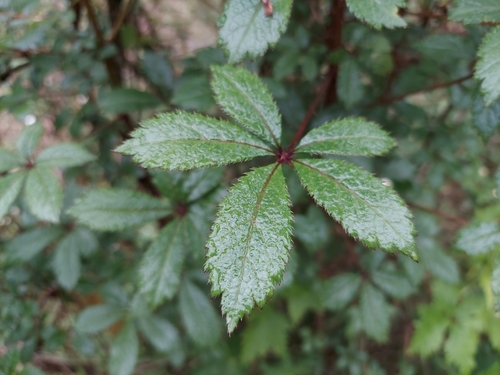
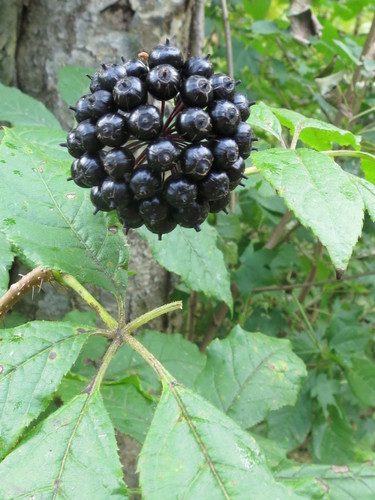
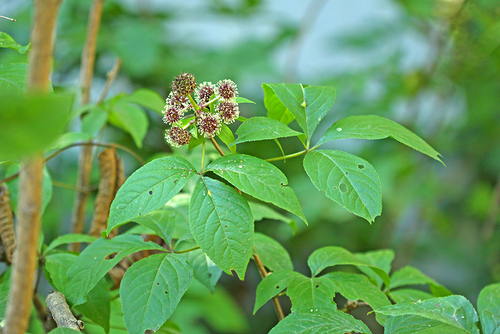
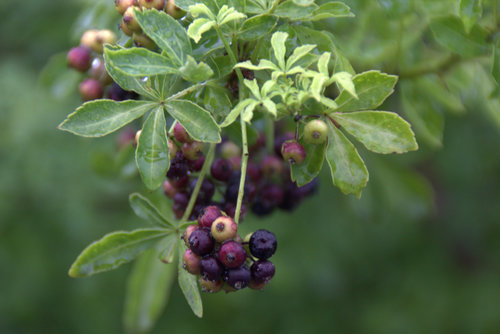
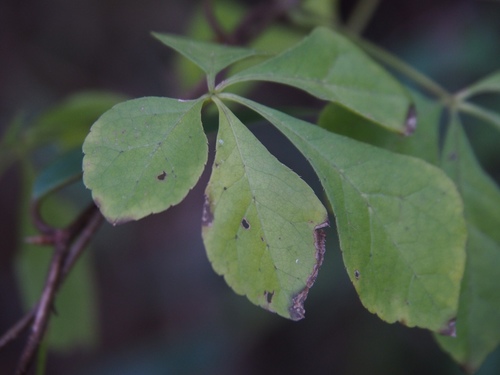
A small plant. It grows about 25 cm high. It has a long creeping rootstock under the ground. The leaves are compound and have 3 divisions with 3-5 oval leaflets with teeth along the edge. Each leaflet is 5-12 cm long. The flowers are white or green and small. There are usually 3 dense clusters on a single leafless stalk. The fruit is a round, purplish-black berry.
Edible Uses
Edible Parts: Fruit Leaves Root Shoots Edible Uses: Condiment Tea The rootstock is used as a flavouring, it is a substitute for sarsaparilla and is also used for making 'root beer'. It is also used as an emergency food (usually mixed with oil), having a sweet spicy taste and a pleasant aromatic smell. A nutritious food, it was used by the Indians during wars or when they were hunting since it is very sustaining. Young shoots - cooked as a potherb. A refreshing herbal tea is made from the root. Pleasantly flavoured. The roots are boiled in water until the water is reddish-brown. A jelly is made from the fruit. The fruit is also used to make wine. The fruit is about 6mm in diameter. The fruit is a round, purplish-black berry.
Traditional Uses
The rootstock is used as an ingredient in root beer. It is also used in a herbal tea. The rootstock is boiled and the water can be sweetened and drunk.
Medicinal Uses
Alterative Diaphoretic Diuretic Eczema Homeopathy Pectoral Stimulant Wild sarsaparilla is a sweet pungent tonic herb that acts as an alterative. It had a wide range of traditional uses amongst the North American Indians and was at one time widely used as a substitute for the tropical medicinal herb sarsaparilla. The root is alterative, diaphoretic, diuretic, pectoral and stimulant. The herb encourages sweating, is stimulating and detoxifying and so is used internally in the treatment of pulmonary diseases, asthma, rheumatism, stomach aches etc. Externally it is used as a poultice in treating rheumatism, sores, burns, itchy skin, ulcers and skin problems such as eczema. The root is collected in late summer and the autumn and dried for later use. A drink made from the pulverised roots is used as a cough treatment. A poultice made from the roots and/or the fruit is applied to sores, burns, itchy skin, ulcers, swellings etc. A homeopathic remedy made from the roots is important in the treatment of cystitis.
Distribution
It grows in moist poplar woods and thickets. It suits hardiness zone 3.
Where It Grows
Canada, Europe, North America, Turkey, Türkiye, USA,
Cultivation
Prefers a good deep loam and a semi-shady position. Requires a sheltered position. Plants are hardier when grown in poorer soils. The young growth in spring, even on mature plants, is frost-tender and so it is best to grow the plants in a position sheltered from the early morning sun.
Propagation
Seed - best sown as soon as ripe in a cold frame. Stored seed requires 3 - 5 months of cold stratification. Germination usually takes place within 1 - 4 months at 20°c. When large enough to handle, prick the seedlings out into individual pots and grow them on in light shade in a greenhouse for at least their first winter. Once the plants are 25cm or more tall, they can be planted out into their permanent positions, late spring or early summer being the best time to do this. Root cuttings 8cm long, December in a cold frame. Store the roots upside down in sand and pot up in March/April. High percentage. Division of suckers in late winter. Very easy, the suckers can be planted out direct into their permanent positions if required.
Other Uses
Groundcover. Wildlife - food source. A specialist nectary plant [1-2]. Special Uses Food Forest
Notes
There are about 40-55 Aralia species.
Also Known As
wild sarsparilla, wild sarsaparilla.
References (13)
- Beckstrom-Sternberg, Stephen M., and James A. Duke. "The Foodplant Database." http://probe.nalusda.gov:8300/cgi-bin/browse/foodplantdb.(ACEDB version 4.0 - data version July 1994)
- Bircher, A. G. & Bircher, W. H., 2000, Encyclopedia of Fruit Trees and Edible Flowering Plants in Egypt and the Subtropics. AUC Press. p 37
- Brown, D., 2002, The Royal Horticultural Society encyclopedia of Herbs and their uses. DK Books. p 126
- Cormack, R. G. H., 1967, Wild Flowers of Alberta. Commercial Printers Edmonton, Canada. p 219
- Facciola, S., 1998, Cornucopia 2: a Source Book of Edible Plants. Kampong Publications, p 25
Show all 13 references Hide references
- Jackes, D. A., Edible Forest Gardens
- MacKinnon, A., et al, 2009, Edible & Medicinal Plants of Canada. Lone Pine. p 184
- Plants for a Future database, The Field, Penpol, Lostwithiel, Cornwall, PL22 0NG, UK. http://www.scs.leeds.ac.uk/pfaf/
- Sp. pl. 1:274. 1753
- Tozer, F., 2007, The Uses of Wild Plants. Green Man Publishing. p 31
- Turner, N., 1995, Food Plants of Coastal First Peoples. Royal BC Museum Handbook p 60
- Wiersema, J. H. & Leon, B., 2013, World Economic Plants. A Standard Reference CRC Press. 2nd Ed. p 63
- World Checklist of Useful Plant Species 2020. Royal Botanic Gardens, Kew