Salicornia bigelovii
Torr.
Dwarf glasswort
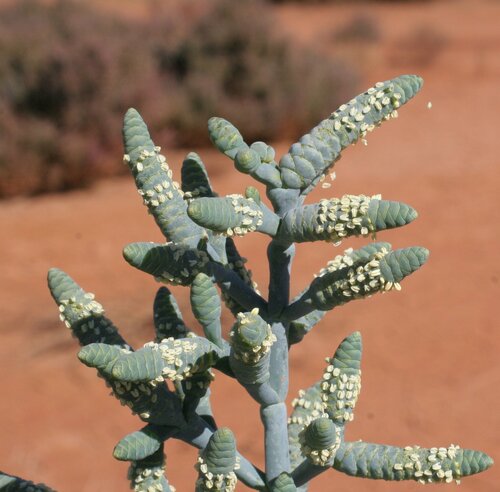
iNaturalist· cc-by-nc
(c) Pro Esteros, A.C., some rights reserved (CC BY-NC), uploaded by Pro Esteros, A.C.
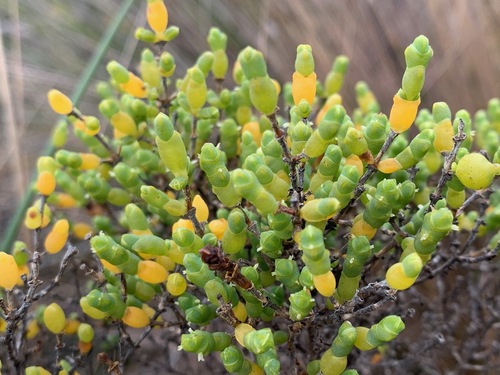
iNaturalist· cc-by-nc
(c) chriseggleston, some rights reserved (CC BY-NC)
iNaturalist· cc-by-nc
(c) jrebman, some rights reserved (CC BY-NC), uploaded by jrebman
Summary
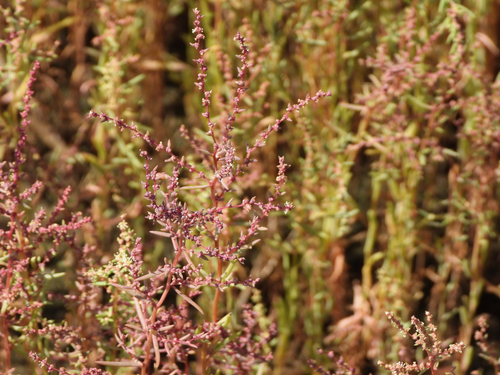
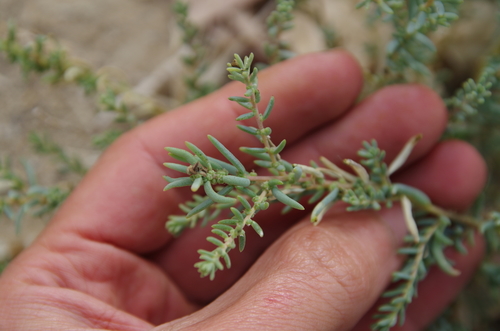
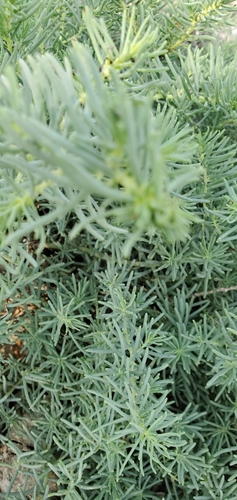
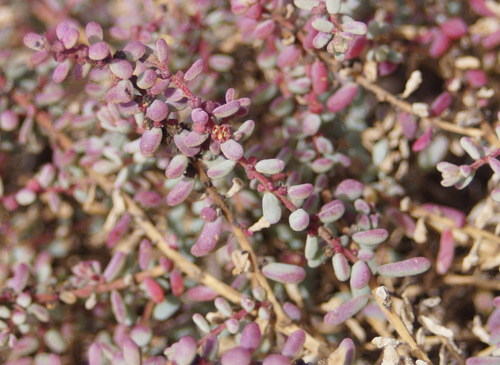
Source: WikipediaSalicornia bigelovii is a species of flowering plant in the family Amaranthaceae known by the common names dwarf saltwort and dwarf glasswort. It is native to coastal areas of the eastern and southern United States, Belize, and coastal Mexico (both the east and west coasts). It is a plant of salt marshes, a halophyte which grows in saltwater. It is an annual herb producing an erect, branching stem which is jointed at many internodes. The fleshy, green to red stem can reach about 60 cm in height. The leaves are usually small plates, pairs of which are fused into a band around the stem. The inflorescence is a dense, sticklike spike of flowers. Each flower is made up of a fused pocket of sepals enclosing the stamens and stigmas, and no petals. The fruit is an utricle containing tiny, fuzzy seeds. The southern part of the species range is represented by the Petenes mangroves of the Yucatán, where it is a subdominant plant associate in the mangroves.
Description
An annual plant growing to 0.3 m in height, hardy to UK zone 8. Flowering occurs from August to September with seeds ripening September to October. The species is hermaphrodite with wind pollination. It tolerates light sandy, medium loamy, and heavy clay soils across mildly acidic to basic pH ranges, including saline soils. The plant requires full sun and prefers moist soil.
Edible Uses
Young stems and seeds are both edible but extremely salty. Fresh stems can be eaten raw or cooked as a crunchy, saline vegetable similar to samphire, and they can also be pickled. The seeds are oily and nutritious: they contain about 30% edible oil and 35% protein. The oil is highly polyunsaturated with a fatty-acid composition similar to safflower oil (Carthamus tinctorius), a pleasant nut-like flavour, and a texture comparable to olive oil. Note that raw seed is inedible due to the presence of saponins, which remain in the seed-meal after oil extraction. Because of their high salt content, both stems and seeds should be consumed in moderation. Collecting sufficient seed quantities in the wild is difficult.
Traditional Uses
The stems are eaten cooked or pickled.
This uses section is brief — help expand it
Medicinal Uses
None known.
Known Hazards
The seed contains saponins. Although poisonous, saponins are poorly absorbed by the human body and so most pass through without harm. Saponins are quite bitter and can be found in many common foods such as some beans. They can be removed by carefully leaching the seed or flour in running water. Thorough cooking, and perhaps changing the cooking water once, will also normally remove most of them. However, it is not advisable to eat large quantities of food that contain saponins. Saponins are much more toxic to some creatures, such as fish, and hunting tribes have traditionally put large quantities of them in streams, lakes etc in order to stupefy or kill the fish.
Distribution
It is a Mediterranean climate plant.
Where It Grows
Bahamas, Caribbean, Cuba, Dominican Republic, Haiti, Lesser Antilles, Mexico*, North America*, Pakistan, USA, West Indies*,
Cultivation
Native to coastal salt marshes and tidal flats of the Gulf of Mexico and Pacific coasts. Often found in hypersaline environments unsuitable for most plants. Growth & Ecology: Annual halophyte adapted to tidal flooding and extreme salinity. Its tolerance of salt and capacity for oil-rich seed production make it of interest for sustainable agriculture. It can be cultivated under irrigation with seawater in saline soils. Requires full sun and moist to wet conditions.Recent research has shown this plant to have excellent potential as a commercial crop in arid and desert regions near the sea. It needs irrigation, which can be sustainably provided by using seawater. 10–40 cm tall, bushy and sprawling. USDA zones 8–11; frost-sensitive annual.
Propagation
No specific information is available for this species. It is suggested to sow seed in situ as soon as it is ripe where possible, otherwise sow in spring.
Other Uses
The seeds contain about 30% oil and are being explored for both food oil and biodiesel production. This species has been trialled as an experimental crop in saline agriculture, notably in Mexico and the Middle East. Traditionally, plant ashes were used in making soap and glass. The plant also provides habitat for shorebirds in coastal wetlands.
Notes
Also put in the family Chenopodiaceae.
Synonyms
Also Known As
Dwarf saltwort. Salicornia depressa Standl.
References (8)
- Centofanti, T. & Banuelos, G., 2019, Practical uses of Halophytic Plants as Sources of Food and Fodder. CAB International. p 328
- W. H. Emory, Rep. U.S. Mex. bound. 2(1):184. 1858 ("1859")
- Kermath, B. M., et al, 2014, Food Plants in the Americas: A survey of the domesticated, cultivated and wild plants used for Human food in North, Central and South America and the Caribbean. On line draft. p 776
- Martin, F.W. & Ruberte, R.M., 1979, Edible Leaves of the Tropics. Antillian College Press, Mayaguez, Puerto Rico. p 182 (As Salicornia bignelonii)
- Plants for a Future database, The Field, Penpol, Lostwithiel, Cornwall, PL22 0NG, UK. http://www.scs.leeds.ac.uk/pfaf/
Show all 8 references Hide references
- Plants of Haiti Smithsonian Institute http://botany.si.edu
- Wiersema, J. H. & Leon, B., 2013, World Economic Plants. A Standard Reference CRC Press. 2nd Ed. p 604
- World Checklist of Useful Plant Species 2020. Royal Botanic Gardens, Kew