Sacoglottis gabonensis
(Baill.) Urb.
iNaturalist· cc-by-nc
(c) Carel Jongkind, some rights reserved (CC BY-NC), uploaded by Carel Jongkind
iNaturalist· cc-by-nc
(c) Nick Helme, some rights reserved (CC BY-NC), uploaded by Nick Helme
iNaturalist· cc-by-nc
(c) Nick Helme, some rights reserved (CC BY-NC), uploaded by Nick Helme
Summary
Source: WikipediaSacoglottis gabonensis, commonly known as bitterbark tree or cherry mahogany is a medium to large sized evergreen tree within the Humiriaceae family. It is the only species within the genus that is native to tropical Africa. It occurs in rainforests or on sandy soils of Senegal eastwards to Angola in central Africa. It is traded locally and known in some countries under the name Ozouga.
Description
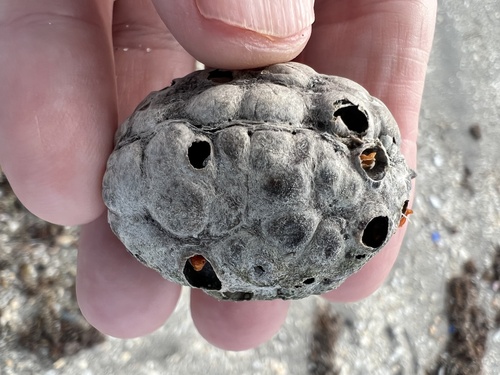
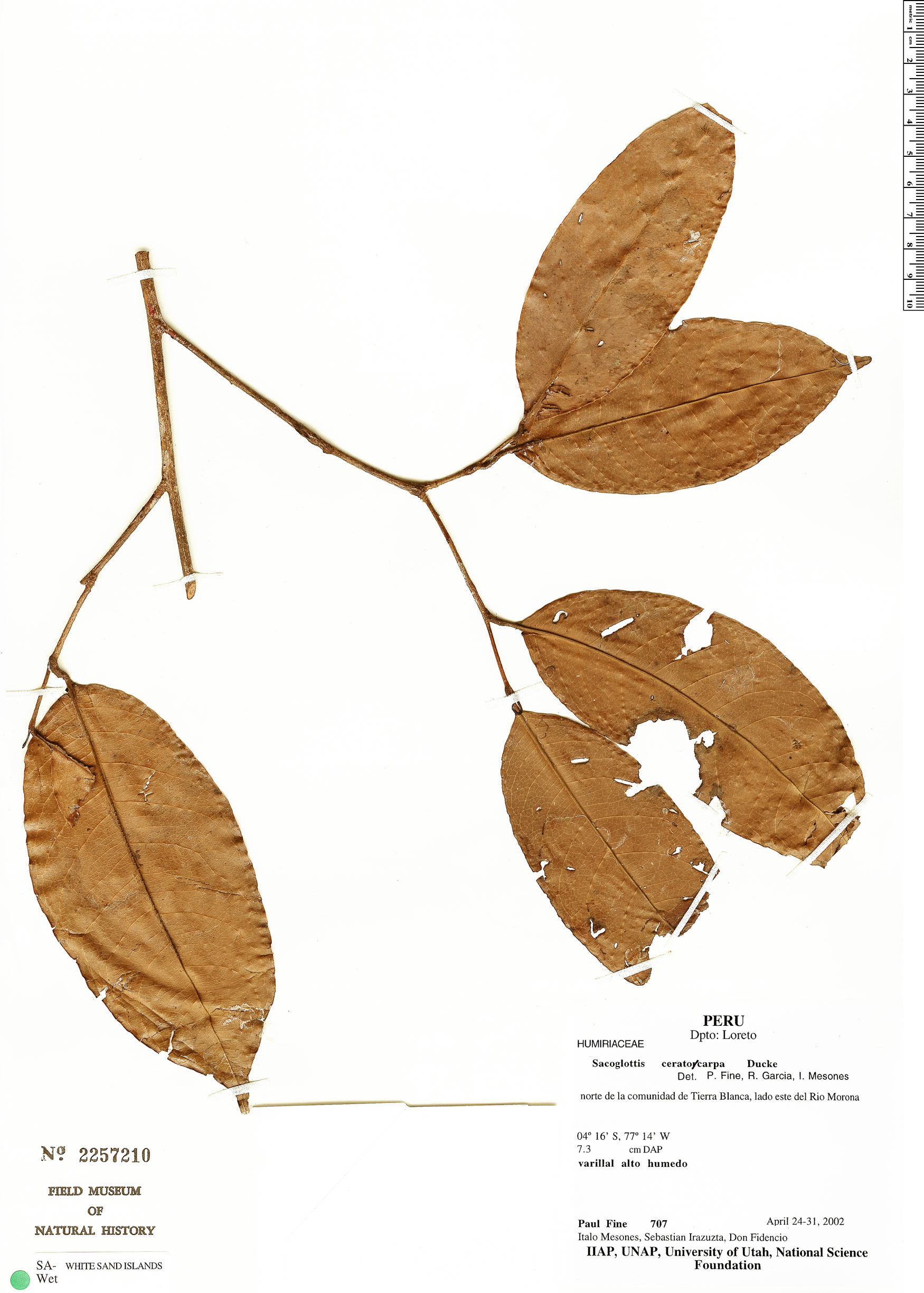
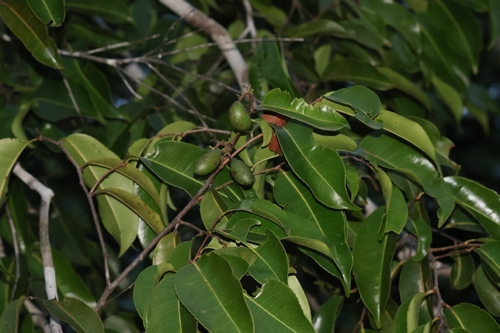
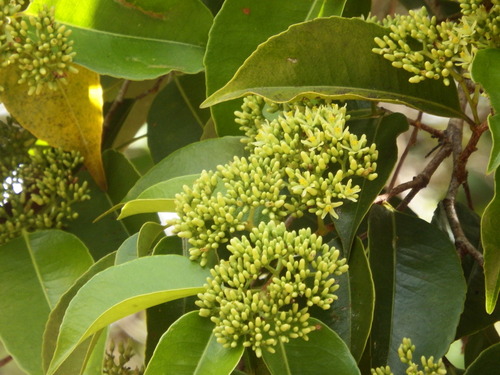
A tree. It grows 30 m high. The trunk can be 3 m around. It has buttresses. The crown is dense and dark green. The bark is reddish-brown. It peels off easily. The small branches are smooth. The leaves are 7.5-15 cm long by 3-6 cm wide. They are wedge shaped at the base and taper to the tip. They are slightly notched with shallow, forward pointing teeth. They are leathery. The flowers are crowded on branched stalks in the axils of leaves. The individual flowers are almost without stalks. The buds are green and the petals yellow. The fruit are oval or round and 2.5-4.5 cm long. They have a hard stone inside.
Edible Uses
Stem bark extracts is used as a palm wine additive for the preservation and potency of the alcoholic drink, while fruits of the species are favored by the African bush elephants at the Lope National Park. Some monkeys are also adapted to eat their hard seeds. Its wood is used in local marine related works such as canoe and boat making and bridge construction. It is also a good source of firewood.
Traditional Uses
The bark is used for adding a bitter taste to palm wine. The fruit is sweet and edible.
This uses section is brief — help expand it
Medicinal Uses
The stembark is a popular and much used medicine in west Africa, An infusion is used as an emetic and in the treatment of fevers, diarrhoea, gonorrhoea and abdominal pain - it is also sometimes used to treat hypertension and diabetes. A bark decoction is used to treat stomach-ache. It is used as a spice in food to induce heat in nursing and pregnant mothers. A decoction of the crushed bark, combined with the leaves of Dioscorea minutiflora, are used as a rectal enema to treat acute abdominal pain. Applied externally, a decoction of the stem bark is used to cure difficult cases of dermatitis. A stem bark decoction, combined with other plants, is added to bath water to treat ovarian troubles, vaginal infections and children with fevers. The diluted stem sap is used in hipbaths to promote muscle tone in women after childbirth. Bergenin, an isocoumarin, has been identified as the main active compound of the stem bark. The bark also contains appreciable amounts of tannins, with a trace of saponins. They have also revealed the presence of 2 cis/trans isomers of lignans (calopiptine and galgravine) which may play a role in cancer prevention. The stem bark extract is reported to have hepatoprotective properties. A stem bark extract added to drinking water of rats increased prothrombin and thrombin levels of blood plasma.
Known Hazards
The bark is used as a fish poison.
Distribution
It is a tropical plant. It grows in tropical rainforest. It especially grows in fresh water swamp forest. It suits humid locations.
Where It Grows
Africa, Angola, Benin, Cameroon, Central Africa, Central African Republic, CAR, Congo, Congo DR, Côte d'Ivoire, Gabon, Gambia, Ghana, Ivory Coast, Liberia, Nigeria, Senegal, Sierra Leone, Togo, West Africa,
Cultivation
Plants can be grown by seed. Seeds can take 4 months to germinate.
Propagation
Seeds take 2 - 4 months to germinate. The germination rate is quite low.
Other Uses
Bergenin, a compound found in the bark, protects stored vegetable oils against peroxidative deterioration over a period of time. The heartwood is reddish brown to purplish red; it is rather indistinctly demarcated from the narrow band of yellowish sapwood. The grain is straight to wavy; texture fine and even. The wood is heavy; hard; elastic; and durable, being resistant to termites, fungal and insect attacks. It seasons slowly, with a high risk of checking and distortion; once dry it is moderately stable in service. Considering its high density and hardness, the wood is not difficult to saw and work, but it has a severe blunting effect on saw teeth and cutting edges; stellite-tipped saw teeth and tungsten-carbide cutting edges are needed; it is difficult to nail and screw without pre-boring, but the holding power is good; gluing can be difficult because of the density of the wood; finishing is satisfactory, but the wood is not suited for veneer and plywood production. The wood is widely, though mainly locally, used for hydraulic works, house and bridge construction, carpentry, heavy flooring, poles, ship building, vehicle bodies, railway sleepers and mine props. It is suitable for interior trim, furniture, cabinet work, toys, novelties, turnery and pattern making. The wood is a good fuel and produces a valuable charcoal.
Production
Fruit develop slowly over the dry season.
Other Information
The fruit are eaten especially by children.
Notes
There are 9 Sacoglottis species. Most are in South America.
Also Known As
Akouapo, Atala, Edat, Edoue, Eloue, Fawere, Ozouga, Tiabutuo, Ugu
References (15)
- Abbiw, D.K., 1990, Useful Plants of Ghana. West African uses of wild and cultivated plants. Intermediate Technology Publications and the Royal Botanic Gardens, Kew. p 48
- Awodoyin, R.O., Olubode, O.S., Ogbu, J.U., Balogun, R.B., Nwawuisi, J.U. and Orji, K.O., 2015, Indigenous Fruit Trees of Tropical Africa: Status, Opportunity for Development and Biodiversity Management. Agricultural Sciences, 6, 31-41
- Burkill, H. M., 1985, The useful plants of west tropical Africa, Vol. 4. Kew.
- Dounias, E., 2008. Sacoglottis gabonensis (Baill.) Urb. [Internet] Record from Protabase. Schmelzer, G.H. & Gurib-Fakim, A. (Editors). PROTA (Plant Resources of Tropical Africa), Wageningen, Netherlands. < http://database.prota.org/search.htm>. Accessed 22 October 2009
- FAO Corporate Document Repository. The Major Significance of 'Minor' Forest Products. Appendix 3
Show all 15 references Hide references
- Heywood, V.H., Brummitt, R.K., Culham, A., and Seberg, O. 2007, Flowering Plant Families of the World. Royal Botanical Gardens, Kew. p 168
- Jardin, C., 1970, List of Foods Used In Africa, FAO Nutrition Information Document Series No 2.p 160
- JSTOR Global Plants edible
- Keay, R.W.J., 1989, Trees of Nigeria. Clarendon Press, Oxford. p 141
- Manvell, A., 2011, Use of Non-Timber Forest Products around Sapo National Park, Liberia (Report B) p 50
- Oteng-Amoako, A. A. (Ed.), 2006, 100 Tropical African Timber Trees from Ghana. Forestry Research Institute of Ghana. p 222
- Smith, N., Mori, S.A., et al, 2004, Flowering Plants of the Neotropics. Princeton. p 185
- Vivien, J. & Faure, J.J., 1985, Abres des forets dense d'Afrique Centrale. Agence de Cooperation Culturelle et Technique. Paris. p 222
- Voorhoeve, A. G., 1965, Liberian high forest trees. Pudoc p 133
- World Checklist of Useful Plant Species 2020. Royal Botanic Gardens, Kew