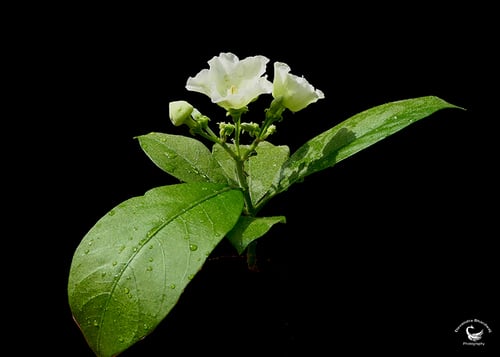
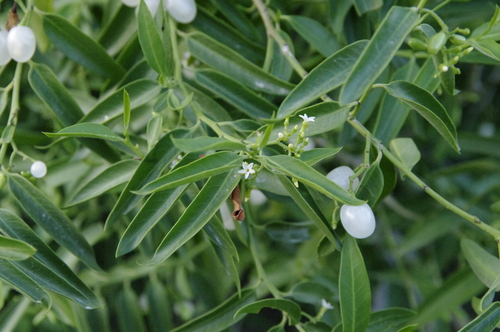
Saba senegalensis
(A. DC.) Pichon
Saba, Gumvine
iNaturalist· cc-by-nc-sa
(c) marcoschmidt.frankfurt, some rights reserved (CC BY-NC-SA), uploaded by marcoschmidt.frankfurt
iNaturalist· cc-by-nc-sa
(c) Enrico Castello, some rights reserved (CC BY-NC-SA), uploaded by Enrico Castello
iNaturalist· cc-by-nc
(c) Josh Davidson, some rights reserved (CC BY-NC), uploaded by Josh Davidson
Summary
Source: WikipediaSaba senegalensis, known as weda in the Moore, French, and English languages and madd in Wolof and laare in Pulaar, is a fruit-producing plant of the Apocynaceae family, native to the Sahel region of sub-Saharan Africa. It has several common names in various West African languages. The tree grows predominantly on riverbanks and in woodlands in Senegal, Mali, Guinea-Bissau, The Gambia, Burkina Faso, Somalia and Ivory Coast. It has been observed growing as vine up trees, as a small erect shrub, and oftentimes growing to the size of a large tree. ICRISAT has cited S. senegalensis as a useful food crop plant and as a tool to combat soil degradation in rural Africa.
Description
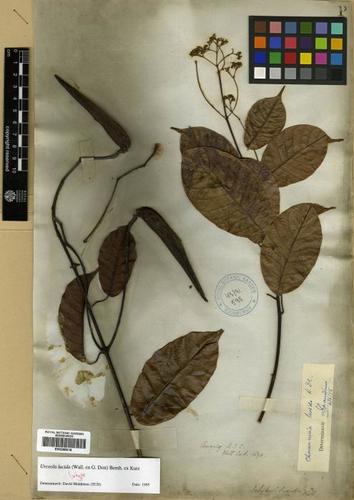
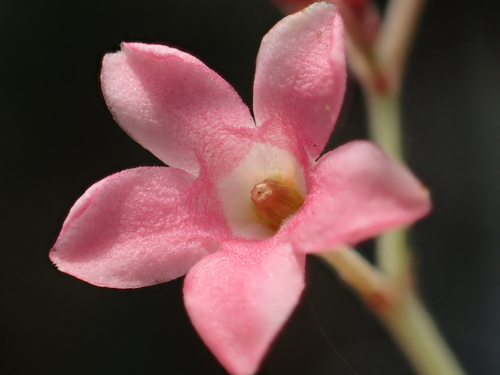
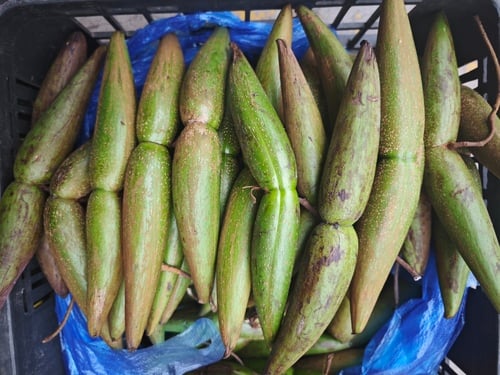
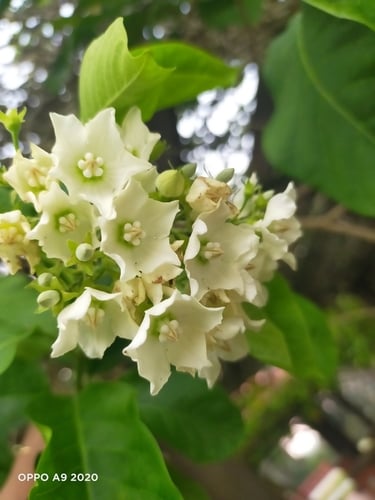
A creeper or liana. It grows over 40 m long. It can be 47 cm around. The trunk can be 20 cm across. The leaves are opposite and twice as long as wide. The flowers are in groups of 3-30 and a loose group. They are tube shaped and have a yellow throat. The fruit are oval and 6 cm long and 8 cm across. The pulp is yellow. It is sweet-sour, soft and edible.
Edible Uses
The fruit is eaten raw or used for drinks. The leaves are used for flavouring and the bark is also edible.
Traditional Uses
The fruit are eaten raw. They are also used for drinks.
This uses section is brief — help expand it
Medicinal Uses
The fruit is sold in local markets in West Africa.
Distribution
A tropical plant. It grows on the edges of forests in West Africa.
Where It Grows
Africa, Benin, Burkina Faso, Côte d'Ivoire, Gambia, Ghana*, Guinea, Guinée, Guinea-Bissau, Ivory Coast, Mali, Niger, Senegal, Tanzania, Togo, West Africa,
Cultivation
Plants are grown from seeds.
Propagation
Seed - traditionally, the seed is sown in situ or young seedlings are gathered from the wild and planted into gardens.
Other Uses
The plant contains an abundance of white sticky latex which hardens on exposure. It was exploited at one time for its rubber, but it was of poor quality and its main use was an adulterant of better quality rubbers. The latex can be used as an adhesive. Locally, the latex-filled sap is used to mend bicycle tires, football bladders, and so forth. The almost unbreakable vines are used to tie down the roofs of native huts. They are also made into ropes, with which to scale trees (for tapping palm-wine, for instance, or collecting nuts).
Other Information
The fruit are sold in local markets.
Nutrition
| Part | Moisture | kJ | kcal | Protein | Vit A | Vit C | Iron | Zinc |
|---|---|---|---|---|---|---|---|---|
| Fruit | 80 | 297 | 71 | 0.8 | — | 36 | 1 | — |
| Fruit | 80 | — | 71 | 0.8 | — | 48 | 1 | — |
Synonyms
Also Known As
Anoma, Bindipe, Bundok, Bu hindik, Buoca, Capdjone, Fole-de-elefanta, Fole, Foli, Foligros, Gulugu, Ibo gidi, Lare, Liane goine, Mad, Ora, Sagba, Sono-nantin, Tole, Wedga, Zaban
References (32)
- Abbiw, D.K., 1990, Useful Plants of Ghana. West African uses of wild and cultivated plants. Intermediate Technology Publications and the Royal Botanic Gardens, Kew. p 48
- Asase, A. & Oteng-Yeboah, A. A., 2012, Plants used in Wechiau Community Hippotamus Sanctuary in Northwest Ghana. Ethnobotany research & Applications 10:605-618
- Batawila, K., et al, 2007, Diversite et gestion des legumes de cueillete au Togo. African Journal of Food, Agriculture, Nutrition and Development 7( 3& 4): 64
- Belem, B., et al, 2007, Use of Non Wood Forest Products by local people bordering the “Parc National Kaboré Tambi”, Burkina Faso. The Journal of Transdisciplinary Environmental Studies vol. 6, no. 1 p 9
- Belem, M., et al, 2017, Strategy of Conservation and Protection of Wild Edible Plants Diversity in Burkina Faso. ANADOLU 27 (2) 2017, 82- 90
Show all 32 references Hide references
- Burkill, H. M., 1985, The useful plants of west tropical Africa, Vol. 1. Kew.
- Busson, 1965,
- Catarino, L., et al, 2016, Ecological data in support of an analysis of Guinea-Bissau's medicinal flora. Data in Brief 7 (2016):1078-1097
- Codjia, J. T. C., et al, 2003, Diversity and local valorisation of vegetal edible products in Benin. Cahiers Agricultures 12:1-12
- Dalziel, J. M., 1937, The Useful plants of west tropical Africa. Crown Agents for the Colonies London.
- Diarra, N. et al, 2016, Etude ethnobotanique des plantes alimentaires utilisées en période de soudure dans les régions Sud du Mali. Int. J. Biol. Chem. Sci. 10(1): 184-197
- Djihounouck, Y., et al, 2018, Diversité Et Importance Socio-Economique Des Espèces Fruitières Sauvages Comestibles En Zone Kasa (Sud-Ouest Du Sénégal). European Scientific Journal December 2018 edition Vol.14, No.36 ISSN: 1857 – 7881
- Djihounouck, Y., et al, 2021, Ethnobotanical Uses of Non-cultivated Edible Fruit Species in the Department of Oussouye (South Senegal). Journal of Food Research; Vol. 10, No. 4 p 20
- Food Composition Tables for use in Africa FAO http://www.fao.org/infoods/directory No. 941
- Gallagher, D. E., 2010, Farming beyond the escarpment: Society, Environment, and Mobility in Precolonial Southeastern Burkina Faso. PhD University of Michigan.
- Gueye, M., et al, 2014, Wild Fruits Traditionally Gathered by the Malinke Ethnic Group in the Edge of Niokolo Koba Park (Senegal). American Journal of Plant Sciences 5, 1306-1317
- Guinko, S. & Pasgo, L. J., Harvesting and marketing of edible products from local woody species in Zitenga, Burkina Faso. Unasylva - No. 168
- http://www.naturalhub.com/natural_food_guide_fruits_uncommon_Landolphia_spp.htm (As Landolphia senegalensis)
- INFOODSUpdatedFGU-list.xls
- Janick, J. & Paul, R. E. (Eds.), 2008, The Encyclopedia of Fruit & Nuts. CABI p 76
- Jardin, C., 1970, List of Foods Used In Africa, FAO Nutrition Information Document Series No 2.p 160
- JSTOR Global Plants edible
- Lamien-Meda, A., et al, 2008, Polyphenol Content and Antioxidant Activity of Fourteen Wild Edible Fruits from Burkina Faso. Molecules 2008,13, 581-594
- Le Houerou, H. N., (Ed.), 1980, Browse in Africa. The current state of knowledge. International Livestock Centre for Africa, Ethiopia. p 161
- Martin, F. W., et al, 1987, Perennial Edible Fruits of the Tropics. USDA Handbook 642 p 19
- Mem. Inst. Franc. Afrique Noire 35:316. 1953
- N'Diaye, M., et al.,2003, Principle fruits of gathering consumed and marketed in Guinea. Fruits, Vol. 58: 99-116 (As var. glabiflora)
- Peters, C. R., O'Brien, E. M., and Drummond, R.B., 1992, Edible Wild plants of Sub-saharan Africa. Kew. p 60
- Sambou, A., et al, 2016, The contribution of trees and palms to a blanced diet in three rural villages of the Fatick Province, Senegal. FORESTS, TREES AND LIVELIHOODS, 2016 VOL. 25, NO. 3, 212–225
- Segnon, A. C. & Achigan-Dako, E. G., 2014, Comparative analysis of diversity and utilization of edible plants in arid and semi-arid areas in Benin. Journal of Ethnobiology and Ethnomedicine 2014, 10:80
- World Checklist of Useful Plant Species 2020. Royal Botanic Gardens, Kew
- www.worldagroforestrycentre.org/treedb/