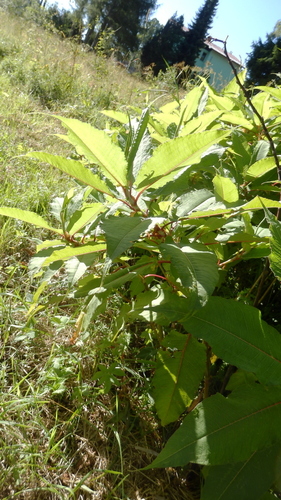
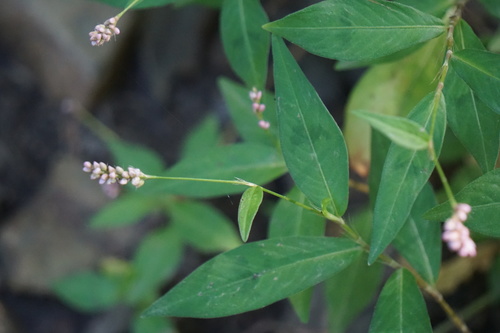
Rumex maritimus
L.
Golden dock
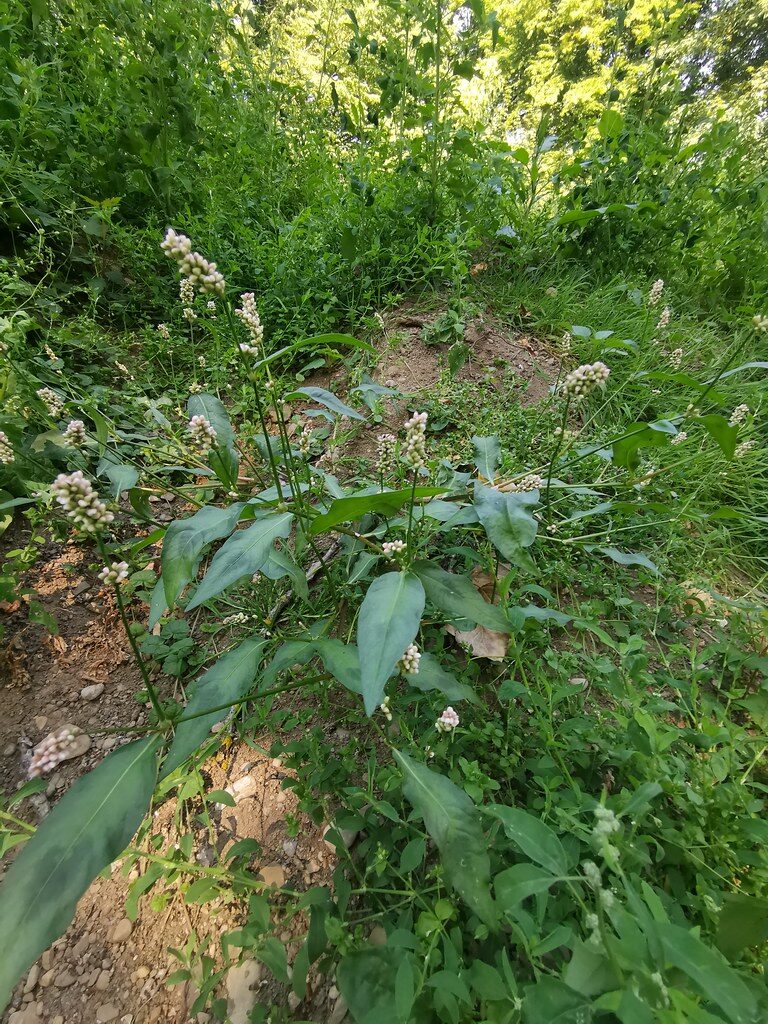
iNaturalist· cc-by
(c) Nuuuuuuuuuuul, some rights reserved (CC BY)
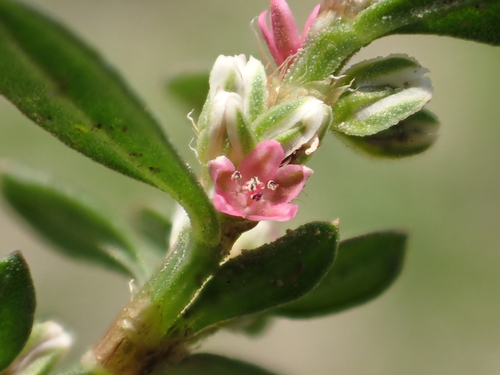
iNaturalist· cc-by-nc
(c) Sebastian J. Dunkl, some rights reserved (CC BY-NC), uploaded by Sebastian J. Dunkl
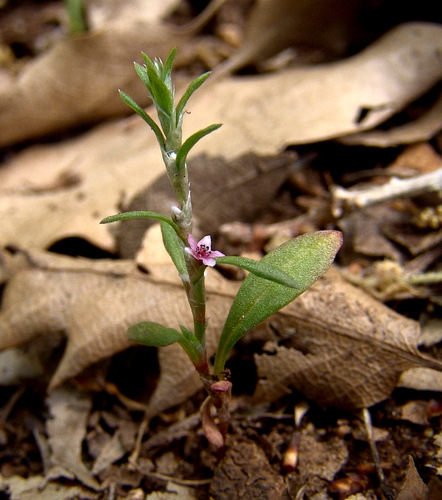
iNaturalist· cc-by-nc
(c) Sebastian J. Dunkl, some rights reserved (CC BY-NC), uploaded by Sebastian J. Dunkl
Summary
Source: WikipediaRumex maritimus, commonly called golden dock, bristle dock, or seashore dock, is an annual plant species of the genus Rumex. Rumex D maritimus grows in Argentina, Burma, Canada, China, and the United States. It is native to Canada and most of the 48 states. The life span of Rumex maritimus is rarely biennial in moist environments. This herb belongs to the family Polygonaceae.
Description
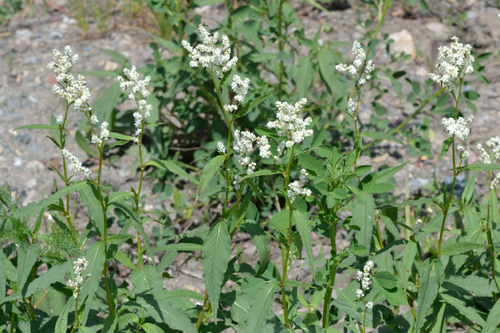
An erect herb. It has a rootstock that lasts from year to year. It grows 25-70 cm tall. The leaves are narrowly oval and heart shaped at the base. The lower leaves have long stalks and upper leaves are small and have short stalks. The flowers are in rings. The fruit are small brown nutlets.
Edible Uses
Leaves are edible when cooked. Seed is cooked and can be ground into a powder, mixed with water, and cooked like porridge.
Traditional Uses
The leaves are eaten cooked as a vegetable. They are usually mixed with other leaves. They are used in curries.
This uses section is brief — help expand it
Medicinal Uses
The leaves are applied externally to burns. The seeds are aphrodisiac and contain about 5% tannin. The plant is considered cooling, and an infusion is used to treat bloat.
Known Hazards
Plants can contain quite high levels of oxalic acid, which is what gives the leaves of many members of this genus an acid-lemon flavour. Perfectly alright in small quantities, the leaves should not be eaten in large amounts since the oxalic acid can lock-up other nutrients in the food, especially calcium, thus causing mineral deficiencies. The oxalic acid content will be reduced if the plant is cooked. People with a tendency to rheumatism, arthritis, gout, kidney stones or hyperacidity should take especial caution if including this plant in their diet since it can aggravate their condition.
Distribution
It is a temperate plant. It usually grows in marshy places. In Argentina it grows below 500 m above sea level.
Where It Grows
Argentina, Asia, Bangladesh, Britain, Central Asia, Chile, China, Europe, Himalayas, India, Kazakhstan, Korea, Mongolia, Myanmar, North America, Northeastern India, NW India, Russia, SE Asia, Siberia, South America, Taiwan, USA,
Cultivation
Succeeds in most soils but prefers a deep fertile moderately heavy soil that is humus-rich, moisture-retentive but well-drained and a position in full-sun or part shade. Plants are likely to require a moist to wet soil. Closely related to R. palustris.
Propagation
Sow seed in spring in situ.
Other Uses
No dye data specific to this species has been recorded, but roots of many plants in this genus yield dark green to brown and dark grey dyes without the need for a mordant.
Other Information
It is sold in local markets.
Notes
There are about 200 Rumex species.
Synonyms
Also Known As
Ban palang, Bijband, Bon palong, Bon suka sak, Bun-palang, Jangali palak, Jangli palak, Jub-palum, Jungli palak, Kali hulli, Khattikan, Maitha sikhia, Okung, Talbarua, Torong khongchak
References (17)
- Ambasta S.P. (Ed.), 2000, The Useful Plants of India. CSIR India. p 534
- BARC, 2016, State of Biodiversity for Food and Agriculture in Bangladesh. Bangladesh Agricultural Research Council.
- Chowdhury, M. & Mukherjee, R., 2012, Wild Edible Plants Consumed by Local Communities of Maldah of West Bengal, India. Indian J.Sci.Res.3(2) : 163-170
- Deka, N. & Devi, N., 2015, Wild edible aquatic and marshland angiosperms of Baka district, BTC area, Assam, India. Asian J. Plant Sci. Res. 5(1):32-48
- Devi, O.S., P. Komor & D. Das, 2010, A checklist of traditional edible bio-resources from Ima markets of Imphal Valley, Manipur, India. Journal of Threatened Taxa 2(11): 1291-1296
Show all 17 references Hide references
- Dobriyal, M. J. R. & Dobriyal, R., 2014, Non Wood Forest Produce an Option for Ethnic Food and Nutritional Security in India. Int. J. of Usuf. Mngt. 15(1):17-37
- Flora of China @ efloras.org Volume 5
- HOOPER,
- Marandi, R. R. & Britto, S. J., 2015, Medicinal Properties of Edible Weeds of Crop Fields and Wild plants Eaten by Oraon Tribals of Latehar District, Jharkhand. International Journal of Life Science and Pharma Research. Vo. 5. (2) April 2015
- Moerman, D. F., 2010, Native American Ethnobotany. Timber Press. p 498
- Patiri, B. & Borah, A., 2007, Wild Edible Plants of Assam. Geethaki Publishers. p 117
- Pegu, R., et al, 2013, Ethnobotanical study of Wild Edible Plants in Poba Reserved Forest, Assam, India. Research Journal of Agriculture and Forestry Sciences 1(3):1-10
- Plants for a Future database, The Field, Penpol, Lostwithiel, Cornwall, PL22 0NG, UK. http://www.scs.leeds.ac.uk/pfaf/
- Rashid, A., Anand, V.K. & Serwar, J., 2008, Less Known Wild Plants Used by the Gujjar Tribe of District Rajouri, Jammu and Kashmir State. International Journal of Botany 4(2):219-244
- Singh, H.B., Arora R.K.,1978, Wild edible Plants of India. Indian Council of Agricultural Research, New Delhi. p 34
- Sinha, R. & Lakra, V., 2007, Edible weeds of tribals in Jharkhand, Orissa and West Bengal. Indian Journal of Traditional Knowledge 6(1) January 2007 pp 217-222
- Taram, M., et al, 2018, Wild Food Plant Resources of Komkar Adi Tribe of Upper Siang District in Arunachal Pradesh, India. Bulletin of Arunachal Forest Research, Vol. 33(2), 27-35