Rumex conglomeratus
Murray
Sharp dock, Clustered Dock
iNaturalist· cc0
no rights reserved, uploaded by Piermario Maculan
iNaturalist· cc-by-nc-sa
(c) Vincent Luis, some rights reserved (CC BY-NC-SA), uploaded by Vincent Luis
iNaturalist· cc-by-sa
(c) Douglas Goldman, some rights reserved (CC BY-SA), uploaded by Douglas Goldman
Summary
Source: WikipediaRumex conglomeratus, known as clustered dock and sharp dock, is a plant of the family Polygonaceae. It is an annual or biennial plant growing up to 100 cm high. A native of Europe, Asia and North Africa, it has also been introduced into North America.
Description
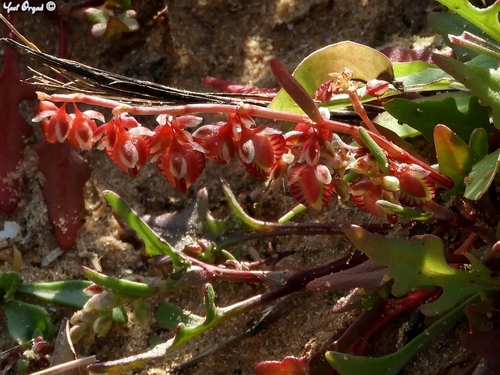
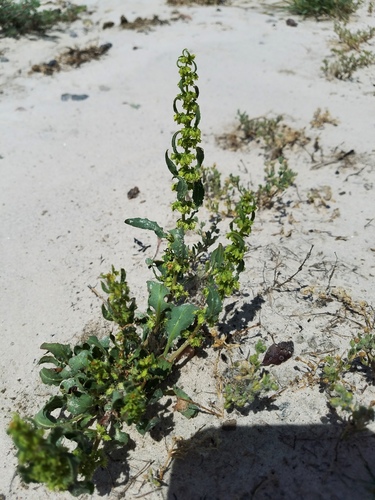
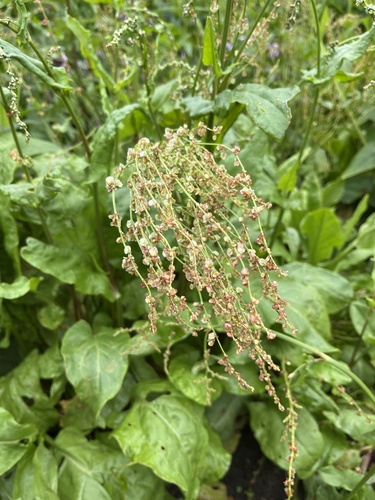
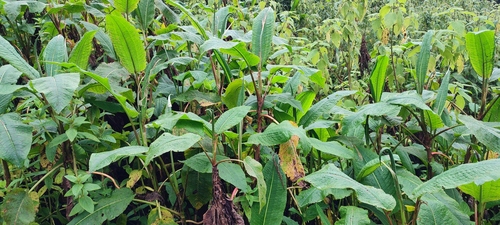
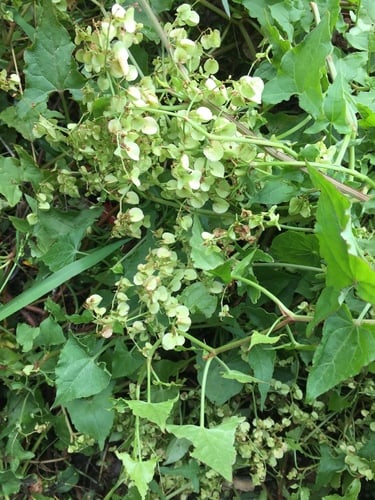
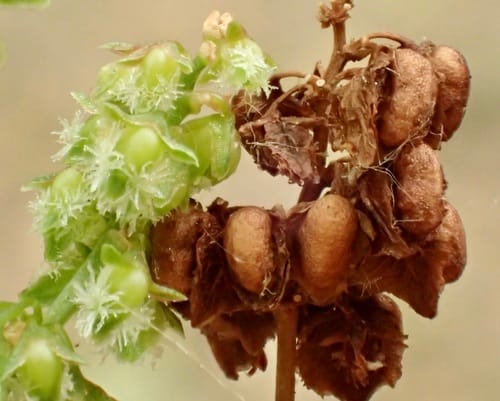
A herb which keeps growing from year to year. It grows about 50 cm high. It branches in the lower half. The branches spread at 30°-90°. The leaf stalks of the lower leaves are as long as the blade. These lower leaves are narrowly oval and 10-25 cm long by 2.5-3.5 cm wide. The leaves get more narrow up the plant and the base becomes heart shaped. The flower is branched and has many flowers in rings. There are small leaves around the lower flowers. The fruit has oblong narrow valves with rounded ends. The nut is 1.5-2 mm long and dark brown.
Edible Uses
The leaves are cooked and eaten as greens, though they are quite bitter, becoming more so as they age. The seeds can be eaten raw or cooked — they can be ground into a powder and added to flours for making bread, biscuits, and similar foods, though they are small and fiddly to harvest.
Traditional Uses
The leaves are cooked and eaten as greens. The leaves are used for sarma in Turkey. They are rolled around a filling of rice or minced meat. They are fried with eggs.
Medicinal Uses
The root is antiscorbutic and astringent. An infusion taken internally is used to treat scurvy and as a general blood cleanser, and is also useful in treating bleeding. Externally, the root infusion can be made into an ointment for cutaneous eruptions. The root is harvested in early spring and dried for later use. A decoction of the leaves is used in the treatment of various skin diseases.
Known Hazards
Plants can contain quite high levels of oxalic acid, which is what gives the leaves of many members of this genus an acid-lemon flavour. Perfectly alright in small quantities, the leaves should not be eaten in large amounts since the oxalic acid can lock-up other nutrients in the food, especially calcium, thus causing mineral deficiencies. The oxalic acid content will be reduced if the plant is cooked. People with a tendency to rheumatism, arthritis, gout, kidney stones or hyperacidity should take especial caution if including this plant in their diet since it can aggravate their condition.
Distribution
It is a temperate plant. It grows in damp pastures. Tasmania Herbarium.
Where It Grows
Afghanistan, Africa, Albania, Algeria, Argentina, Australia, Austria, Balkans, Belarus, Bolivia, Brazil, Britain, Bulgaria, Canary Islands, Caucasus, Central Asia, Chile, Colombia, Crete, Cyprus, Czech Republic, Denmark, Ecuador, Europe*, Finland, France, Georgia, Germany, Greece, Guatemala, Haiti, Himalayas, Hungary, Iran, Iraq, Ireland, Italy, Japan, Kazakhstan, Korea, Kyrgyzstan, Lebanon, Libya, Mediterranean*, Mexico, Middle East, Morocco, Netherlands, New Zealand, Norfolk Island, North Africa, North America, Norway, Oman, Pakistan, Palestine, Peru, Poland, Portugal, Romania, Saudi Arabia, South Africa, Southern Africa, Spain, Switzerland, Syria, Tajikistan, Tasmania, Tunisia, Turkey, Türkiye, Turkmenistan, Ukraine, Uruguay, Uzbekistan, USA, Venezuela, Yugoslavia,
Cultivation
Succeeds in most soils but prefers a deep fertile moderately heavy soil that is humus-rich, moisture-retentive but well-drained and a position in full-sun or part shade. This species is often confused with R. sanguineus.
Propagation
Sow seed in spring directly in situ. Can also be propagated by division in spring.
Other Uses
Dark green to brown and dark grey dyes can be obtained from the roots of many species in this genus without the need for a mordant.
Other Information
Leaves are sold in local markets.
Notes
There are about 200 Rumex species.
Synonyms
Also Known As
Eksikulak, Eksimek, Ghvalo, Kuzukulagi, Labada, Lengua de vaca, Romaza, Tirso, Tirsik, Vinagrera, Yabani ispanak
References (25)
- Caballero, J. N., & Mapes, C. S., 1985, Gathering and Subsistence Patterns among the P'urhepecha Indians of Mexico. J. Ethnol. 5(1): 31-47
- Cordero, S. E., Abello, L. A., & Galvez, F. L., 2017, Plantas silvestres comestibles y medicinales de Chile y otras partes del mundo. CORMA p 232
- Curtis, W.M., 1993, The Student's Flora of Tasmania. Part 3 St David's Park Publishing, Tasmania, p 585
- Dashorst, G.R.M., and Jessop, J.P., 1998, Plants of the Adelaide Plains & Hills. Botanic Gardens of Adelaide and State Herbarium. p 52
- Dogan, Y., et al, 2015, Of the importance of a leaf: the ethnobotany of sarma in Turkey and the Balkans. Journal of Ethnobiology and Ethnomedicine, 11:56
Show all 25 references Hide references
- Ertug, F, Yenen Bitkiler. Resimli Türkiye Florası -I- Flora of Turkey - Ethnobotany supplement
- FAO, 1988, Traditional Food Plants, FAO Food and Nutrition Paper 42. FAO Rome p 433
- Flora of Australia Volume 49, Oceanic Islands 1, Australian Government Publishing Service, Canberra. (1994) p 102
- Fox, F. W. & Young, M. E. N., 1982, Food from the Veld. Delta Books. p 306
- Gunes, S. et al, 2018, Survey of wild food plants for human consumption in Karaisali (Adana-Turkey). Indian Journal of Traditional Knowledge. Vol. 17(2), April 2018, pp 290-298
- Hussey, B.M.J., Keighery, G.J., Cousens, R.D., Dodd, J., Lloyd, S.G., 1997, Western Weeds. A guide to the weeds of Western Australia. Plant Protection Society of Western Australia. p 200
- Hyde-Wyatt, B.H. & Morris D.I., 1975, Tasmanian Weed Handbook. Dept of Ag Tasmania. p 24, 59
- Kew Plants of the World Online
- Lamp, C & Collet F., 1989, Field Guide to Weeds in Australia. Inkata Press. p 248
- Luczaj, L. et al, 2017, Comfrey and Buttercup Eaters: Wild Vegetables of the Imereti Region in Western Georgia, Caucasus. Economic Botany, 71(2), 2017, pp. 188–193
- Malezas Comestibles del Cono Sur, INTA, 2009, Buernos Aires
- Moerman, D. F., 2010, Native American Ethnobotany. Timber Press. p 495
- Paczkowska, G . & Chapman, A.R., 2000, The Western Australian Flora. A Descriptive Calatogue. Western Australian Herbarium. p 461
- Pieroni, A. et al, 2014, Resilience at the border: traditional botanical knowledge among Macedonians and Albanian living in Gollobordo, Eastern Albania. Journal of Ethnobiology and Ethnomedicine. 10:31
- Plants for a Future database, The Field, Penpol, Lostwithiel, Cornwall, PL22 0NG, UK. http://www.scs.leeds.ac.uk/pfaf/
- Prodr. stirp. gott. 52. 1770
- Ruiters-Welcome, A. K., 2019, Food plants of southern Africa. Ph.D. thesis. Univ. of Johannesburg p 91
- Tasmanian Herbarium Vascular Plants list p 45
- Tardio, J., et al, Ethnobotanical review of wild edible plants in Spain. Botanical J. Linnean Soc. 152 (2006), 27-71
- Welcome, A. K. & Van Wyk, B.-E., 2019, An inventory and analysis of the food plants of southern Africa. South African Journal of Botany 122 (2019) 136–179