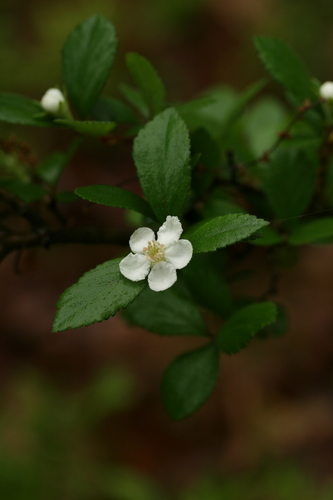
Rubus crataegifolius
Bunge
Korean raspberry, Hawthorn raspberry
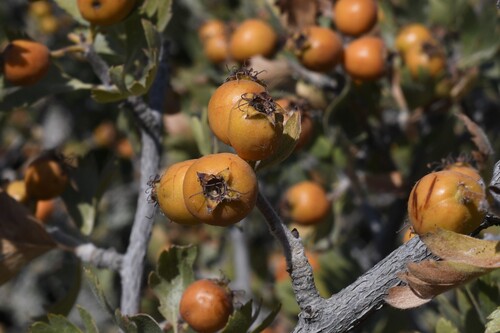
iNaturalist· cc-by-nc-nd
(c) Paul B., some rights reserved (CC BY-NC-ND), uploaded by Paul B.
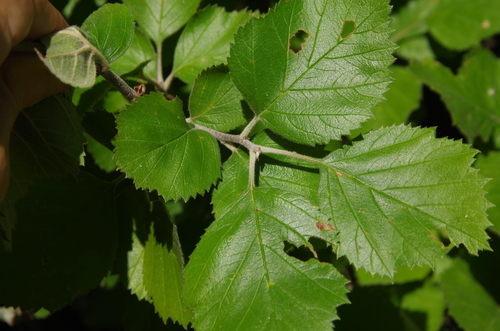
iNaturalist· cc-by
(c) Nina Filippova, some rights reserved (CC BY), uploaded by Nina Filippova
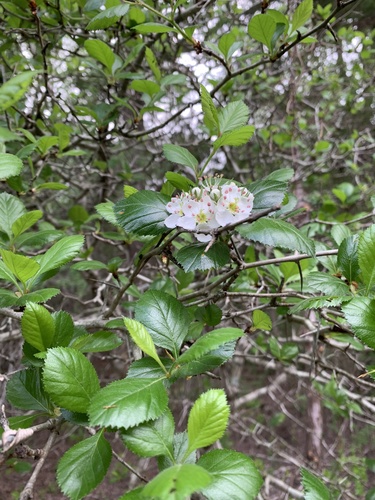
iNaturalist· cc-by
(c) Repina Tatyana, some rights reserved (CC BY), uploaded by Repina Tatyana
Summary
Source: WikipediaRubus crataegifolius, also called Korean raspberry, is a species of raspberry native to East Asia. It is a shrub growing to 1–2 m (rarely 3 m) tall. The leaves are 5–12 cm long and 5–8 cm broad, palmately lobed with three or five lobes, and a serrated margin. The flowers are 1–1.5 cm diameter, with five white petals. The fruit is an aggregate fruit 1 cm diameter, made up of numerous drupelets. The species grows on forest margins and mountain slopes, in areas with moist and well-drained soil. Its fruit is used for food and is sometimes cultivated; the cultivar 'Jingu Jengal' has been selected for its large fruit. Root extracts have been found to contain substances with anti-inflammatory effects in mice.
Description
A shrub. It grows 2.4 m high and spreads 1.5 m wide. The leaves are deeply lobed. The flowers are small and white. The fruit are large, juicy and bright red.
Edible Uses
The fruit can be eaten raw or cooked. It is a large, transparent raspberry with a sweet, agreeable flavour; the dark red fruit is about 10mm in diameter. The leaves may also be edible, though this is uncertain.
Traditional Uses
The ripe fruit are eaten raw. They are also used for juice and to make wine. The young shoots are used as a vegetable.
This uses section is brief — help expand it
Medicinal Uses
None known.
Distribution
It is a temperate plant. In north China it grows between 300-2,500 m above sea level. It suits hardiness zones 5-9.
Where It Grows
Asia, Australia, China, Japan, Korea, Manchuria, Mongolia, Russia, USA,
Cultivation
Easily grown in a good well-drained loamy soil in sun or semi-shade. Occasionally cultivated for its edible fruit, there is at least one named variety. 'Jingu Jengal' is a high-yielding selection from Korea with larger fruits, up to 2g in weight. This species is a raspberry with biennial stems, it produces a number of new stems each year from the perennial rootstock, these stems fruit in their second year and then die. Plants in this genus are notably susceptible to honey fungus.
Propagation
Seed requires stratification and is best sown in early autumn in a cold frame. Stored seed needs one month stratification at about 3°c and should be sown as early as possible in the year. Prick out seedlings when large enough to handle and grow on in a cold frame, then plant out into permanent positions in late spring of the following year. Cuttings of half-ripe wood can be taken in July/August in a frame. Tip layering in July, planting out in autumn. Division can be done in early spring or just before leaf-fall in autumn.
Other Uses
A purple to dull blue dye is obtained from the fruit.
Other Information
It is cultivated.
Notes
There are about 250 Rubus species.
Dangerous Lookalikes
This plant can be confused with the following toxic species. Always verify identification carefully before consuming any wild plant.
Red Baneberry
Actaea rubra
Walter Siegmund (talk)
Korean raspberry
Rubus crataegifolius
(c) Paul B., some rights reserved (CC BY-NC-ND), uploaded by Paul B.
Red Baneberry: Short herbaceous plant (no thorns), berries on thick red stems, each berry has a single seed, compound sharply-toothed leaves.
Korean raspberry: Thorny woody canes (brambles), aggregate berry made of many drupelets, berries pull easily from receptacle.
Synonyms
Also Known As
Chattalgi, Kuma-ichigo, Santtalgi, Ttalgi
References (18)
- Chen, B. & Qiu, Z., Consumer's Attitudes towards Edible Wild Plants, Ishikawa Prefecture, Japan. p 24 www.hindawi.com/journals/ijfr/aip/872413.pdf
- Cundall, P., (ed.), 2004, Gardening Australia: flora: the gardener's bible. ABC Books. p 1284
- Enum. pl. China bor. 24. 1833 (Mem. Acad. Imp. Sci. St.-Petersbourg Divers Savans 2:98. 1835)
- Facciola, S., 1998, Cornucopia 2: a Source Book of Edible Plants. Kampong Publications, p 208
- Flora of China @ efloras.org Volume 9
Show all 18 references Hide references
- Hedrick, U.P., 1919, (Ed.), Sturtevant's edible plants of the world. p 575
- Hedrick, U.P., 1919, (Ed.), Sturtevant's edible plants of the world. p 578 (As Rubus morifolius)
- Hwang, H., et al, 2013, A Study on the Flora of 15 Islands in the Western Sea of Jeollanamdo Province, Korea. Journal of Asia-Pacific Biodiversity Vol. 6, No. 2 281-310
- Hwang, HS, et al, 2014, Distribution characteristics of plant in the Ungseokbong Mountain, Gyeongsangnam-do, Korea. Journal of Asia-Pacific Biodiversity. 7(2014) e164-e178
- Kim, H. & Song, M., 2013, Ethnobotanical analysis for traditional knowledge of wild edible plants in North Jeolla Province (Korea). Genetic. Resour. Crop Evol. (2013) 60:1571-1585
- Mansfield's Encyclopedia of Agricultural and Horticultural Crops
- Ong, H. G., et al, 2015, Ethnobotany of the wild edible plants gathered in Ulleung Island, South Korea. Genet Resourc Crop Evol. Springer (As Rubus takesimensis)
- Plants for a Future database, The Field, Penpol, Lostwithiel, Cornwall, PL22 0NG, UK. http://www.scs.leeds.ac.uk/pfaf/
- Song, M., et al, 2013, Traditional knowledge of wild edible plants in Jeju Island, Korea. Indian Journal of Traditional Knowledge. 12(2) pp 177-194
- Tanaka,
- Uphof,
- Williams, D., 2017, Ainu Ethnobiology. Contributions in Ethnobiology. Society of Ethnobiology. p 140
- www.eplantscience.com