Rubia argyi
(H. Lev. & Vaniot) Hara ex Lauener
Akane
iNaturalist· cc0
no rights reserved, uploaded by 葉子
iNaturalist· cc-by-nc
(c) MP Zhou, some rights reserved (CC BY-NC)
iNaturalist· cc-by-nc
(c) MP Zhou, some rights reserved (CC BY-NC)
Summary
Source: WikipediaRubia argyi is a species of flowering plant of the family Rubiaceae. Its common names may include East Asian madder. It occurs in southern and eastern China, Taiwan, Japan, and Korea. Rubia argyi is a herbaceous, perennial vine. The stem can grow to a length of 2 m (6 ft 7 in) or more.
Description
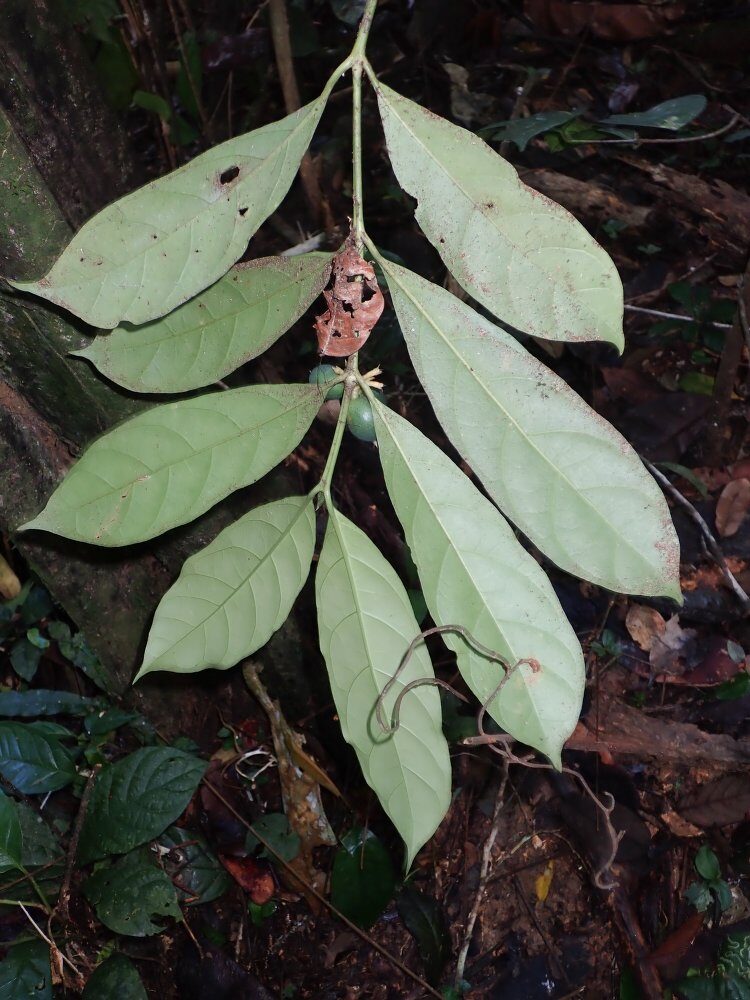
A climber or vine. It keeps growing from year to year. The stems are 2 m or more long and 4 angled. The leaves are mostly in rings of four. The leaves are broadly oval to heart shaped. They are 2-5 cm long by 2-4 cm wide. The flowers are in groups. The fruit are black.
Edible Uses
The fruit and leaves are eaten.
Distribution
It is a temperate plant. It grows in thickets and hedges. In China it grows between 300-3,400 m above sea level. In Sichuan.
Where It Grows
Asia, China, Japan, Korea, Taiwan,
Production
In China plants flower July to October and fruit August to November.
Notes
There are about 60 Rubia species. It has anticancer properties.
Synonyms
References (4)
- Kim, H. & Song, M., 2013, Ethnobotanical analysis for traditional knowledge of wild edible plants in North Jeolla Province (Korea). Genetic. Resour. Crop Evol. (2013) 60:1571-1585 (As Rubia akane)
- Kintzios, S. E., 2006, Terrestrial Plant-Derived Anticancer Agents and Plant Species Used in Anticancer research. Critical Reviews in Plant Sciences. 25: pp 79-113 (As Rubia akane)
- J. Jap. Bot. 13:781. 1937 (As Rubia akane)
- Plants for a Future database, The Field, Penpol, Lostwithiel, Cornwall, PL22 0NG, UK. http://www.scs.leeds.ac.uk/pfaf/ (As Rubia akane)