Ricinodendron heudelotii subsp. africanum
(Baill.) Heckel, (Muell.Arg.) J. Leonard
Zambezi Almond, Mugongo Nut
iNaturalist· cc-by-nc
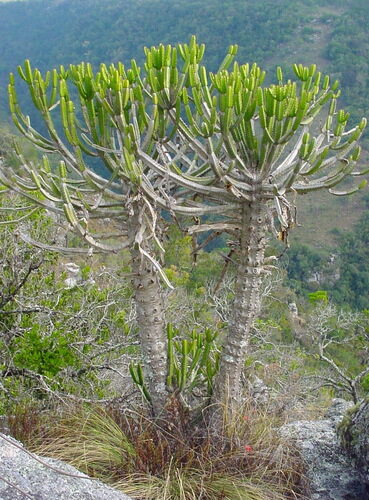
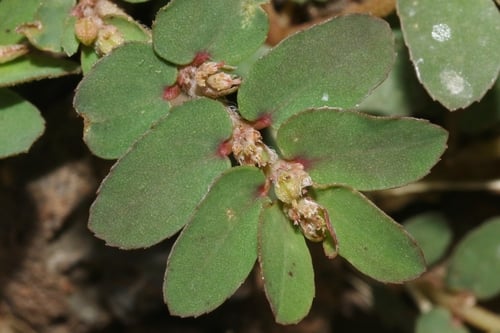
(c) Carel Jongkind, some rights reserved (CC BY-NC), uploaded by Carel Jongkind
iNaturalist· cc-by-nc
(c) Carel Jongkind, some rights reserved (CC BY-NC), uploaded by Carel Jongkind
iNaturalist· cc-by-nc
(c) Carel Jongkind, some rights reserved (CC BY-NC), uploaded by Carel Jongkind
Description
A deciduous tree. It grows to 25-40 m tall. It has a very straight trunk and this is 1 m across. It sometimes has short buttresses at the base. Young trees have branches in layers which curve upwards. Small branches are 1 cm thick and densely brown and hairy when young. The young bark is grey-brown, thin and smooth. It becomes dark and scaly later. The leaves are compound leaves with 3-6 leaflets like fingers. The central leaflet is largest and is 10-30 cm long. The leaflet tip is long and pointed. The leaflets narrow towards the base. The stalk of the leaflets is very short. At the base of the leaf there are fan shaped leafy stipules. The edges of these are deeply toothed. Male and female flowers are on separate trees. There are 5 petals and 5 sepals and they are united in a tube. The flowers are green to yellow and small. The male heads are 15-30 cm long while the female heads are 6-10 cm and more dense. The fruit is a capsule. They are 4-5 cm across. The fruit have 2-3 lobes and are green to yellow. The fruit are slightly fleshy and smell of rotten apples. They contain 2-3 red to brown seeds. The seeds are 1 cm long and flattened. The capsule breaks open scattering the seed.
Edible Uses
The seeds are usually dried for use as a flavouring agent in West and Central African food dishes. The whole seeds are pounded in a pestle and mortar and the paste of ground seed is added as a thickener for soups and stews, or crumbled over rice as a flavouring. The spice from the seed is also sold in African markets, rolled into sausage shapes.
Traditional Uses
The seeds are eaten cooked. They are also pounded and the powder used for porridge in times of food shortage. They can also be used for edible oil. They are pounded, boiled and cooled and the floating oil skimmed off, boiled and filtered then used for cooking.
Medicinal Uses
The extract from the bark of the tree is used by traditional doctors as an antidote against poison because the extracts are said to contain lupeol. It is also used to cure various diseases as cough, malaria, yellow fever, stomach pain, rheumatism etc. Other characteristics are aphrodisiac and anti-inflammatory properties. Seed husk and latex, leaf decoction and sap are also used to treat divers illnesses.
Distribution
A tropical tree. It grows in rainforests in Africa. It suits humid locations. It needs light to grow so grows in gaps in the forest. It also grows in dry lowland forests. In Tanzania it grows between 100-1,200 m above sea level.
Where It Grows
Africa, Angola, Central Africa, Central African Republic, CAR, Congo R, East Africa, Guinea-Bissau, Mozambique, Nigeria, Southern Africa, Sudan, Tanzania, Uganda, West Africa, Zimbabwe,
Cultivation
Plants are grown from seed. Seeds can be collected from the ground from capsules which have burst open. The seed should be soaked in cold water for 24 hours to help them grow more quickly.
Production
It is a fast growing plant. In Tanzania fruit are collected from October to December. The dried seeds can be stored for several months. In Central African Republic plants have flowered in March and fruited in November.
Synonyms
Also Known As
Corkwood tree, Erimado, Manketti Nut, Monguela, Munguela
References (7)
- Katende, A.B., Birnie, A & Tengnas B., 1995, Useful Trees and Shrubs for Uganda. Identification, Propagation and Management for Agricultural and Pastoral Communities. Technical handbook No 10. Regional Soil Conservation Unit, Nairobi, Kenya. p 536
- Keay, R.W.J., 1989, Trees of Nigeria. Clarendon Press, Oxford. p 152
- Lautenschläger, T., et al, 2018, First large-scale ethnobotanical survey in the province of Uíge, northern Angola. Journal of Ethnobiology and Ethnomedicine (2018) 14:51
- Lovett, J. C. et al, Field Guide to the Moist Forest Trees of Tanzania. p 57
- Menninger, E.A., 1977, Edible Nuts of the World. Horticultural Books. Florida p 54
Show all 7 references Hide references
- Nkeoua, G. & Boundzanga, G. C., 1999, Donnees sur les produits forestieres non ligneux en Republique du Congo. FAO. p 35
- Ruffo, C. K., Birnie, A. & Tengnas, B., 2002, Edible Wild Plants of Tanzania. RELMA p 564