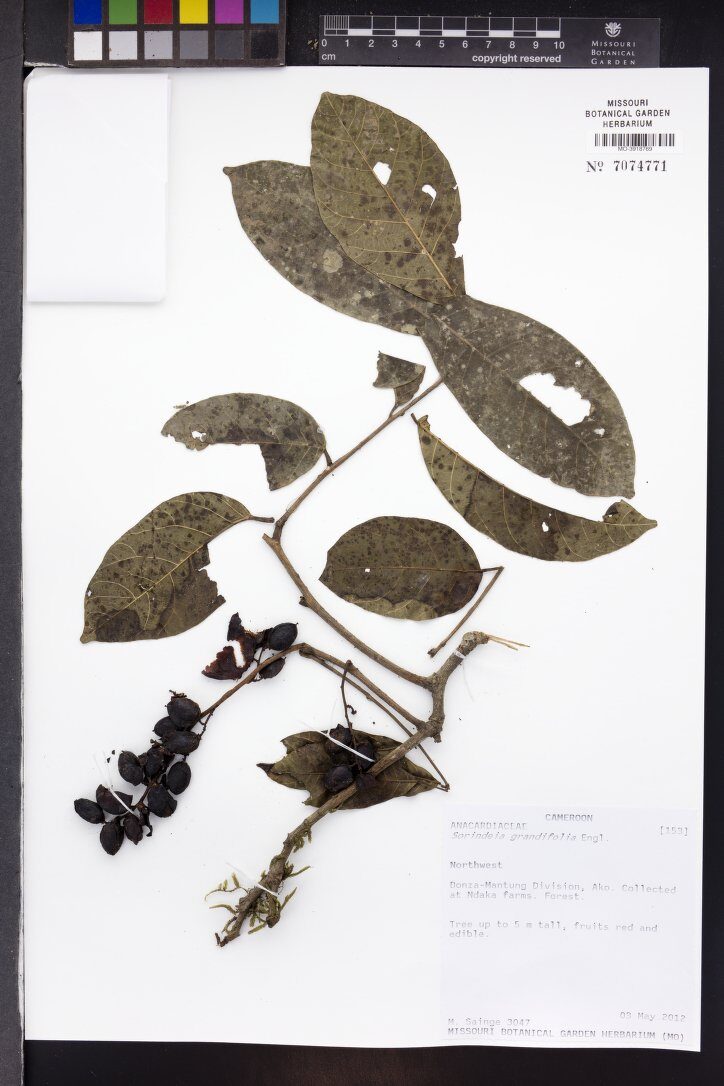
Schmaltzia copallina
(Linn.) Small
Dwarf Sumach, Winged sumac
No photos yet for Schmaltzia copallina
Sign in to contribute a photoDescription
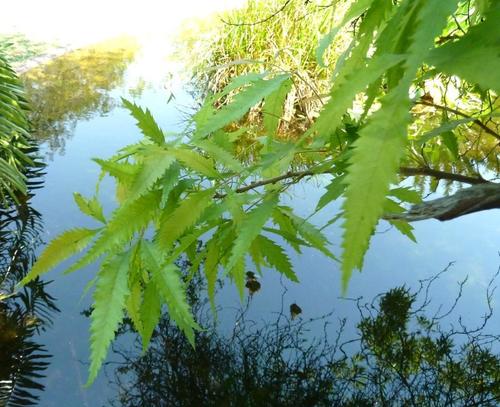
A shrub or small tree. It is deciduous. It grows 8 m high. The bark is dark grey and thinly scaly. The leaves are alternate and compound. There are 5-11 leaflets on a winged central stalk. This stalk is 10-20 cm long. The leaflets are shiny above and hairy underneath. The leaflets are 10 cm long by 2 cm wide. In autumn the leaves turn a brilliant clear red. The flowers are small and yellowish in dense cone shaped clusters. The fruit are red and hairy. They occur in large clusters at the ends of branches.
Edible Uses
The red fruit are used to produce a drink.
Traditional Uses
The fruit are used to produce a drink.
This uses section is brief — help expand it
Distribution
A temperate plant. It is a native of North America. It grows on sandy soils and rocky outcrops. It tolerates heavy alkaline soils. It suits hardiness zones 5-9.
Where It Grows
Asia, Australia, Canada, Central America, Cuba, Indonesia, North America*, Pakistan, SE Asia, USA, West Indies,
Cultivation
Plants can be grown from seeds.
Notes
There are about 200 Rhus species.
Synonyms
Also Known As
Black sumac, Flameleaf sumac, Mountain sumac, Pohon sumak amerika, Shining sumac, Winged sumac
References (16)
- Beckstrom-Sternberg, Stephen M., and James A. Duke. "The Foodplant Database." http://probe.nalusda.gov:8300/cgi-bin/browse/foodplantdb.(ACEDB version 4.0 - data version July 1994) (As Rhus copallinum)
- Bremness, L., 1994, Herbs. Collins Eyewitness Handbooks. Harper Collins. p 119 (As Rhus copallinum)
- Brickell, C. (Ed.), 1999, The Royal Horticultural Society A-Z Encyclopedia of Garden Plants. Convent Garden Books. p 882 (As Rhus copallinum)
- Coombes, A.J., 2000, Trees. Dorling Kindersley Handbooks. p 105 (As Rhus copallinum)
- Cundall, P., (ed.), 2004, Gardening Australia: flora: the gardener's bible. ABC Books. p 1204 (As Rhus copallinum)
Show all 16 references Hide references
- Facciola, S., 1998, Cornucopia 2: a Source Book of Edible Plants. Kampong Publications, p 10 (As Rhus copallinum)
- Farrar, J.L., 1995, Trees of the Northern United States and Canada. Iowa State University press/Ames p 225 (As Rhus copallinum)
- Hedrick, U.P., 1919, (Ed.), Sturtevant's edible plants of the world. p 560 (As Rhus copallinum)
- Jackes, D. A., 2007, Edible Forest Gardens (As Rhus copallina)
- Little, E.L., 1980, National Audubon Society Field Guide to North American Trees. Alfred A. Knopf. p 547 (As Rhus copallinum)
- Moerman, D. F., 2010, Native American Ethnobotany. Timber Press. p 471 (As Rhus copallinum)
- Plants for a Future database, The Field, Penpol, Lostwithiel, Cornwall, PL22 0NG, UK. http://www.scs.leeds.ac.uk/pfaf/ (As Rhus copallinum)
- Saunders, C.F., 1948, Edible and Useful Wild Plants. Dover. New York. p 154 (As Rhus copallinum)
- Sp. pl. 1:266. 1753 - published consistently as a substantive epithet ("Copallinum") by Linnaeus in Sp. pl. ed. 1, Sp. pl. ed. 2, and Syst. nat. ed. 10. (As Rhus copallinum)
- Sukarya, D. G., (Ed.) 2013, 3,500 Plant Species of the Botanic Gardens of Indonesia. LIPI p 501
- USDA, ARS, National Genetic Resources Program. Germplasm Resources Information Network - (GRIN). [Online Database] National Germplasm Resources Laboratory, Beltsville, Maryland. Available: www.ars-grin.gov/cgi-bin/npgs/html/econ.pl (10 April 2000) (As Rhus copallinum)