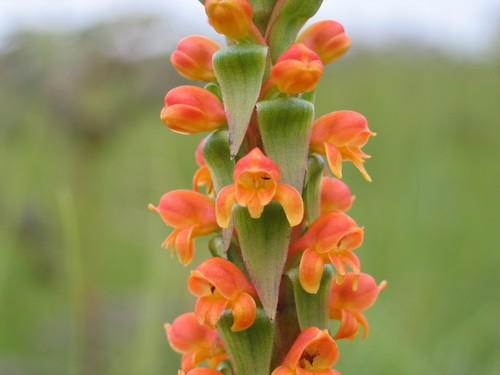
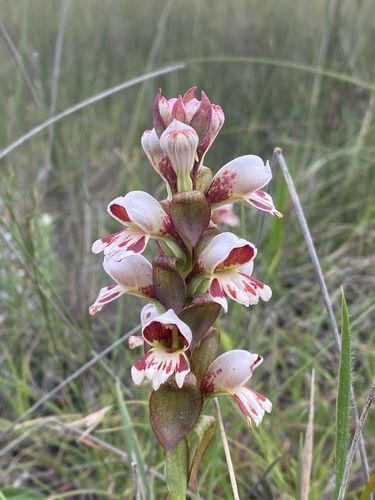
Pterostylis longifolia
R. Br.
Long-leaf Greenhood, Tall green-hood
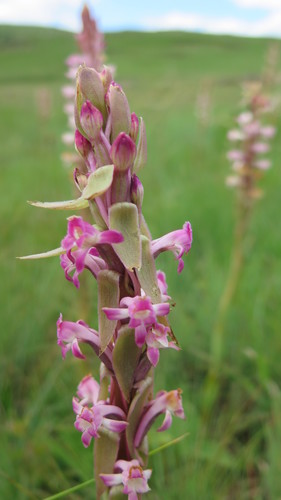
iNaturalist· cc-by-nc
(c) izakschoon, some rights reserved (CC BY-NC), uploaded by izakschoon
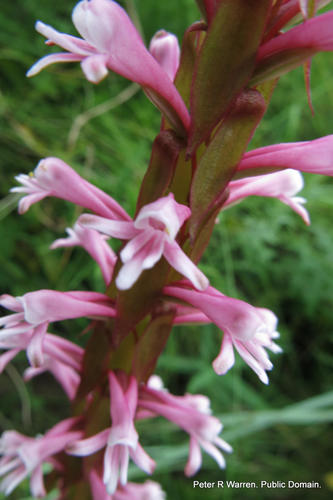
iNaturalist· cc-by-nc
(c) izakschoon, some rights reserved (CC BY-NC), uploaded by izakschoon
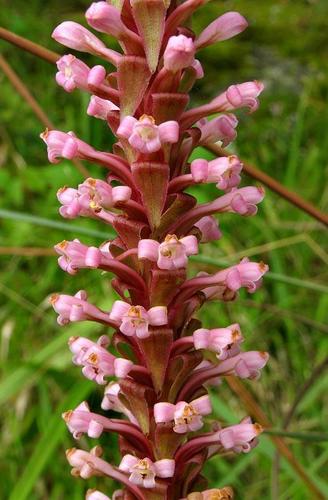
iNaturalist· cc-by-nc
(c) David James, some rights reserved (CC BY-NC), uploaded by David James
Summary
Source: WikipediaPterostylis longifolia, commonly known as the common leafy greenhood or tall greenhood, is a plant in the orchid family Orchidaceae and is endemic to eastern Australia. Flowering plants have up to seven flowers which are green, partly transparent and which have a labellum which is pale green and hairy with a blackish central stripe. Non-flowering plants have a rosette of leaves but flowering plants lack the rosette, instead having five to eight stem leaves. A similar species, Pterostylis melagramma has paler green flowers which have a less hairy labellum.
Description
A slender orchid. The leaves form a ring or rosette but these have normally gone by flowering time. There are 3 to 10 spreading long and narrow leaves 6-10 cm long. It has a tough, erect flowering stem. This is 10-60 cm high.
Edible Uses
The tuber and root are edible.
Distribution
It is a warm temperate plant. It grows in gullies and moist shady places. It can also grow in drier locations.
Where It Grows
Australia*, Tasmania,
Notes
There are about 150 Pterostylis species. They are mostly in the Australia and Pacific area. The Tasmanian one may be Pterostylis melagramma and Pterostylis williamsonii.
Synonyms
References (10)
- Bodkin, F., 1991, Encyclopedia Botanica. Cornstalk publishing, p 849
- Cherikoff V. & Isaacs, J., The Bush Food Handbook. How to gather, grow, process and cook Australian Wild Foods. Ti Tree Press, Australia p 196
- Collier, P., 1993, Orchids of Tasmania. Plant Identikit. Society for growing Australian Plants. Tasmania. p 56
- Cronin, L., 1989, The Concise Australian Flora. Reed. p 73
- Dashorst, G.R.M., and Jessop, J.P., 1998, Plants of the Adelaide Plains & Hills. Botanic Gardens of Adelaide and State Herbarium. p 200
Show all 10 references Hide references
- Lim, T. K., 2015, Edible Medicinal and Non Medicinal Plants. Volume 9, Modified Stems, Roots, Bulbs. Springer p 70
- Low, T., 1992, Bush Tucker. Australia’s Wild Food Harvest. Angus & Robertson. p 121
- Minchin, R.F., Tasmanian Wildflowers. A Field Guide. Volume one. Regal Publications, Launceston p 38
- Tasmanian Herbarium Vascular Plants list p 76
- Williams, K.A.W., 1999, Native Plants of Queensland Volume 4. Keith A.W. Williams North Ipswich, Australia. p 334