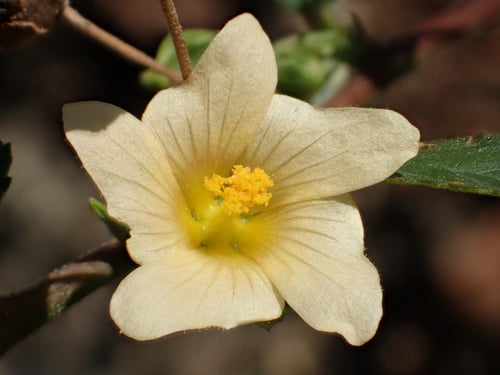
Pterospermum semisagittatum
Buch.-Ham. ex Roxb.
Laosian nayur tree, Lao pterospermum tree
wikimedia· cc0
Wikimedia Commons - Francisco Manuel Blanco (O.S.A.)
wikimedia· cc0
Wikimedia Commons - Francisco Manuel Blanco (O.S.A.)
Description
A tree. It grows 15-25 m tall. The bark is brown and slightly flaky. The leaves are alternate. The leaves have lobes at the base partly clasping the stalk. They are hairy underneath. There are teeth along the edge in the upper half. The flowers occur singly in the axils of leaves. The fruit are capsules 6-8 cm long. It is woody and splits into 5 sections. There are many oval seeds.
Edible Uses
The bark is chewed as a masticatory, traditionally used with betel leaf as a substitute for betel nut.
Traditional Uses
The bark is chewed with betel leaf replacing betel nut.
This uses section is brief — help expand it
Medicinal Uses
The bark is used as a masticatory in traditional practice.
Distribution
A tropical plant.
Where It Grows
Asia, Bangadesh, Cambodia, India, Indochina, Laos, Myanmar, SE Asia, Sri Lanka, Thailand, Vietnam,
Cultivation
Plants can be grown from seeds.
Other Uses
The bark fibres have been used for cordage. The reddish-grey wood is heavy, fairly hard, durable. It is used to make axe handles and is used as house columns in traditional buildings. The wood is used for fuel.
Production
The tree is fast growing.
Notes
The bark is chewed as a masticatory. Also put in the family Pentapetaceae.
Synonyms
Also Known As
Longman la-lech, Mai-ham-hpan, Mukau, Nagye, Ngaba nahk, Nwa-labyin, Pohon bayur laosian, Top-la
References (6)
- Ambasta S.P. (Ed.), 2000, The Useful Plants of India. CSIR India. p 503
- Fl. ind. ed. 1832 3:160. 1832
- Forest Inventory and Planning Institute, 1996, Vietnam Forest Trees. Agriculture Publishing House p 696
- Pham-Hoang Ho, 1999, An Illustrated Flora of Vietnam. Nha Xuat Ban Tre. p 502
- Sukarya, D. G., (Ed.) 2013, 3,500 Plant Species of the Botanic Gardens of Indonesia. LIPI p 481
Show all 6 references Hide references
- Thai Forestry Bulletin 23:62-108, 1995