Pterocarpus soyauxii
Taub.
Camwood, African coralwood
wikimedia· cc-by-sa
Wikimedia Commons - cs:User:Pernak
wikimedia· cc-by-sa
Wikimedia Commons - Leiem
wikimedia· cc-by-sa
Wikimedia Commons - User:Ragesoss
Summary
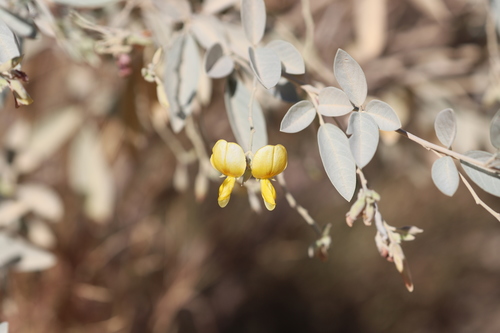
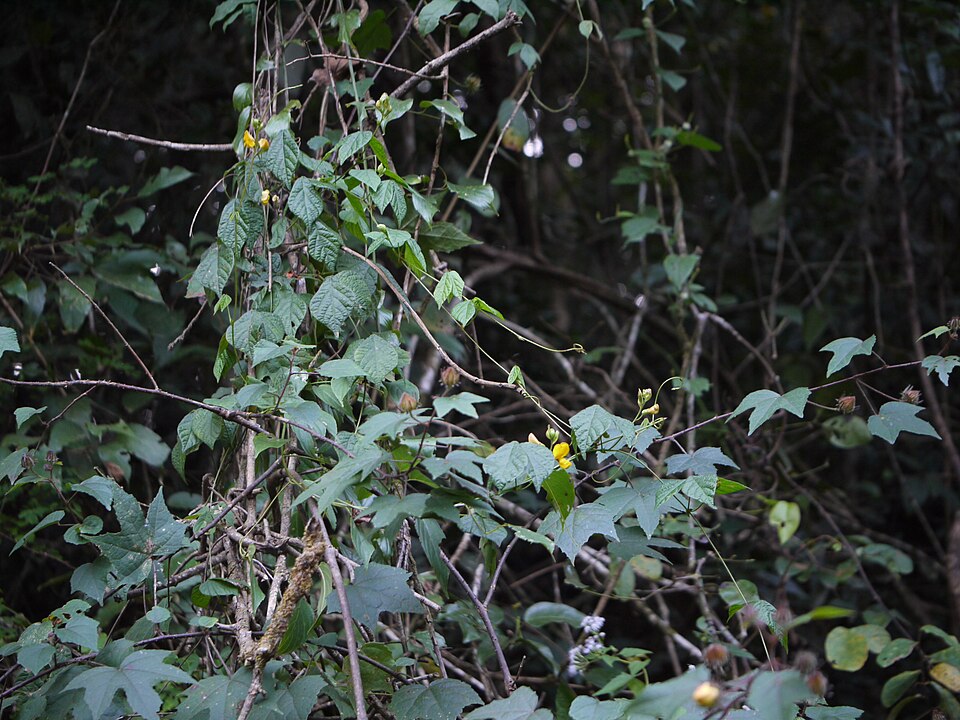
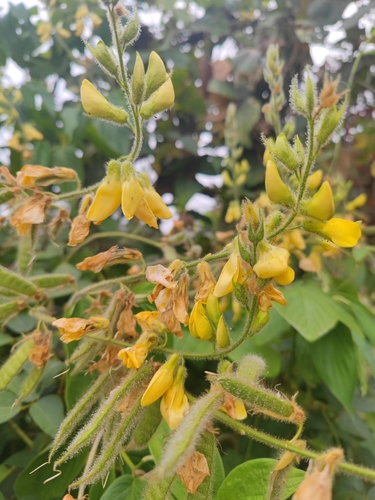
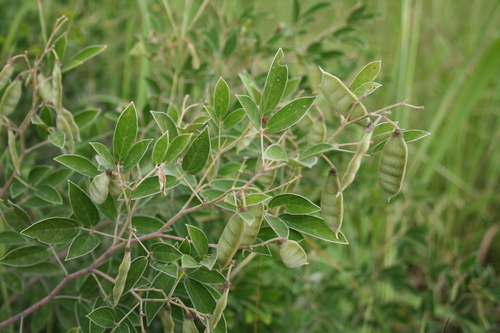
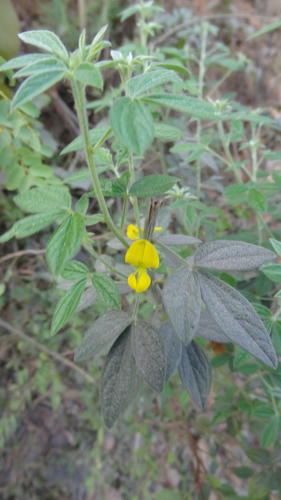
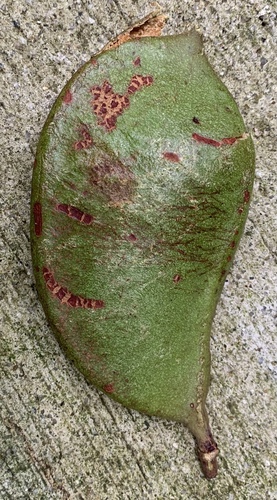
Source: WikipediaPterocarpus soyauxii, the African padauk or African coralwood, is a species of Pterocarpus in the family Fabaceae, native to central and tropical west Africa, from Nigeria east to Congo-Kinshasa and south to Angola. It is a tree growing to 27–34 m tall, with a trunk diameter up to 1 m with flaky reddish-grey bark. The leaves are pinnate, with 11–13 leaflets. The flowers are produced in panicles. The fruit is a thorny pod 6–9 cm long, which does not split open at maturity.
Description
A tall tree. The trunk is 25 m tall and 1.5 m across. The leaves are alternate and compound. The leaves are 20-25 cm long. There are 11-17 leaflets along the stalk that are 7-8 cm long by 2.5-3 cm wide. The flowers are bright yellow. The fruit is a round pod. It has a membrane layer around it. They are 7 cm across. There is one seed.
Edible Uses
Leaves and young shoots are cooked as a vegetable, made into soups, or used in other dishes with cassava and yam. They have a high ascorbic acid content that is retained even after cooking.
Traditional Uses
The leaves and young shoots are cooked as a vegetable and used in soups.
This uses section is brief — help expand it
Medicinal Uses
Powdered wood, baked with a slice of lime, is used as a wound dressing. Mixed with palm oil, raffia oil, or vegetable butter, it treats skin diseases, ringworm, and yaws. The bark contains a kino-type resin known as 'dragon's blood', which is strongly astringent and used to repel skin parasites in ethnoveterinary medicine. It is also used, usually combined with other plants, as an enema for dysentery and against toothache, gonorrhoea, and excessive menstruation. A bark decoction is drunk to treat dysmenorrhoea, uterine haemorrhage, dysentery, and haemorrhoids. A pulp scraped from the inner bark surface is applied as a wet dressing for inflammations, oedemas, incipient hernia, and whitlow. Decoctions, draughts, or vapour-baths of leaves and bark are taken for broncho-pulmonary complaints. In trials, the bark showed antifungal activity against some pathogenic fungi.
Known Hazards
The dry sawdust may cause irritation to skin, nose and bronchi.
Distribution
A tropical plant. It grows in evergreen or deciduous forests. It grows between 50-500 m above sea level. It is best with an annual rainfall of 1,500-1,700 mm. It is best in a sunny position and a moist well-drained soil.
Where It Grows
Africa, Angola, Cabinda, Cameroon, Central Africa, Central African Republic, CAR, Congo DR, Congo R, Equatorial Guinea, Gabon, Nigeria, West Africa,
Cultivation
A plant of the lowland wet tropics, where it is found at elevations up to 500 metres. It grows best in areas where the mean annual temperature is about 23°c. It prefers a mean annual rainfall of 1,500 - 1,700mm. Requires a sunny position. Prefers a moist but well-drained deep soil. Seedling growth is rather fast. In a trial plantation in Cote d'Ivoire, annual height growth in the first 7 years varied between 1.6 metres and 2.7 metres. Trees do not coppice well, stump regrowth is weak and uneconomic for wood production. This species has a symbiotic relationship with certain soil bacteria, these bacteria form nodules on the roots and fix atmospheric nitrogen. Some of this nitrogen is utilized by the growing plant but some can also be used by other plants growing nearby.
Propagation
Seed germinates readily. In a Nigerian trial, 86% of seeds — with the fruit wall removed, soaked overnight in water — germinated within 7 days. Seedlings can be planted out into the field about 40 days after sowing. Seedling growth responded better after inoculation with fungi from the rhizosphere of the mother tree than after inoculation with a similar spore number of fungi from a fallow field. Propagation by non-woody cuttings in normal topsoil achieved an 83% success rate.
Other Uses
A red dye obtained from the heartwood is the source of the so-called true barwood dye, used to colour fibres and cloth, in cosmetics, and in ritual and ceremonial contexts. More recently it has been used in Europe as a food colouring for ketchup. Combined with tannin-rich plants and an iron-rich mud mordant, it produces the famous 'Kasai velvet' dyes of Zaire. A pomade made by mixing red wood powder with oil is used as a body cosmetic. Roots prepared in the same way as the heartwood yield a dye of equal or better quality. Pulverised bark mixed with palm oil is also used as a cosmetic pomade. For dye extraction, old and hollow trees are preferred; trees are often felled and left lying on the forest floor for 2–3 years before the heartwood is taken for dyeing. Heartwood is split into billets and chips, dried, pounded into powder, mixed with a little oil, and moulded into cakes for storage and local sale. The heartwood is bright red when freshly cut, becoming orange-red on exposure and darkening to purple-brown, clearly separated from a 6–20cm wide band of whitish to brownish-yellow sapwood. The grain is straight to interlocked, the texture coarse, with a faint aromatic scent when freshly cut. The wood is moderately heavy to heavy, hard to very hard, and very durable — resistant to fungi, Lyctus beetles, termites, and marine borers. It seasons somewhat slowly but with only slight risk of checking and distortion, and is stable once dry. Working is moderately difficult with a fairly high blunting effect; stellite-tipped sawteeth and tungsten carbide cutting tools are recommended. It takes a good finish, though interlocked grain sometimes causes tearing; slicing presents no problems; nailing and screwing are good, but pre-boring is advisable; gluing properties are good. The wood is used locally for canoes owing to its water resistance, and its rich reddish colour makes it favoured for carving, sculpturing, high-class furniture, cabinet making, knife and tool handles, traditional hair combs, walking sticks, and musical instruments. Its high resonance quality — due to low damping of vibrations — has made it the traditional material for large telegraph slit drums, war drums, and xylophones, and it is increasingly used for the backs and sides of guitars. Its high durability also makes it suitable for construction, carpentry, outdoor joinery, flooring, staircases, railway sleepers, boats, veneer, inlay, billiard tables, toys, dowels, shuttles, bobbins, spindles, sporting goods, and paddles. Its resistance to marine borers made it historically valuable for marine constructions such as piers and sluice gates. The wood is also used as fuel. The tree is a nitrogen fixer.
Production
Seedlings grow quickly. There is a flush of edible leaves during the dry season.
Other Information
Leaves are sold in local markets.
Nutrition
| Part | Moisture | kJ | kcal | Protein | Vit A | Vit C | Iron | Zinc |
|---|---|---|---|---|---|---|---|---|
| Leaves | 74.7 | — | — | 3.8 | — | — | 3.8 | 0.8 |
Synonyms
Also Known As
Akume, Epion, Kisese, Koula, Mbe, Mbel, Mbele, Mbie, Mohingue, Ngele, Oha, Osun pupa, Tizeze
References (11)
- Akoroda M.O., 1990, Ethnobotany of Telfairia occidentalis (Cucurbitaceae) among Igbos of Nigeria. Economic Botany. 44(1) pp 29-39
- Bosch, C.H., 2004. Pterocarpus mildbraedii Harms. [Internet] Record from Protabase. Grubben, G.J.H. & Denton, O.A. (Editors). PROTA (Plant Resources of Tropical Africa), Wageningen, Netherlands. < http://database.prota.org/search.htm>. Accessed 22 October 2009.
- FAO Corporate Document Repository. The Major Significance of 'Minor' Forest Products. Appendix 3
- Hooker's Icon. Pl. 24: t. 2369. 1895
- Okafor, J. C., 1978, Development of Forest Tree crops for Food Supplies in Nigeria. Forest Ecology and Management 1:235-247
Show all 11 references Hide references
- Okafor, J. C., Conservation and use of traditional vegetables from woody forest species in southeastern Nigeria. FAO
- Okigbo, B.N., Vegetables in Tropical Africa, in Opena, R.T. & Kyomo, M.L., 1990, Vegetable Research and development in SADCC countries. Asian Vegetable Research and development Centre. Taiwan. p 42
- USDA, ARS, National Genetic Resources Program. Germplasm Resources Information Network - (GRIN). [Online Database] National Germplasm Resources Laboratory, Beltsville, Maryland. Available: www.ars-grin.gov/cgi-bin/npgs/html/econ.pl (10 April 2000)
- Vivien, J. & Faure, J.J., 1985, Abres des forets dense d'Afrique Centrale. Agence de Cooperation Culturelle et Technique. Paris. p 356
- Wiersema, J. H. & Leon, B., 2013, World Economic Plants. A Standard Reference CRC Press. 2nd Ed. p 570
- www.worldagroforestrycentre.org/treedb/