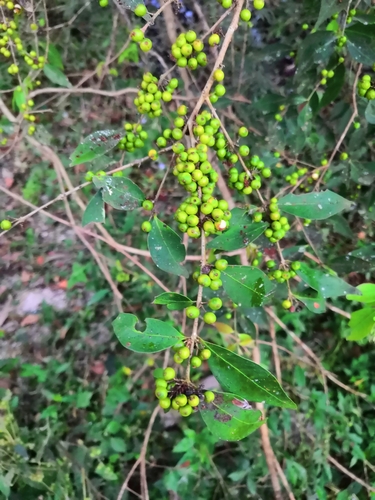
Psidium friedrichsthalianum
(O. Berg.) Niedz.
Costa Rica guava
iNaturalist· cc-by-nc
(c) Nestor Herrera, some rights reserved (CC BY-NC), uploaded by Nestor Herrera
iNaturalist· cc-by
(c) Michelle Monge-Velazquez, some rights reserved (CC BY)
iNaturalist· cc-by
(c) Michelle Monge-Velazquez, some rights reserved (CC BY)
Summary
Source: WikipediaPsidium friedrichsthalianum, the Costa Rican guava or cas, is a species of guava origin in Costa Rica but also grown in Guatemala, Nicaragua and other Central American countries. It can be found in Costa Rica as "fresco de cas”. This fruit is commonly used to prepare a sour and refreshing drink. It is used as the base for fresco de Cas, in which Costa Ricans mix it with sugar and water and sometimes add cream for a slightly acidic fruit drink. The cas fruit was described by Otto Karl Berg in 1893.
Description
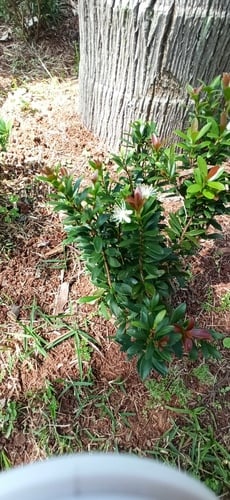
A small tree. It grows 3-4 m tall. The branches are angular and hairy. They are reddish. The leaves are papery and 4-10 cm long. There are 8 pairs of secondary veins. The flowers occur singly. They are white and have a scent. The fruit are a medium size and yellow with soft acid pulp. They are like a guava. They have many seeds. The fruit are 6-7 cm across.
Edible Uses
Fruits - raw or cooked. An aromatic but very acid flavour, they are usually cooked in pies, made into jellies etc. Sometimes eaten raw, often with salt added. They make a refreshing drink. The pectin content is high, so the fruit makes a good, firm jelly, even when used fully ripe. The yellow, spherical to ovoid fruit is 4 - 6cm in diameter.
Traditional Uses
The fruit are eaten fresh or used in jelly and juice. It is very acid.
This uses section is brief — help expand it
Distribution
It is tropical. It suits hot, tropical lowlands. It cannot tolerate frosts. It grows naturally in seasonally flooded forests in Central America. It is best with medium to high rainfall. It can tolerate a range soils conditions if well drained.
Where It Grows
Asia, Belize, Bolivia, Brazil, Central America*, Colombia, Costa Rica*, Cuba, Ecuador, El Salvador, Guatemala, Honduras, Indonesia, Mexico, Nicaragua, North America, Pacific, Panama, Peru, Philippines, SE Asia, South America, West Indies, Venezuela,
Cultivation
Plants are grown from seed. It can also be grown by cuttings.
Other Uses
The wood is fine-grained and durable.
Production
It produces fruit in 4-5 years if grown from seed. The fruit matures in 90 days.
Other Information
It is a cultivated fruit tree.
Notes
There are about 150 Psidium species.
Nutrition
| Part | Moisture | kJ | kcal | Protein | Vit A | Vit C | Iron | Zinc |
|---|---|---|---|---|---|---|---|---|
| Fruit | 83.2 | — | — | 0.8 | — | — | — | — |
Synonyms
Also Known As
Arrayan, Cas, Cos, Goiaba-da-cosa-rica, Goiaba-da-agua, Guayaba agria, Guayaba de choco, Guayabina, Kachore, Pohon jambu kosta rika
References (31)
- Burkill, I.H., 1966, A Dictionary of the Economic Products of the Malay Peninsula. Ministry of Agriculture and Cooperatives, Kuala Lumpur, Malaysia. Vol 2 (I-Z) p 1846
- Coronel, R.E., 1982, Fruit Collections in the Philippines. IBPGR Newsletter p 10
- D'Ambrosio, U., & Puri, R. K., 2016, Foodways in transition: food plants, diet and local perceptions of change in a Costa Rican Ngäbe community. Journal of Ethnobiology and Ethnomedicine (2016) 12:3 p 27
- H. G. A. Engler & K. A. E. Prantl, Nat. Pflanzenfam. 3(7):69. 1893
- Facciola, S., 1998, Cornucopia 2: a Source Book of Edible Plants. Kampong Publications, p 159
Show all 31 references Hide references
- Garcia-Serrano, C. R., & Del Monte, J. P., 2004, The Use of Tropical Forest (Agroecosystems and wild Plant harvesting) as a Source of Food in the Bribri and Cabecar Cultures in the Caribbean Coast of Costa Rica. Economic Botany 58(1) pp 58-71
- Garner, R.J., and Chaudhri, S.A., (Ed.) 1976, The Propagation of Tropical fruit Trees. FAO/CAB. p 532
- Grandtner, M. M., 2008, World Dictionary of Trees. Wood and Forest Science Department. Laval University, Quebec, Qc Canada. (Internet database http://www.wdt.qc.ca)
- Grandtner, M. M. & Chevrette, J., 2013, Dictionary of Trees, Volume 2: South America: Nomenclature, Taxonomy and Ecology. Academic Press p 545
- Hazlett, D. L., 1986, Ethnobotanical Observations from Cabecar and Guaymi Settlements in Central America. Economic Botany 40(3): 339-352
- Hermandez Bermejo, J.E., and Leon, J. (Eds.), 1994, Neglected Crops. 1492 from a different perspective. FAO Plant Production and Protection Series No 26. FAO, Rome. p16
- John, L., & Stevenson, V., 1979, The Complete Book of Fruit. Angus & Robertson p 151
- Kew Plants of the World Online
- Kiple, K.F. & Ornelas, K.C., (eds), 2000, The Cambridge World History of Food. CUP p 1881
- Kermath, B. M., et al, 2014, Food Plants in the Americas: A survey of the domesticated, cultivated and wild plants used for Human food in North, Central and South America and the Caribbean. On line draft. p 722
- Lorenzi, H., Bacher, L., Lacerda, M. & Sartori, S., 2006, Brazilian Fruits & Cultivated Exotics. Sao Paulo, Instituto Plantarum de Estuados da Flora Ltda. p 457
- Martin, F. W., et al, 1987, Perennial Edible Fruits of the Tropics. USDA Handbook 642 p 42
- Miguel, E., et al, 1989, A checklist of the cultivated plants of Cuba. Kulturpflanze 37. 1989, 211-357
- Morton, Julia F., 1987, Fruits of Warm Climates. Creative Resources Systems, Inc. . p. 365
- Pascual-Mendoza, S. et al, 2021, Traditional knowledge of edible plants in an indigenous community in the Sierra Norte of Oaxaca, Mexico. Plant Biosystems - An International Journal Dealing with all Aspects of Plant Biology
- Piedra-Malagón, E. M., et al, 2022, Edible native plants of the Gulf of Mexico Province. Biodiversity Data Journal 10: e80565 p 26
- Popenoe,
- PROSEA handbook Volume 9 Plants yielding non-seed carbohydrates. p 189 and No. 2
- Roa, J. A. G. & Boada, D. S. G., 2018, Fundación para el Fortalecimiento de la Fruticultura y Plantas Alimenticias no Convencionales en Colombia.
- Segura, S., et al, 2018, The edible fruit species in Mexico. Genet Resour Crop Evol (2018) 65:1767–1793
- Sukarya, D. G., (Ed.) 2013, 3,500 Plant Species of the Botanic Gardens of Indonesia. LIPI p 476
- USDA, ARS, National Genetic Resources Program. Germplasm Resources Information Network - (GRIN). [Online Database] National Germplasm Resources Laboratory, Beltsville, Maryland. Available: www.ars-grin.gov/cgi-bin/npgs/html/econ.pl (10 April 2000)
- van Wyk, B., 2005, Food Plants of the World. An illustrated guide. Timber press. p 313
- Wiersema, J. H. & Leon, B., 2013, World Economic Plants. A Standard Reference CRC Press. 2nd Ed. p 568
- World Checklist of Useful Plant Species 2020. Royal Botanic Gardens, Kew
- Zaldivar, M. E., et al, 2002, Species Diversity of Edible Plants Grown in Homegardens of Chibehan Amerindians from Costa Rica. Human Ecology, Vol. 30, No. 3, pp. 301-316