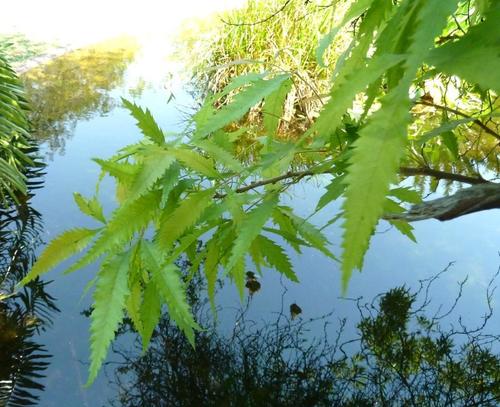
Pseudospondias microcarpa
(A. Rich.) Engl.
African grape tree
iNaturalist· cc-by-nc
(c) Bart Wursten, some rights reserved (CC BY-NC), uploaded by Bart Wursten
iNaturalist· cc-by-nc
(c) Moyen Bafing Chimpanzee Project, some rights reserved (CC BY-NC)
iNaturalist· cc-by-nc
(c) Luke Smith, some rights reserved (CC BY-NC)
Description
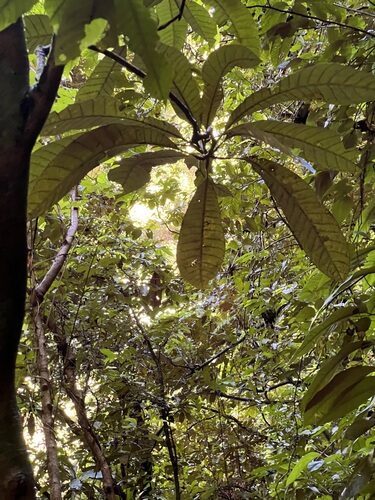
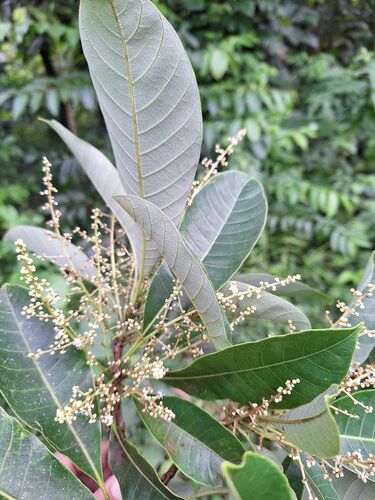
A large spreading tree. It grows 10-14 m tall. It can be 35 m tall. The trunk is short and can be 2 m across. It has buttresses. The trunk is irregular and twisted with branches near the base. The bark is smooth and thin when young. It becomes yellow-grey and rough when old. It flakes off in large pieces. The leaves have an odd number of leaflets along the stalk. The stalk can be 30 cm long. There are 2-8 pairs of leaflets plus one extra. Each leaflet is stalked. The leaflets are rather stiff and oval. They are 5-20 cm long. The base of the leaflets is unequal. The tip is pointed. The leaflets are darker above than below. The flowers are in loose heads. These are 10-32 cm long. They occur beside the leaves. The flower stalks are dull red brown. The flowers are very small and white. The fruit is a soft fruit with a kernel in a stone. The flesh is edible. The fruit are blue-black and 2.5 cm across. The stone is four sided and contains seeds.
Edible Uses
Fruits - raw or cooked. A resinous flavour. A sweet flavour, they are normally only eaten in small quantities as a snack. The fruits are nearly 2.5 cm long, red or bluish black when ripe. The juice stains the fingers. The seeds are sometimes eaten.
Traditional Uses
The fruit is eaten raw.
This uses section is brief — help expand it
Medicinal Uses
The bark contains a little reddish resin, which is used to treat jaundice and other diseases affecting the eyes. The bark contains tannin and is purgative and diuretic. It is used as a decoction or eaten as a powder in the treatment of various complaints including jaundice, cough, febrile lumbago, pains in the ribs, stomach complaints, asthenia, urethral discharge and toothache. Used externally, it is held to be good for treating ulcers on the soles of the feet when it is compounded with the heartwood of Pterocarpus soyauxii, the feet having been previously washed in the sap of Aframomum giganteum. It is also used in vapour baths and the lees used in frictions for treating persistent rheumatic pain. The plant is considered to be an aphrodisiac in some areas, and the sap from a piece of bark cooked in a leaf is given to a girl suffering infatuation because she is under sorcery, in order to make her vomit up the fetish.
Distribution
A tropical plant. It grows in the lowlands. It occurs on lake shores and rain-forest edges and in swampy areas in tropical forests. It is common in Africa. In Tanzania it grows between 900-1,700 m above sea level. It grows in areas with a rainfall between 1,200-2,100 mm.
Where It Grows
Africa*, Angola, Asia, Burkina Faso, Cameroon, Central Africa, Central African Republic, CAR, Congo DR, Congo R, Côte d'Ivoire, East Africa, Gabon, Gambia, Ghana, Guinea, Guinée, Guinea-Bissau, Indonesia, Ivory Coast, Kenya, Liberia, Mozambique, Nigeria, Sao Tome and Principe, SE Asia, Senegal, Sierra Leone, Sudan, Tanzania, Uganda, West Africa, Zambia,
Cultivation
Plants are grown from seed. The seed should have a small cut made in the hard layer or should be soaked in cold water for 12 hours before planting. The seed can be stored for 5 months after drying the whole fruit. It can be topped or pruned.
Other Uses
The bark and leaves contain tannin. The bark contains a little resin. A red paste produced by pounding the bark is smeared on winnowing trays to make them grain-proof. The seeds are used as beads. The greyish or greenish wood is soft to moderately hard, liable to warp, perishable and subject to borer-attack. It is sometimes used for poles, planks, grain mortars, stools, canoes etc.
Production
The plant is fast growing. Fruit mature in 90-120 days. In is collected during the rainy season.
Other Information
It is reasonably commonly eaten in West Africa. The fruit are especially eaten by children.
Nutrition
| Part | Moisture | kJ | kcal | Protein | Vit A | Vit C | Iron | Zinc |
|---|---|---|---|---|---|---|---|---|
| Fruit | 77.1 | — | — | — | — | 3 | 0.9 | — |
Synonyms
Also Known As
Agombe, Bololo, Byungu, Doleke, Chungu, Dowei, Dueke, Ewungu, Iyungu, Ka-dibia, Katawani, Kyungu, Mbolu, Mendiko, Mfiwa, Mubulu, Muziru, Mviwa, Nyibu, Nziru, Ochol, Pela, Pohon anggur afrika, Sana, Wungu
References (30)
- Ambe, G., 2001, Les fruits sauvages comestibles des savanes guinéennes de Côte-d’Ivoire : état de la connaissance par une population locale, les Malinké. Biotechnol. Agron. Soc. Environ. 5(1), 43-48
- Bojang, L., 1999, Non-wood Forest Products in The Gambia. EC-FAO Partnership Programme.
- Dalziel, J. M., 1937, The Useful plants of west tropical Africa. Crown Agents for the Colonies London.
- Djihounouck, Y., et al, 2018, Diversité Et Importance Socio-Economique Des Espèces Fruitières Sauvages Comestibles En Zone Kasa (Sud-Ouest Du Sénégal). European Scientific Journal December 2018 edition Vol.14, No.36 ISSN: 1857 – 7881
- Harris, D. J., 2002, The vascular plants of the Dzanga-Sangha Reserve, Central African Republic. National Botanic Garden of Belgium, 2002. – 274 pages p 40
Show all 30 references Hide references
- Hedrick, U.P., 1919, (Ed.), Sturtevant's edible plants of the world. p 530
- Herzog, F. et al, 1994, Composition and consumption of gathered wild fruits in the V-Baoule, Cote D'Ivoire. Ecology of Food and Nutrition Vol. 32, pp. 181-196
- Jardin, C., 1970, List of Foods Used In Africa, FAO Nutrition Information Document Series No 2.p 96, 157
- Katende, A.B., Birnie, A & Tengnas B., 1995, Useful Trees and Shrubs for Uganda. Identification, Propagation and Management for Agricultural and Pastoral Communities. Technical handbook No 10. Regional Soil Conservation Unit, Nairobi, Kenya. p 518
- Keay, R.W.J., 1989, Trees of Nigeria. Clarendon Press, Oxford. p 367
- Latham, P., 2004, Useful Plants of Bas-Congo province. Salvation Army & DFID p 226
- liberianfaunaflora.org Plant Atlas
- Lovett, J. C. et al, Field Guide to the Moist Forest Trees of Tanzania. p 10
- Martin, F.W. & Ruberte, R.M., 1979, Edible Leaves of the Tropics. Antillian College Press, Mayaguez, Puerto Rico. p 174, 217
- Martin, F. W., et al, 1987, Perennial Edible Fruits of the Tropics. USDA Handbook 642 p 14
- Mawunu, M., et al, 2022, Ethnobotanical uses of wild edible plants of Mucuba municipality, Angola. Natural Resources for Human Health. 2022, 0:1-10
- Okigbo, B.N., Vegetables in Tropical Africa, in Opena, R.T. & Kyomo, M.L., 1990, Vegetable Research and development in SADCC countries. Asian Vegetable Research and development Centre. Taiwan. p 38, 46
- Peters, C. R., O'Brien, E. M., and Drummond, R.B., 1992, Edible Wild plants of Sub-saharan Africa. Kew. p 50
- Raponda-Walker, A & Sillans, R., 1961, Les Plantes Utiles du Gabon. Editions Paul Lechevalier, Paris. p 60
- Ruffo, C. K., Birnie, A. & Tengnas, B., 2002, Edible Wild Plants of Tanzania. RELMA p 546
- Savill, P. S. & Fox, J. E. D., Trees of Sierra Leone. p 37
- Sukarya, D. G., (Ed.) 2013, 3,500 Plant Species of the Botanic Gardens of Indonesia. LIPI p 476
- Tanno, T., 1981, Plant Utilization of the Mbuti Pygmies: With Special reference to their Material Culture and Use of Wild Vegetable Foods. Kyoto University Research. African Study Monographs 1:1-53
- Terashima, H., et al, 1992, Ethnobotany of the Lega in the Tropical Rainforest of Eastern Zaire (Congo): Part Two, Zone de Walikale, African Study Monographs, Suppl. 19:1-60
- Terashima, H., & Ichikawa, M., 2003, A comparative ethnobotany of the Mbuti and Efe hunter-gatherers in the Ituri Forest, Democratic Republic of Congo. African Study Monographs, 24 (1, 2): 1-168, March 2003
- Termote, C., et al, 2011, Eating from the wild: Turumbu, Mbole and Bali traditional knowledge of non-cultivated edible plants, District Tshopo, DRCongo, Gen Resourc Crop Evol. 58:585-618
- Tugume, P. & Nyakoojo, C., 2020, Traditional use of wild edible plants in the communities adjacent to Mabira Central Forest Reserve, Uganda. Ethnobotany Research & Applications 20:15 (2020)
- Vascular Plants of Korup National Park. korupplants.myspecies.info
- Vivien, J., & Faure, J.J., 1996, Fruitiers Sauvages d'Afrique. Especes du Cameroun. CTA p 27
- World Checklist of Useful Plant Species 2020. Royal Botanic Gardens, Kew