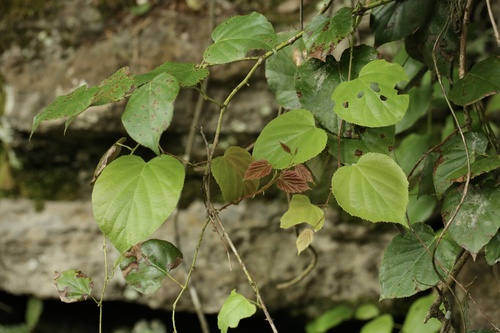
Prunus wallichii
Steudel
Mauli
wikimedia· cc-by-sa
Ian W. Fieggen (via Wikimedia Commons)
Description
A shrub or small tree. It grows up to 12 m tall. The bark is brown and can be smooth or warty. The twigs are smooth and without hairs. The leaves are oval and 7-15 cm long by 2-6 cm wide. The base of the leaf ends in a sharp point while the tip tapers. There are 6-9 pairs of veins which often form distinct loops and join. The leaf stalk is 0.2-1 cm long. Flower clusters can be single or in a small bunch of 2-4. They are 2-10 cm long and in the axils of leaves. The petals are white. The fruit are oval and pear shaped. They are 10-22 mm long by 6-15 mm wide. They are purplish black when ripe with a fleshy payer. The seed have a smooth coat.
Edible Uses
The seeds and fruit are eaten.
Traditional Uses
The seeds are eaten
This uses section is brief — help expand it
Distribution
A tropical plant. It grows in mountain forest mostly from 1,000 to 3,000 m altitude. It occasionally grows down to 600 m or up to 3,600 m.
Where It Grows
Asia, Cambodia, China, India, Indochina, Laos, Malaysia, Myanmar, Northeastern India, Pakistan, SE Asia, Thailand, Vietnam,
Notes
There are about 200 Prunus species.
Synonyms
Also Known As
Vangnuong Wallich
References (6)
- Altschul, S.V.R., 1973, Drugs and Foods from Little-known Plants. Notes in Harvard University Herbaria. Harvard Univ. Press. Massachusetts. no. 1480
- Ambasta, S.P. (Ed.), 2000, The Useful Plants of India. CSIR India. p 497
- Gardner, S., et al, 2000, A Field Guide to Forest Trees of Northern Thailand, Kobfai Publishing Project. p 183
- Kalkman, 1993, Rosaceae. Flora Malesiana ser 1, 11(2) p 329
- Singh, H.B., Arora R.K.,1978, Wild edible Plants of India. Indian Council of Agricultural Research, New Delhi. p 69
Show all 6 references Hide references
- Singh, V. B., et al, (Ed.) Horticulture for Sustainable Income and Environmental Protection. Vol. 1 p 219