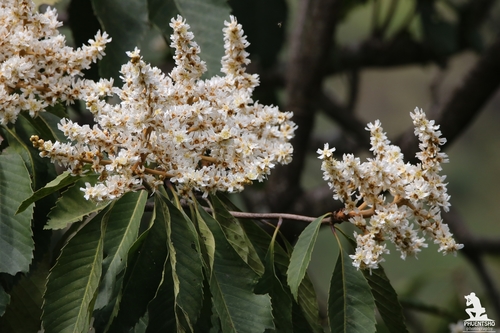
Padus napaulensis
(Seringe) C. K. Schneid.
Nepalese cherry, Khasi cherry
wikimedia· cc-by-sa
Wikimedia Commons - Shwabb Wabby
Description
A tree. It grows to about 7 m high. The leaves have stalks. The leaves are oblong to sword shaped and taper to the tip. They have teeth along the edge. The flowers are white and in long terminal clusters. The fruit are purplish or blackish brown.
Edible Uses
The ripe fruit are eaten raw. The fruit are also used in wine production to impart a purple colour.
Traditional Uses
The ripe fruit are eaten raw. (The seeds are not eaten.) The fruit are also used for wine to give a purple colour.
This uses section is brief — help expand it
Distribution
Temperate. In Nepal it grows between 1600-3000 m altitude. It is frost hardy. In Sichuan and Yunnan.
Where It Grows
Asia, Bhutan, China, Himalayas, India, Indochina, Myanmar, Nepal, Northeastern India, SE Asia, Sikkim,
Cultivation
Plants are grown from seed.
Production
In China plants flower in April and fruit in July. In the Indian Himalayas flowers occur in October to November and fruit mature August and September.
Notes
There are about 200 Prunus species.
Nutrition
| Part | Moisture | kJ | kcal | Protein | Vit A | Vit C | Iron | Zinc |
|---|---|---|---|---|---|---|---|---|
| Fruit | 61.8 | — | — | — | — | 58.4 | — | — |
Synonyms
Also Known As
Aaru pate, Aroopaty, Delaoji, Jangali aaru, Khashi, Messusu, Mokhoshi, Ngau chi, Saiong, Soh-iong
References (13)
- Ambasta, S.P. (Ed.), 2000, The Useful Plants of India. CSIR India. p 496 (As Prunus napaulensis)
- Flora of China @ efloras.org Volume 9
- Joshi, A. R.. and Joshi, J., 2009, Plant Diversity and Ethnobotanical Notes on tree species of Syabru Village, Langtang National Park, Nepal. Ethnobotanical Leaflets 13:651-64 (As Prunus napaulensis)
- Manandhar, N.P., 2002, Plants and People of Nepal. Timber Press. Portland, Oregon. p 382 (As Prunus napaulensis)
- Medhi, P., Sarma, A and Borthakur, S. K., 2014, Wild edible plants from the Dima Hasao district of Assam, India. Pleione 8(1): 133-148
Show all 13 references Hide references
- Nomencl. bot. ed. 2, 2:403. 1841 "nepaulensis" (As Prunus napaulensis)
- Pfoze, N. L., et al, 2012, Assessment of Local Dependency on Selected Wild Edible Plants and fruits from Senapati district, Manipur, Northeast India. Ethnobotany Research & Applications 10:357-367 (As Prunus napaulensis)
- Pfoze, N. L., et al, 2012, Survey and assessment of floral diversity on wild edible plants from Senapati district of Manipur, Northeast India. Journal of Biodiversity and Environmental Sciences. 1(6):50-52 (As Prunus napaulensis)
- Plants for a Future, The Field, Penpol, Lostwithiel, Cornwall, PL22 0NG, UK. http://www.scs.leeds.ac.uk/pfaf/ (As Prunus napaulensis)
- Rymbai, H., et al, 2016, Analysis study on potential underutilized edible fruit genetic resources of the foothills track of Eastern Himalayas, India. Genetic. Resourc. Crop Evol. (2016) 63:125-139
- Sawian, J. T., et al, 2007, Wild edible plants of Meghalaya, North-east India. Natural Product Radiance Vol. 6(5): p 420 (As Prunus napaulensis)
- Singh, H.B., Arora R.K.,1978, Wild edible Plants of India. Indian Council of Agricultural Research, New Delhi. p 69 (As Prunus napaulensis)
- Singh, V. B., et al, (Ed.) Horticulture for Sustainable Income and Environmental Protection. Vol. 1 p 219 (As Prunus napaulensis)