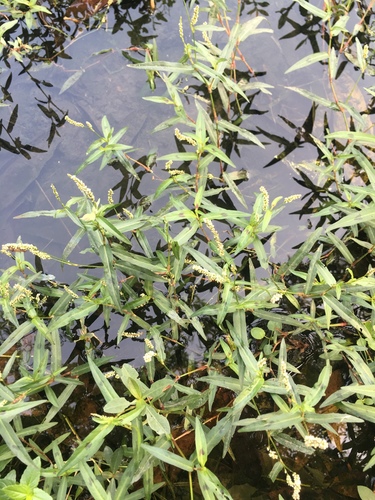
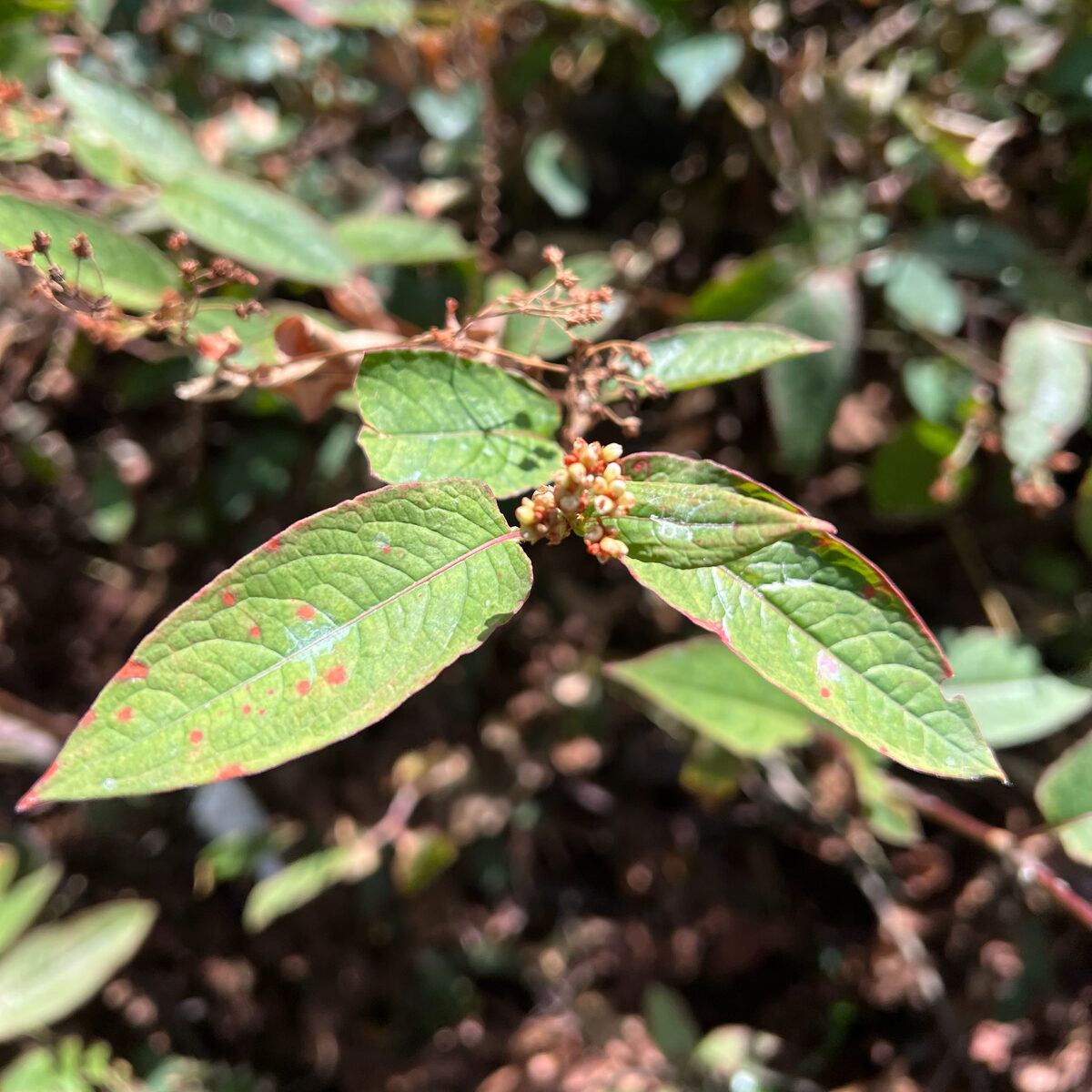
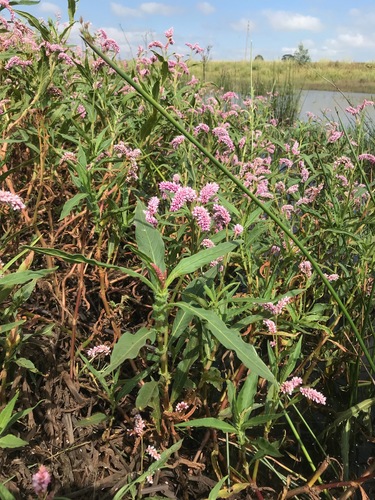
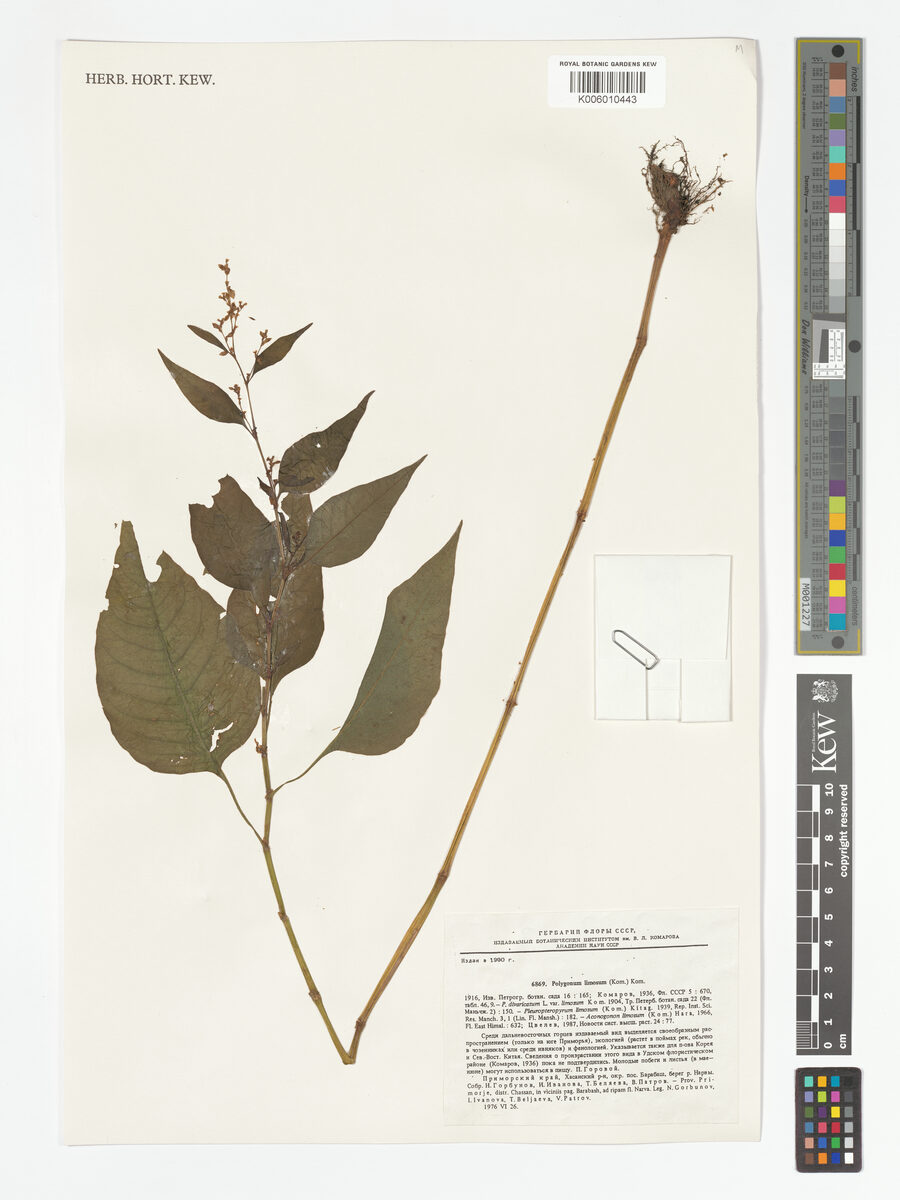
Persicaria amphibia
(L.) Delarbre
Water Knotweed, Willow grass, Amphibious bistort
iNaturalist· cc-by-nc
(c) erik_p, some rights reserved (CC BY-NC), uploaded by erik_p
iNaturalist· cc-by
(c) Kevin Krebs, some rights reserved (CC BY), uploaded by Kevin Krebs
iNaturalist· cc-by-nc
(c) Eduardo Ramirez Esteban, some rights reserved (CC BY-NC), uploaded by Eduardo Ramirez Esteban
Summary
Source: WikipediaPersicaria amphibia (syn. Polygonum amphibium) is a species of flowering plant in the knotweed family known by several common names, including longroot smartweed, water knotweed, water smartweed, and amphibious bistort. It is native to much of North America, Asia, Europe, and parts of Africa, and it grows elsewhere as an introduced species and sometimes a noxious weed.
Description
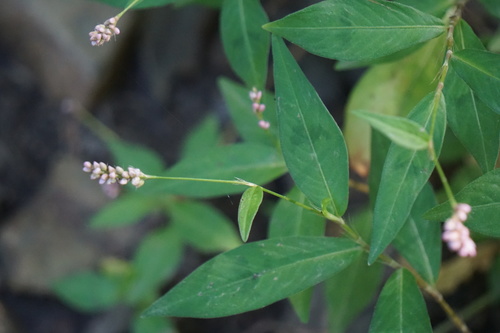
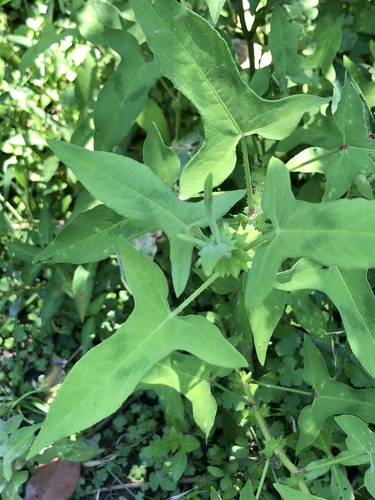
A herb which keeps growing from year to year. The stems trail from the base and root at the nodes. In water the stems are hollow which can be 1 m long. The leaves are sword shape and emerge from the water. They clasp the stem. The leaves are more round when floating. The long leaf stalks emerge from a papery sheath. The leaves are dark green and glossy. They taper to a blunt tip and have dark markings near the tip. The flowers are in neat pink spikes.
Edible Uses
Various parts of this plant were used by several Native American groups as medicinal remedies and sometimes as food.
Traditional Uses
The fruit are used as a substitute for pepper. The leaves are cooked as a vegetable dish.
This uses section is brief — help expand it
Distribution
It is a temperate plant. It can grow in or near water. It suits slow moving water.
Where It Grows
Asia, Britain, Canada, Central Asia, East Africa, Eritrea, Europe, Korea, Luxembourg, North America, Spain, Tajikistan, Turkey, Türkiye, USA,
Notes
There are about 50 Polygonum species.
Synonyms
Also Known As
Istir, Kizilbacak, Kune
References (13)
- Ambasta, S.P. (Ed.), 2000, The Useful Plants of India. CSIR India. p 478 (As Polygonum amphibium)
- Beckstrom-Sternberg, Stephen M., and James A. Duke. "The Foodplant Database." http://probe.nalusda.gov:8300/cgi-bin/browse/foodplantdb.(ACEDB version 4.0 - data version July 1994) (As Polygonum muhlenbergii)
- Cormack, R. G. H., 1967, Wild Flowers of Alberta. Commercial Printers Edmonton, Canada. p 74 (As Polygonum amphibium)
- Duke, J.A., 1992, Handbook of Edible Weeds. CRC Press. p 154 (As Polygonum amphibium)
- Ertug, F, Yenen Bitkiler. Resimli Türkiye Florası -I- Flora of Turkey - Ethnobotany supplement (As Polygonum amphibium)
Show all 13 references Hide references
- Kayabasi, N. P., et al, 2018, Wild edible plants and their traditional use in the human nutrition in Manyas (Turkey). Indian Journal of Traditional Knowledge. Vol. 17(2), April 2018, pp 299-306 (As Polygonum amphibium)
- Kermath, B. M., et al, 2014, Food Plants in the Americas: A survey of the domesticated, cultivated and wild plants used for Human food in North, Central and South America and the Caribbean. On line draft. p 675 (As Polygonum amphibium var. emerson)
- Moerman, D. F., 2010, Native American Ethnobotany. Timber Press. p 423 (As Polygonum amphibium)
- Plants for a Future database, The Field, Penpol, Lostwithiel, Cornwall, PL22 0NG, UK. http://www.scs.leeds.ac.uk/pfaf/ (As Polygonum amphibium)
- Slocum, P.D. & Robinson, P., 1999, Water Gardening. Water Lilies and Lotuses. Timber Press. p 99 (As Polygonum amphibium)
- Sp. pl. 1:361. 1753 (As Polygonum amphibium)
- Thiselton-Dywer, W.T., (Ed.), 1913, Flora of Tropical Africa. Vol VI-section 1. Reeve, p 106 (As Polygonum amphibium)
- Toupal, R. S. & Hollenback, K., 2009, An Ethnobotany of Indiana Dunes National Lakeshore: Plant Uses of the Ojibwa People. Bureau of Applied Research in Anthropology. University of Arizona (As Polygonum amphibium var.)