Podophyllum peltatum
L.
May apple
iNaturalist· cc0
no rights reserved, uploaded by mefisher
iNaturalist· cc-by-nc
(c) eknuth, some rights reserved (CC BY-NC), uploaded by eknuth
iNaturalist· cc-by-sa
(c) Douglas Goldman, some rights reserved (CC BY-SA), uploaded by Douglas Goldman
Summary
Source: WikipediaPodophyllum peltatum is a North American herbaceous perennial plant in the family Berberidaceae. Its common names are mayapple, American mandrake, wild mandrake, and ground lemon.
Description
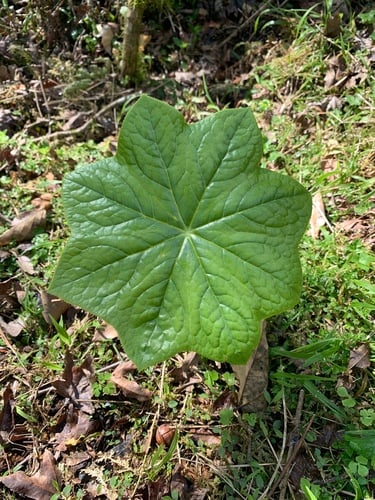
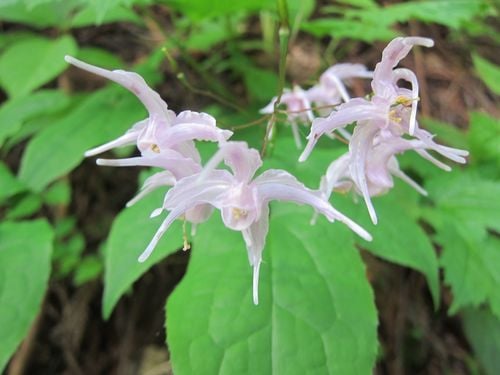
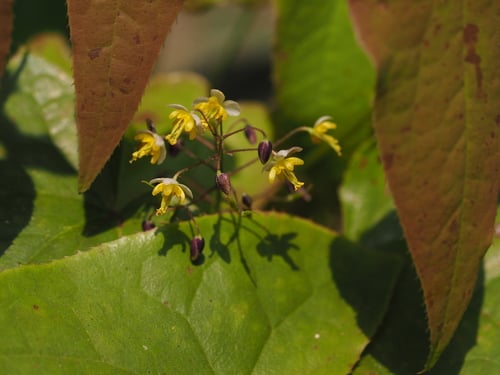
An erect, 1-stemmed may-apple herb. It often forms colonies. There are creeping underground stems and thick fibrous roots. It keeps growing from year to year. It grows 60 cm high and spreads 60 cm wide. It produces one or two, large lobed leaves. These are 30 cm across and have 3-9 lobes. They turns orange brown with maturity. The flowering stem has 2 or 3 leaves or can be leafless. The flowers are white. They occur singly and are nodding and cream. The fruit are lemon shaped and 4-5 cm across. . They are yellow. They are edible.
Edible Uses
The fruit can be eaten raw, cooked, or made into jams, jellies, marmalades, and pies, and can also be dried for later use. It should only be eaten when fully ripe — unripe fruit is strongly laxative. The rind should be removed before eating, and the seeds must not be consumed. The fruit is very aromatic with a peculiar but agreeable sweet-acid flavour. Eaten in excess, even ripe fruit can cause colic. Each fruit is approximately 5cm long.
Traditional Uses
CAUTION: The roots, leaves and seeds are poisonous. The ripe fruit are eaten. It is often made into marmalade. It can be used for jams, jellies, pies and drinks.
Medicinal Uses
American mandrake is a powerful herbal medicine that stimulates the glands and acts strongly on the liver and bowels as a gastro-intestinal irritant and hepatic and intestinal stimulant. The root is antibilious, cathartic, cytostatic, hydrogogue, and purgative. The plant contains podophyllin, which interferes with cell division and has been investigated as a treatment for cancer — particularly ovarian cancer — though alopecia is a commonly reported side effect of such treatment. The root is most medicinally potent in early spring when it begins to shoot. Resin extracted from the root is used to treat warts, including uterine warts that sometimes occur during pregnancy, and is also used in the treatment of small-cell carcinoma. The root is harvested in autumn and either dried or processed for its resin. The entire plant, except the ripe fruit, is highly poisonous and should only be used under the supervision of a qualified practitioner. It must not be prescribed to pregnant women, and large doses have been used to commit suicide. A homeopathic remedy prepared from the fresh root, harvested before the fruit ripens, is used particularly for treating diarrhoea.
Known Hazards
The entire plant, except the ripe fruit, is highly poisonous and should only be used under the supervision of a qualified practitioner. The unripe fruit is strongly laxative. The seeds must not be eaten. Excess consumption of even ripe fruit can cause colic. The plant should not be prescribed to pregnant women. Large doses have been used to commit suicide.
Distribution
It is a temperate plant. It needs moist, peaty soils and a shady location. It suits hardiness zones 4-6.
Where It Grows
Australia, Canada, Europe, France, North America*, Slovenia, USA,
Cultivation
Prefers a moist peaty soil and filtered light or shade. Grows well in a moist open woodland and also succeeds under beech trees in a deep moist leafy soil. Succeeds in a pH ranging from 4 to 7. A very hardy plant, tolerating temperatures down to -15°c or lower when dormant, though the young leaves in spring can be damaged by late frosts. Plants in this genus have excited quite a lot of interest for the compounds found in their roots which have been shown to have anti-cancer activity. There are various research projects under way (as of 1990). The flower has a foul smell. The plant takes some years to become established but is very long lived in a suitable habitat and can become a vigorous colonizer.
Propagation
Seed is best sown as soon as it is ripe in a cold frame. Stored seed should be sown in a cold frame in early spring. Germination occurs in 1–4 months at 15°C. Prick seedlings out into individual pots when large enough to handle and grow on in a shady part of the greenhouse for at least 2 growing seasons before planting out in winter while the plants are dormant. The plant can also be divided in March or April.
Other Uses
An infusion of boiled leaves has been sprayed on potato plants to deter insects, with reports suggesting the effect is insecticidal rather than merely repellent. Root ooze has been used to soak corn seed before planting to prevent it being eaten by crows or insects.
Notes
It has proven anticancer properties. The active ingredient is etoposide.
Also Known As
American Mandrake, Devil's apple, Hog apple, Indian apple, Mandrake, Raccoon-berry, ščitasto majsko jabolko, Wild Lemon
References (29)
- Beckstrom-Sternberg, Stephen M., and James A. Duke. "The Foodplant Database." http://probe.nalusda.gov:8300/cgi-bin/browse/foodplantdb.(ACEDB version 4.0 - data version July 1994)
- Bodkin, F., 1991, Encyclopedia Botanica. Cornstalk publishing, p 816
- Brickell, C. (Ed.), 1999, The Royal Horticultural Society A-Z Encyclopedia of Garden Plants. Convent Garden Books. p 814
- Cundall, P., (ed.), 2004, Gardening Australia: flora: the gardener's bible. ABC Books. p 1065
- Duke, J.A., 1992, Handbook of Edible Weeds. CRC Press. p 152
Show all 29 references Hide references
- Elias, T.S. & Dykeman P.A., 1990, Edible Wild Plants. A North American Field guide. Sterling, New York p 140
- Esperanca, M. J., 1988. Surviving in the wild. A glance at the wild plants and their uses. Vol. 2. p 81
- Facciola, S., 1998, Cornucopia 2: a Source Book of Edible Plants. Kampong Publications, p 184
- Fisk, J. R. & Hoover, E., 2015, Wild Fruits of Minnesota. A Field Guide. University of Minnesota p 27
- Flora of North America. www.eFloras.org
- Glowinski, L., 1999, The Complete Book of Fruit Growing in Australia. Lothian. p 179
- Hedrick, U.P., 1919, (Ed.), Sturtevant's edible plants of the world. p 509
- http://www.botanic-gardens-ljubljana.com/en/plants
- Jackes, D. A., Edible Forest Gardens
- Kermath, B. M., et al, 2014, Food Plants in the Americas: A survey of the domesticated, cultivated and wild plants used for Human food in North, Central and South America and the Caribbean. On line draft. p 673
- Kiple, K.F. & Ornelas, K.C., (eds), 2000, The Cambridge World History of Food. CUP p 1812
- Loughmiller, C & L., 1985, Texas Wildflowers. A Field Guide. University of Texas, Austin. p 17
- MacKinnon, A., et al, 2009, Edible & Medicinal Plants of Canada. Lone Pine. p 177
- Medsger, O. P., 1939, Edible Wild Plants. Macmillan Company. p 13
- Moerman, D. F., 2010, Native American Ethnobotany. Timber Press. p 420
- onecommunityglobal.org
- Ryan, S., 2008, Dicksonia. Rare Plants Manual. Hyland House. p 109
- Saunders, C.F., 1948, Edible and Useful Wild Plants. Dover. New York. p 99
- Schmid, W. G., 2002, An Encyclopedia of Shade Perennials. Timber Press p 263
- Slocum, P.D. & Robinson, P., 1999, Water Gardening. Water Lilies and Lotuses. Timber Press. p 130
- Sp. pl. 1:505. 1753
- Toupal, R. S. & Hollenback, K., 2009, An Ethnobotany of Indiana Dunes National Lakeshore: Plant Uses of the Ojibwa People. Bureau of Applied Research in Anthropology. University of Arizona
- Wild Edible Plants of the Whitmire Wildflower Garden. Missouri Botanical Gardens.
- www.wildediblefood.com