Dracaena angustifolia
(Medik.) Roxb.
Native Dracaena, Suji dracaena
iNaturalist· cc0
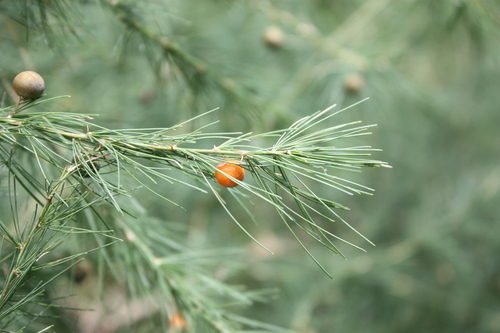
no rights reserved, uploaded by 葉子
iNaturalist· cc-by-nc-sa
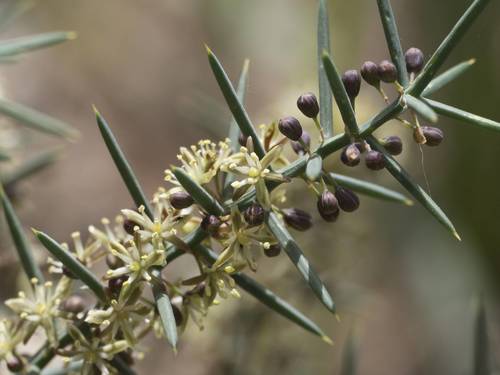
(c) Tony Rodd, some rights reserved (CC BY-NC-SA)
iNaturalist· cc-by-nc
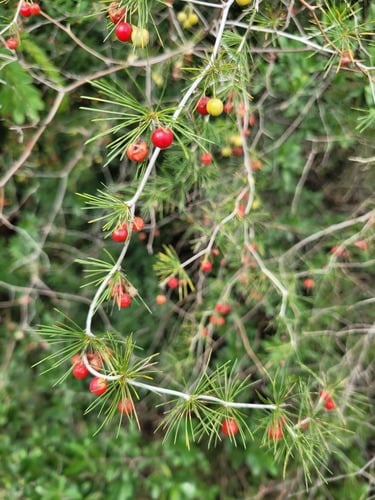
(c) Sébastien SANT, some rights reserved (CC BY-NC), uploaded by Sébastien SANT
Summary
Source: WikipediaDracaena angustifolia is a species of Asian tropical forest under-storey plants in the family Asparagaceae; no subspecies are listed in the Catalogue of Life.
Description
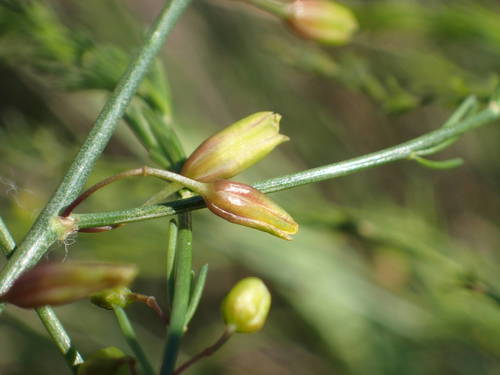
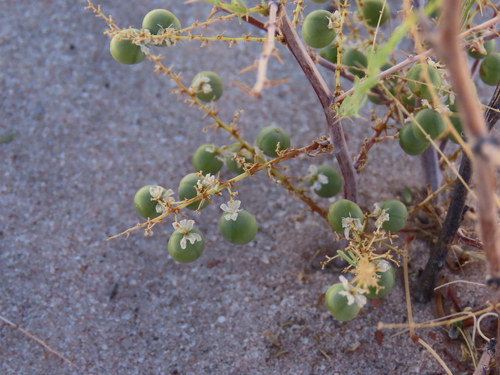
A tall slender shrub. It forms suckers. It has rhizomes or underground stems. It grows 3-8 m high and spreads 1-2 m wide. It can often be sprawling or climbing. The stems are slender and pithy. They are densely covered with scars from the leaf sheaths. The bark is dark grey. The leaves are 12-40 cm long by 2-3 cm wide. They are strap like. They are green, soft and pointed. They are crowded near the top of a stem. They occur in whorls or rings. The flower panicle is 15-40 cm long. It is at the end of the branch and has many branches. The flowers are 1.5-3 cm long and white. They have a scent. They are like tubes at the base. They have lobes which are narrow and spreading or curve back. The fruit is a berry. It is 1-1.5 cm across and brownish-red. It has a brownish pulp. It contains 1-3 large seeds.
Edible Uses
Very young leaves - cooked and eaten as a side dish with rice. The leaves can be pounded then mixed with water to give a green juice that is used for colouring an Indian pastry made of glutinous rice. Fruits - roasted. The orange, globose berry is 8 - 12mm in diameter.
Traditional Uses
Africa, Andaman Islands, Asia, Australia, Bhutan, Cambodia, China, East Africa, East Timor, Himalayas, India, Indochina, Indonesia, Laos, Madagascar, Malaysia, Marshall Islands, Micronesia, Myanmar, Niue, Pacific, Papua New Guinea, PNG, Philippines, SE Asia, Taiwan, Thailand, Timor-Leste, Tuvalu, Vietnam,
Medicinal Uses
The juice squeezed from the boiled leaves is drunk as a remedy for asthma and shortness of breath. A decoction of the leaves is given to people suffering weight loss and poor appetite.
Distribution
It is a tropical plant. It grows in northern Australia. It grows in sheltered rainforests often near the sea. It suits humid locations. They are very sensitive to cold. It needs a shady position and well drained soil. In China it grows in forests and thickets. In Townsville Anderson BG.
Where It Grows
Forests and thickets. Rainforests, in areas near rivers and streams, growing in both primary and the more open secondary formations.
Cultivation
They are sold in local markets.
Propagation
Seed - Cuttings. Dracaena species are generally easy to propagate. Only a small piece of the plant is required to form a new plant, and even when thrown away it may easily root.
Production
There are 140 Pleomele species. Also put in the family Dracaenaceae.
Synonyms
Also Known As
Buckripathi, Chang hua long zue shu, Dandagu, Danalet, Khon khaen, Pandan suji, Semar, Sudji, Tavivolavy, Tsikasinkasina, Txoob ntuab, Zibak
References (29)
- Bhargava, N., 1983, Ethnobotanical Studies of the Tribes of Andaman and Nicobar Islands, India. 1. Onge. Economic Botany 37(1): 110-119
- Borrell, O.W., 1989, An Annotated Checklist of the Flora of Kairiru Island, New Guinea. Marcellin College, Victoria Australia. p 13
- Bull. Misc. Inform. Kew 1914:277. 1914 (As Pleomele angustifolia)
- Chen Xinqi, Liang Songyun, Xu Jiemei, Tamura M.N., Liliaceae. Flora of China. p 147
- Cooper, W. and Cooper, W., 2004, Fruits of the Australian Tropical Rainforest. Nokomis Editions, Victoria, Australia. p 152
Show all 29 references Hide references
- Cowie, I, 2006, A Survey of Flora and vegetation of the proposed Jaco-Tutuala-Lore National Park. Timor-Leste (East Timor) www.territorystories.nt/gov.au p 42 (As Pleomele angustifolia)
- Eiadthong, W., et al, 2010, Management of the Emerald Triangle Protected Forests Complex. Botanical Consultant Technical Report. p 23
- Elliot, W.R., & Jones, D.L., 1984, Encyclopedia of Australian Plants suitable for cultivation. Vol 3. Lothian. p 332
- Elliot, W.R., & Jones, D.L., 1997, Encyclopedia of Australian Plants suitable for cultivation. Vol 7. Lothian. p 383 (As Pleomele angustifolia)
- Facciola, S., 1998, Cornucopia 2: a Source Book of Edible Plants. Kampong Publications, p 92
- Jackes, B.R., 2001, Plants of the Tropics. Rainforest to Heath. An Identification Guide. James Cook University. p 38 (As Pleomele angustifolia)
- Jardin, C., 1970, List of Foods Used In Africa, FAO Nutrition Information Document Series No 2.p 75
- Jones D, L, 1986, Ornamental Rainforest Plants in Australia, Reed Books, p 262
- Kachenchart, B., et al, 2008, Phenology of Edible Plants at Sakaerat Forest. In Proceedings of the FORTROP II: Tropical Forestry Change in a Changing World. Bangkok, Thailand.
- Kuo, W. H. J., (Ed.) Taiwan's Ethnobotanical Database (1900-2000), http://tk.agron.ntu.edu.tw/ethnobot/DB1.htm
- Martin, F.W. & Ruberte, R.M., 1979, Edible Leaves of the Tropics. Antillian College Press, Mayaguez, Puerto Rico. p 202 (Also as Pleomele angustifolia)
- Mot So Rau Dai an Duoc O Vietnam. Wild edible Vegetables. Ha Noi 1994, p 138
- Ochse, J.J. et al, 1931, Vegetables of the Dutch East Indies. Asher reprint. p 460 (As Pleomele angustifolia)
- Peekel, P.G., 1984, (Translation E.E.Henty), Flora of the Bismarck Archipelago for Naturalists, Division of Botany, Lae, PNG. p 83, 82
- Ratcliffe D & P., 1987, Australian Native Plants for Indoors. Little Hills press. p 118
- Sukarya, D. G., (Ed.) 2013, 3,500 Plant Species of the Botanic Gardens of Indonesia. LIPI p 738
- Sukenti, K., et al, 2016, Ethnobotanical study on local cuisine of the Sasak tribe in Lombok Island, Indonesia. Journal of Ethnic Foods. 3 (2016) 189-200 p 198
- Terra, G.J.A., 1973, Tropical Vegetables. Communication 54e Royal Tropical Institute, Amsterdam, p 67 and p 45 (Also as Pleomele angustifolia)
- Townsend, K., 1994, Across the Top. Gardening with Australian Plants in the tropics. Society for Growing Australian Plants, Townsville Branch Inc. p 169
- Thaman, R. R, 2016, The flora of Tuvalu. Atoll Research Bulletin No. 611. Smithsonian Institute p 34
- Vander Velde, N, 2003, The Vascular Plants of Majuro Atoll, Republic of the Marshall Islands. Atoll research Bulletin. No. 503. Smithsonian Institute. p 16
- Whitney, C. W., et al, 2014, Conservation and Ethnobotanical Knowledge of a Hmong Community in Long Lan, Luang Prabang, Lao People’s Democratic Republic. Ethnobotany Research and Applications 12:643-658
- World Checklist of Useful Plant Species 2020. Royal Botanic Gardens, Kew
- Yuncker, T. G., 1943, The Flora of Niue Island. Bernice P. Bishop Museum Bulletin 178 p 24 (As Cordyline terminalis)