Piper methysticum
G. Forster
Kava
iNaturalist· cc-by-nc
(c) j_tari, some rights reserved (CC BY-NC)
iNaturalist· cc-by-nc
(c) j_tari, some rights reserved (CC BY-NC)
iNaturalist· cc-by-nc
(c) j_tari, some rights reserved (CC BY-NC)
Description
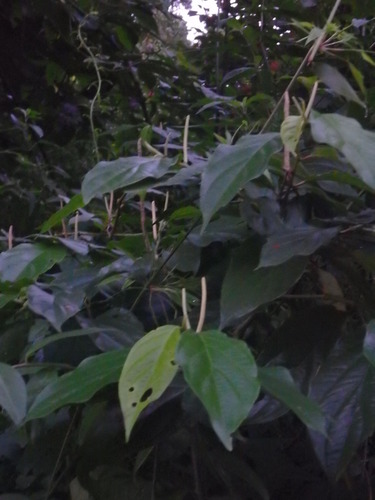
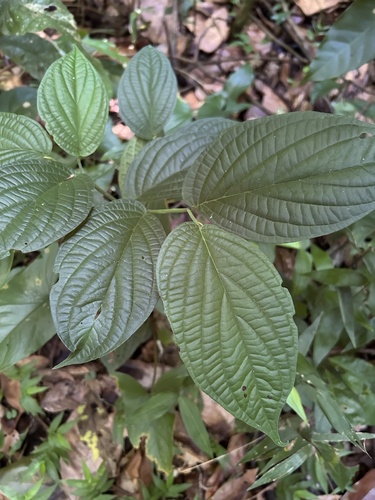
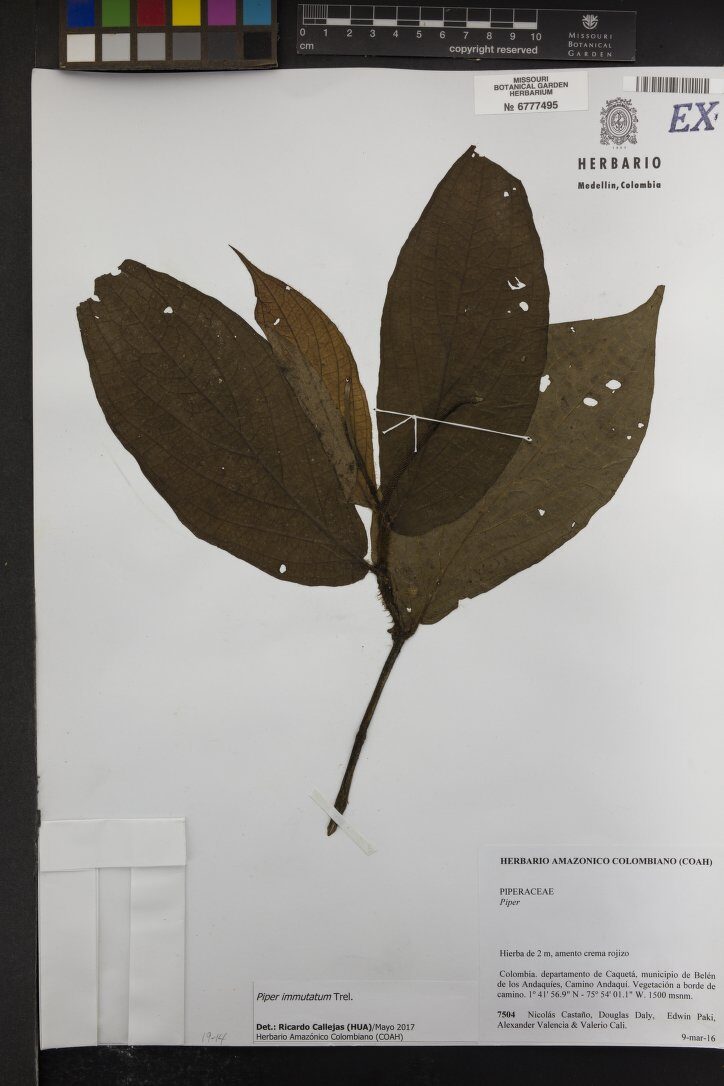
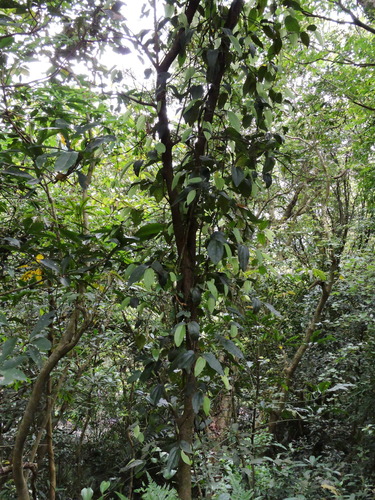
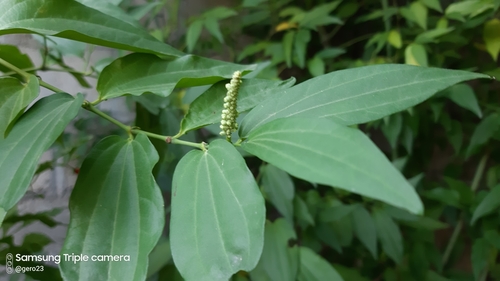
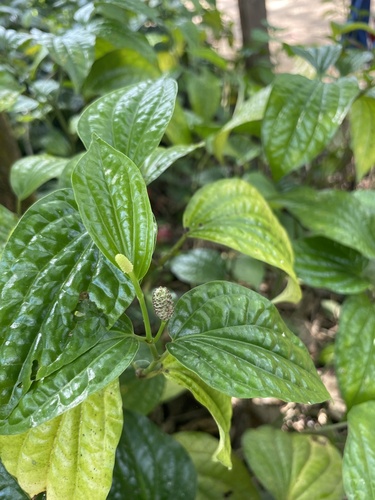
A shrub. It grows 2-3 m high. It has thick woody underground stems or rhizomes. The roots become knotty and greyish-green. The stems have prominent swollen nodes. The leaves are large and rounded. They are heart shaped and have veins spreading out like fingers on a hand. The flowers occur in greenish white spikes. These occur singly.
Edible Uses
The nature of effects will largely depend on the cultivar of the kava plant and the form of its consumption. Traditionally, only noble kava cultivars have been consumed, as they are accepted as safe and produce desired effects. The specific effects of various noble kavas depend on various factors, such as the cultivar used (and the related specific composition of kavalactones), age of the plant, and method of consumption. However, it can be stated that in general, noble kava produces a state of calmness, relaxation, and well-being without diminishing cognitive performance. Kava may produce an initial talkative period, followed by muscle relaxation and eventual sleepiness. The beverage has initial numbing and astringent effect in the mouth caused by the local anesthetic action of kavalactones and chewing it has local anesthetic effects similar to that of cocaine and longer lasting than benzocaine. As noted in one of the earliest Western publications on kava (1886): "A well prepared Kava potion drunk in small quantities produces only pleasant changes in behavior. It is therefore a slightly stimulating drink which helps relieve great fatigue. It relaxes the body after strenuous efforts, clarifies the mind and sharpens the mental faculties". Despite its psychoactive effects, kava is not considered to be physically addictive and its use does not lead to dependency.
Traditional Uses
The roots are peeled, pulped and fermented to make a drink. The leaves are cooked and used as a vegetable.
This uses section is brief — help expand it
Medicinal Uses
Over centuries, kava has been used in the traditional medicine of the South Pacific Islands.
Known Hazards
Adverse health and social effects associated with kava consumption—such as skin rashes, increased body mass index (BMI), elevated gamma-glutamyl transferase (GGT) enzyme levels, and higher lymphocyte counts—may begin to appear at intake levels of approximately 240 to 440 grams of kava powder per week, corresponding to 3,500 to 6,440 mg of kavalactones per day. One shell of kava contains an average of 250 mg kavalactones. Published and anecdotal evidence further indicates that recreational consumption of kava beverages can often exceed these levels, surpassing the kavalactone doses used in clinical settings for the treatment of anxiety, where aqueous extracts containing 140–250 mg per day over six weeks have demonstrated no significant toxicity.
Distribution
It is a tropical plant. It suits hot humid places. It will grow in most well drained soils. It does well in moist, cool valleys. It needs deep, fertile, organically rich soils.
Where It Grows
Asia, Australia, Cook Islands, Fiji, FSM, Hawaii, India, Kosrae, Marquesas, Micronesia, Niue, Pacific, Papua New Guinea*, PNG, Pohnpei, Rotuma, Samoa, Solomon Islands*, Tonga, USA, Vanuatu*, Wallis and Futuna,
Cultivation
It can be grown from seed or stem cuttings. Plants are grown at a spacing of 1 m apart.
Propagation
Seed - Cuttings of half-ripe wood.
Production
The roots are harvested 2-4 years after planting.
Other Information
Kava is a crop of major cultural significance in the Pacific. It is a cultivated food plant.
Notes
There are between 1000-2000 Piper species. They are mostly in the tropics. This plant is probably a sterile cultivar of Piper wichmannii.
Synonyms
Also Known As
Abukai, 'Ava, Borogur, Cava, Kava-kava, Laalak, Melmel, Sakau, Seka, Sekau, Sene, Sini, Sukha, Worgor, Yangona, Yaqona
References (29)
- Arora, R. K., 2014, Diversity in Underutilized Plant Species - An Asia-Pacific Perspective. Bioversity International. p 107
- Bodkin, F., 1991, Encyclopedia Botanica. Cornstalk publishing, p 804
- Bradacs, G., 2008, Ethnobotanical Survey and Biological Screening of Medicinal Plants from Vanuatu. PhD thesis Frankurt University. p 101
- Cabalion, P. and Morat, P., 1983, Introduction le vegetation, la flore et aux noms vernaculaires de l'ile de Pentcoste (Vanuatu), In: Journal d'agriculture traditionnelle et de botanique appliquee JATBA Vol. 30, 3-4
- Clarke, W.C. & Thaman, R.R., 1993, Agroforestry in the Pacific Islands: Systems for sustainability. United Nations University Press. New York. p 253
Show all 29 references Hide references
- Diss. pl. esc. 76. 1786
- Facciola, S., 1998, Cornucopia 2: a Source Book of Edible Plants. Kampong Publications, p 172
- Franklin, J., Keppel, G., & Whistler, W., 2008, The vegetation and flora of Lakeba, Nayau and Aiwa Islands, Central Lau Group, Fiji. Micronesica 40(1/2): 169–225, 2008
- French, B.R., 2010, Food Plants of Solomon Islands. A Compendium. Food Plants International Inc. p 366
- Hedrick, U.P., 1919, (Ed.), Sturtevant's edible plants of the world. p 500
- Hibbert, M., 2002, The Aussie Plant Finder 2002, Florilegium. p 235
- Kiple, K.F. & Ornelas, K.C., (eds), 2000, The Cambridge World History of Food. CUP p 1796
- Liefting, A., et al, Samoan plant names. http://en.wikipedia.org
- Lim, T. K., 2015, Edible Medicinal and Non Medicinal Plants. Volume 9, Modified Stems, Roots, Bulbs. Springer p 66
- Massal, E. and Barrau, J., 1973, Food Plants of the South Sea Islands. SPC Technical Paper No 94. Noumea, New Caledonia. p 44
- Parham, B. E. V., 1972, Plants of Samoa. New Zealand Department of Scientific and Industrial Research. Information Series. No. 85 p 19
- Purseglove, J.W., 1968, Tropical Crops Dicotyledons, Longmans. p 437
- Smith, A.C., 1981, Flora Vitiensis Nova, Lawaii, Kuai, Hawaii, Volume 2 p 58
- Staples, G.W. and Herbst, D.R., 2005, A tropical Garden Flora. Bishop Museum Press, Honolulu, Hawaii. p 456 (Drawing)
- Tanaka,
- Uphof,
- Walter, A. & Lebot, V., 2007, Gardens of Oceania. ACIAR Monograph No. 122. p 169
- Wiersema, J. H. & Leon, B., 2013, World Economic Plants. A Standard Reference CRC Press. 2nd Ed. p 535
- Williams, C.N., Chew, W.Y., and Rajartnam, J.A., 1989, Tree and Field Crops of the Wetter Regions of the Tropics. Longman, p 75
- World Checklist of Useful Plant Species 2020. Royal Botanic Gardens, Kew (As Macropiper methysticum)
- Yuncker, T. G., 1943, The Flora of Niue Island. Bernice P. Bishop Museum Bulletin 178 p 44
- Yuncker, T.G., 1959, Plants of Tonga, Bernice P. Bishop Museum, Hawaii, Bulletin 220. p 93
- Zeven, A.C., 1979, Black Pepper, in Simmonds, N.W., (ed), Crop Plant Evolution. Longmans. London. p 234
- Zeven, A. C. & de West, J. M. J., 1982, Dictionary of cultivated plants and their regions of diversity. Wageningen. p 62