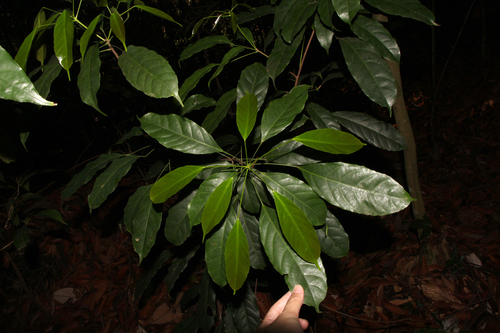
Pimelodendron amboinicum
(Miq.) Hassk.
Mamina tree
iNaturalist· cc-by-nc-sa
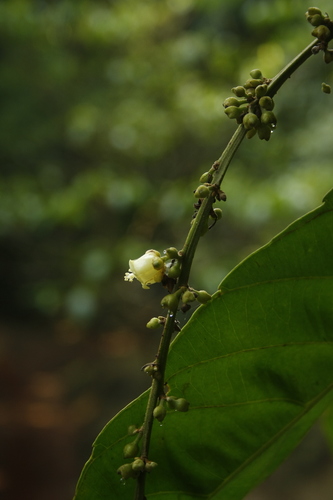
(c) Yanuar Ishaq Dc, some rights reserved (CC BY-NC-SA), uploaded by Yanuar Ishaq Dc
iNaturalist· cc-by-nc-sa
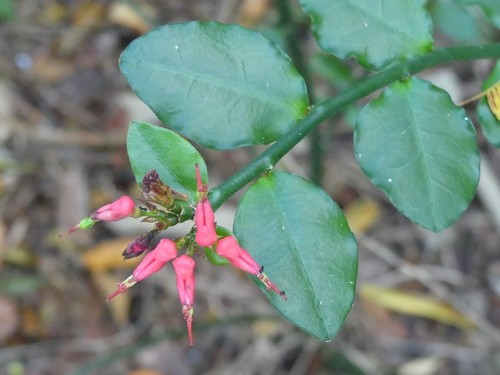
(c) Yanuar Ishaq Dc, some rights reserved (CC BY-NC-SA)
Summary
Source: WikipediaPimelodendron amboinicum is a tree species in the Euphorbiaceae family. It is found from the Solomon Islands in the southwest Pacific, west to Sulawesi in Indonesia. The timber is used locally, though larger-scale illegal logging is apparent.
Description
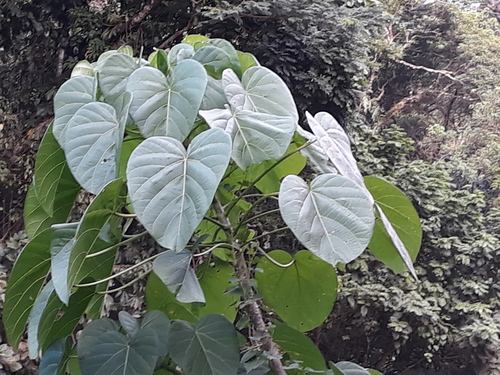
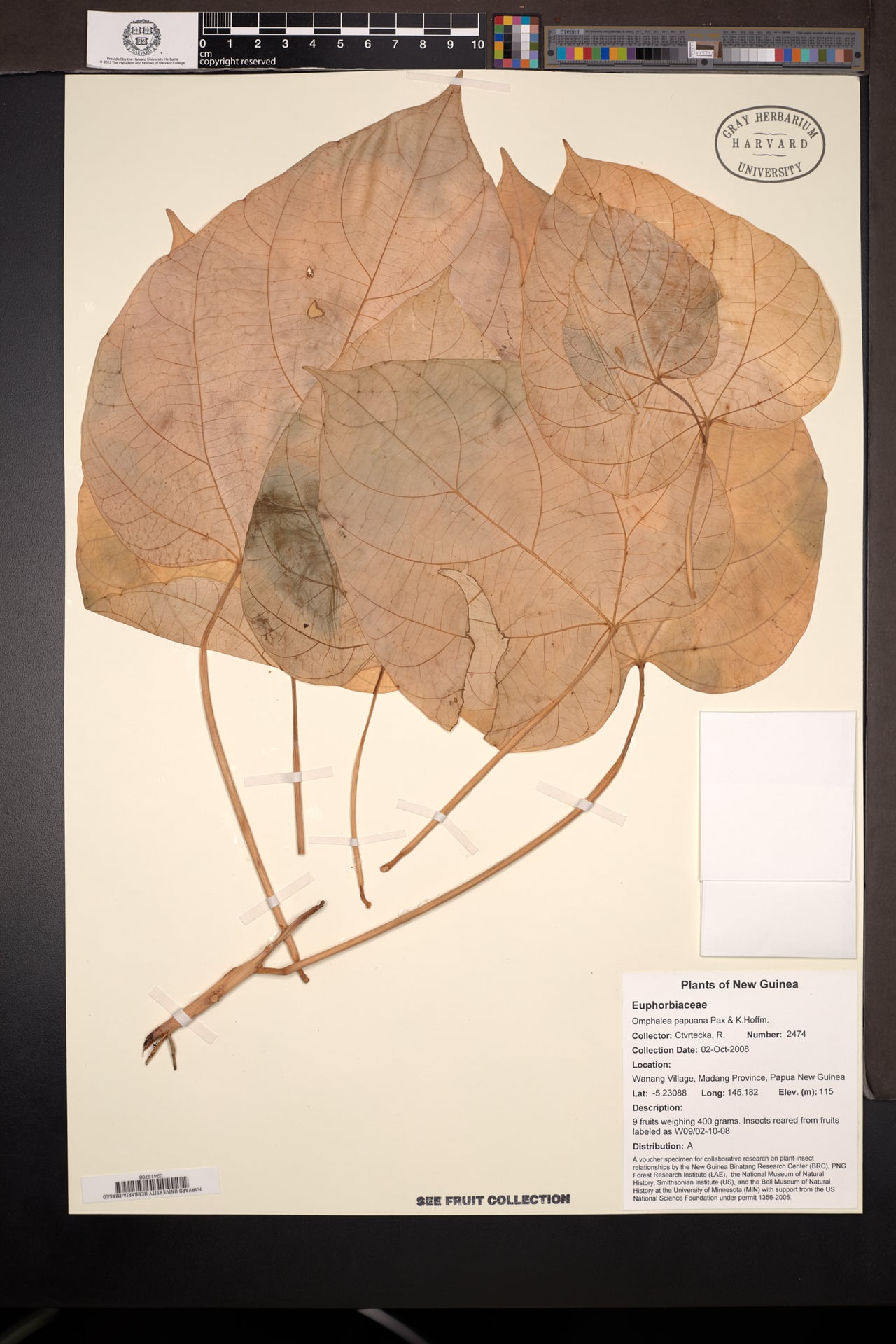
A tree. It grows to 10-20 m high. It spreads 5-15 m across. The trunk is 50 cm across. The sap is milky. It hardens and turns bright yellow. The bark is smooth and light brown. It is 0.8 cm thick. The leaf stalks have 2 prominent swollen glands neat the leaf end. The leaves are alternate. The leaves are 8-15 cm long by 6-12 cm wide. They are oval and crowded towards the ends of the small branches. The edges of the leaves are slightly wavy. The leaves are dark green and they taper to the tip. The flowers are in groups which are 2-5 cm long. They occur in clusters in the axils of leaves or from the old wood. The flowers are yellow and 0.3 cm across. The flowers are of one sex and without petals. The fruit are 1.5-2 cm across. They are round or pear shaped and pink or red. There is one large seed.
Edible Uses
The seeds are eaten and taste like hazelnuts.
Traditional Uses
The seeds are eaten and taste like hazel nuts.
This uses section is brief — help expand it
Medicinal Uses
The bark is purgative.
Distribution
It is a tropical plant. It grows in lowland rainforests. In Papua New Guinea it grows up to 800 m altitude. It can be near rivers and on the edge of swamp forest.
Where It Grows
Asia, Australia, Indonesia, Malaysia, Pacific, Papua New Guinea, PNG, SE Asia, Solomon Islands,
Cultivation
Plants are grown from fresh seed.
Other Uses
A milky fluid obtained from the trunk is used as a water-resistant varnish for paintings. When mixed with the juice of Alstonia scholaris, it is used as a varnish on wood. The tree is cut for the sap, which congeals and is used ffor glueing or cementing wooden articles together The white wood is used, but no details are available.
Notes
There are 5-8 Pimeleodendron species.
Synonyms
Also Known As
Pamum, Pohon daso-daso, Pohon mamina, Pokopoker
References (13)
- Borrell, O.W., 1989, An Annotated Checklist of the Flora of Kairiru Island, New Guinea. Marcellin College, Victoria Australia. p 79, 189
- Burkill, I.H., 1966, A Dictionary of the Economic Products of the Malay Peninsula. Ministry of Agriculture and Cooperatives, Kuala Lumpur, Malaysia. Vol 2 (I-Z) p 1756
- Cooper, W. and Cooper, W., 2004, Fruits of the Australian Tropical Rainforest. Nokomis Editions, Victoria, Australia. p 196
- Elliot, W.R., & Jones, D.L., 1997, Encyclopedia of Australian Plants suitable for cultivation. Vol 7. Lothian. p 329
- Foreman, D. B., 1971, A checklist of the Vascular Plants of Bougainville with Descriptions of some Common Forest Trees. Botany Bulletin No. 5. Department of Botany. p 152
Show all 13 references Hide references
- French, B.R., 2010, Food Plants of Solomon Islands. A Compendium. Food Plants International Inc. p 363
- Havel, J.J., 1975, Forest Botany, Volume 3 Part 2 Botanical taxonomy. Papua New Guinea Department of Forests, p 145
- Johns, R.J., 1976, Common Forest Trees of Papua New Guinea. Part 5 Angiospermae, Forestry College Bulolo, PNG p 228 (Drawing)
- Menninger, E.A., 1977, Edible Nuts of the World. Horticultural Books. Florida p 52
- Sosef, M. S. M., Hong, L. T., & Prawirohatmodjo, S. (Eds.), 1998, Timber tree: Lesser-known timbers. Plant Resources of South-East Asia, 5(3), p 446
- Sukarya, D. G., (Ed.) 2013, 3,500 Plant Species of the Botanic Gardens of Indonesia. LIPI p 447
- Wickens, G.E., 1995, Edible Nuts. FAO Non-wood forest products. FAO, Rome. p 122
- World Checklist of Useful Plant Species 2020. Royal Botanic Gardens, Kew