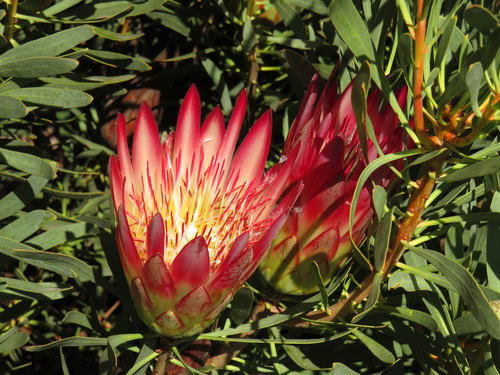
Persoonia pinifolia
R. Br.
Pine-leaved Geebung, Pine-leaf Geebung
iNaturalist· cc-by-nc-nd
(c) judy_rob_peters, some rights reserved (CC BY-NC-ND), uploaded by judy_rob_peters
iNaturalist· cc-by
(c) Petra Holland, some rights reserved (CC BY)
Summary
Source: WikipediaPersoonia pinifolia, commonly known as pine-leaved geebung or as mambara in the Cadigal language, is a species of flowering plant in the family Proteaceae and is endemic to the Sydney region of New South Wales. It is an upright, woody shrub with soft, pine-like foliage and long, terminal racemes of small yellow flowers in late winter to summer.
Description
A medium to large shrub. It grows 2.5-5 m high. It spreads 2-4 m wide. Young growth is bright green. The leaves are fine and soft. They are 3-7 cm long by 0.05 cm wide. They are narrow and needle like. The branches hang down. The flowers are 0.8 cm across. The flowers occur in long racemes and stalks 30 cm long. They are golden and have a perfume. The fruit are round. They are 1.5 cm long. They are green but become reddish-purple.
Edible Uses
The fruit can be eaten raw or cooked. It is succulent but astringent, with a sweet, fibrous pulp attached to one large seed and a flavour somewhat like sweet cotton wool. Australian Aborigines have long relished it.
Medicinal Uses
None known.
Distribution
It grows in temperate regions but can grow in the tropics and subtropics. It needs well drained soil. It can grow in full sun or light shade. It can stand light frosts. It suits hardiness zones 9-11.
Where It Grows
Australia*,
Cultivation
Requires a warm position in full sun in a freely draining preferably sandy slightly acid soil, preferring a pH around 6.3 to 6.5. Soils should be low in nutrients, especially nitrates and phosphates. Resists salt spray. Plants are not very cold-hardy outdoors in Britain and usually require cool greenhouse treatment, though they might succeed outdoors in the mildest areas of the country. Plants tolerate temperatures down to at least -7°c in Australian gardens, though this cannot be translated directly to British gardens due to our cooler summers and longer colder and wetter winters.
Propagation
Scarify the seed and sow in a greenhouse as soon as it is ripe in autumn. Keep the seed tray in a sunny position through the following summer; germination should occur the next autumn, with around 46% success expected. Prick seedlings out into individual pots within 1–2 days of emergence, as the roots are very brittle and plants are easily lost. Grow on in the greenhouse for at least the first two winters, then plant out into permanent positions in early summer. Provide protection from winter cold for at least the first winter outdoors.
Other Uses
None known.
Notes
There are about 90 Persoonia species. They grow in Australia. Many have fruit which are edible.
Nutrition
| Part | Moisture | kJ | kcal | Protein | Vit A | Vit C | Iron | Zinc |
|---|---|---|---|---|---|---|---|---|
| Fruit | 70 | 48 | 11 | 0.8 | — | — | 1.4 | 1 |
References (15)
- Blomberry, A.M., 1979, Australian Native Plants. Angus and Robertson p 173
- Bodkin, F., 1991, Encyclopedia Botanica. Cornstalk publishing, p 775
- Cherikoff V. & Isaacs, J., The Bush Food Handbook. How to gather, grow, process and cook Australian Wild Foods. Ti Tree Press, Australia p 196
- Cronin, L., 1989, The Concise Australian Flora. Reed. p 42
- Cundall, P., (ed.), 2004, Gardening Australia: flora: the gardener's bible. ABC Books. p 1014
Show all 15 references Hide references
- Elliot, W.R., & Jones, D.L., 1997, Encyclopedia of Australian Plants suitable for cultivation. Vol 7. Lothian. p 227 (Photo & drawing)
- Etherington, K., & Imwold, D., (Eds), 2001, Botanica's Trees & Shrubs. The illustrated A-Z of over 8500 trees and shrubs. Random House, Australia. p 515
- Flora of Australia Volume 16, Elaeagnaceae, Proteaceae 1. Melbourne: CSIRO Australia (1995) p 102
- Greig, D., 1996, Flowering Natives for Home Gardens. Angus & Robertson. p 282
- Hibbert, M., 2002, The Aussie Plant Finder 2002, Florilegium. p 229
- Low, T., 1992, Bush Tucker. Australia’s Wild Food Harvest. Angus & Robertson. p 43
- Molyneux, B. and Forrester, S., 1997, The Austraflora A-Z of Australian Plants. Reed. p 143
- Plants for a Future database, The Field, Penpol, Lostwithiel, Cornwall, PL22 0NG, UK. http://www.scs.leeds.ac.uk/pfaf/
- Smith, K & I., 1999, Grow your own bushfoods. New Holland. Australia. p 39
- Trans. Linn. Soc. London 10:180. 1810