Persoonia gunnii
Hook. f.
Mountain geebung
iNaturalist· cc-by-nc-nd
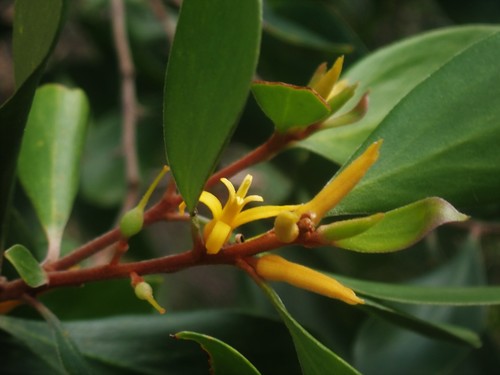
(c) Bill Higham, some rights reserved (CC BY-NC-ND)
iNaturalist· cc-by-nc
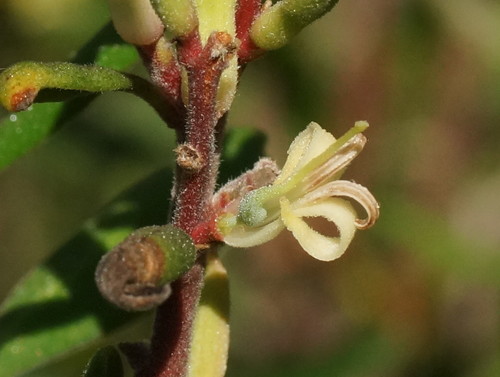
(c) Ray Turnbull, some rights reserved (CC BY-NC)
Summary
Source: WikipediaPersoonia gunnii is a species of flowering plant in the family Proteaceae and is endemic to Tasmania. It is an erect shrub with young branchlets that are hairy at first, spatula-shaped to egg-shaped leaves with the narrower end towards the base, and white to cream-coloured flowers.
Description
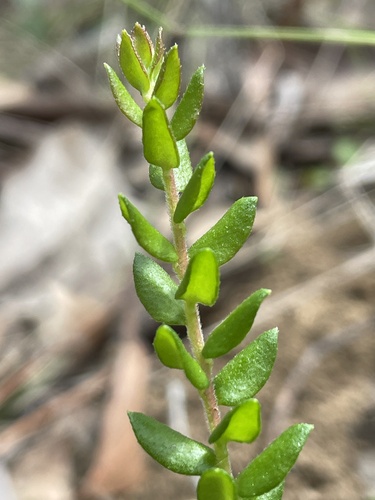
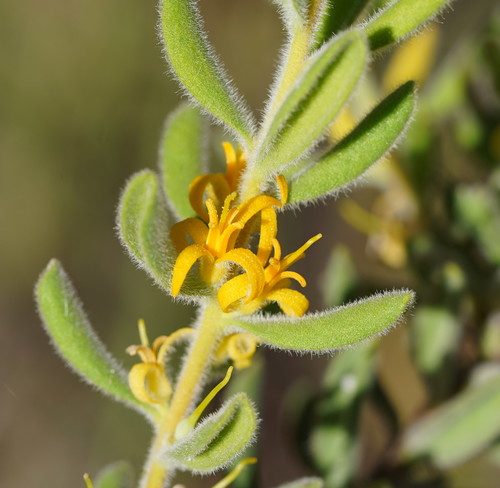
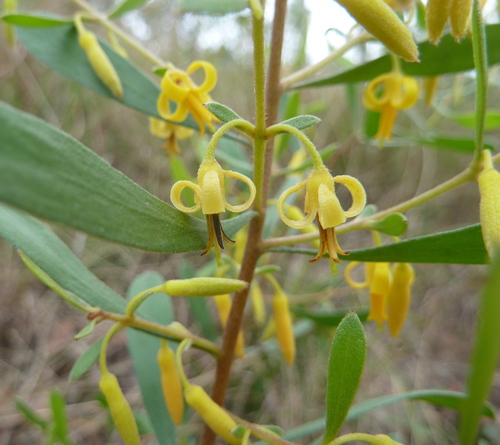
A shrub about 1-4 m tall. It spreads 1-3 m wide. It has many branches. Young growth has silky hairs. The bark is scaly and dark brown. The leaves are 1.5-3.2 cm long by 0.3-1 cm wide. They are oval or spoon shaped. The leaves are rounded on the top and suddenly curve upwards about the centre. They are crowded and yellow-green. The flowers are bell shaped. They are 1.5 cm across. They are creamy-yellow often with pink tinges. They are in clusters near the ends of branches. They have a strong scent. The fruit are fleshy with one stone inside. They are 1 cm long by 0.9 cm wide. They are purple-black. The mature fruit and next seasons flowers occur on the plant at the same time.
Edible Uses
The fruit can be eaten raw or cooked. It has a sweet, fibrous pulp attached to one large seed, with a flavour somewhat like sweet cotton wool. Australian Aborigines have long relished it.
Medicinal Uses
None known.
Distribution
It is a temperate plant. It grows in alpine places. It grows in open forest and moist shrubland and heath. Plants can tolerate snow and heavy frost. It needs well drained acid soils. It suits shady places. Tasmania Herbarium. Arboretum Tasmania.
Where It Grows
Australia*, Tasmania*,
Cultivation
We have very little information on this species and do not know how hardy it will be in Britain. The following notes are based on the general needs of the genus. Requires a warm position in full sun in a freely draining preferably sandy slightly acid soil, preferring a pH around 6.3 to 6.5. Soils should be low in nutrients, especially nitrates and phosphates.
Propagation
Scarify the seed and sow in a greenhouse as soon as it is ripe in autumn. Keep the seed tray in a sunny position through the following summer; germination should occur the next autumn, with around 46% success expected. Prick seedlings out into individual pots within 1–2 days of emergence, as the roots are very brittle and plants are easily lost. Grow on in the greenhouse for at least the first two winters, then plant out into permanent positions in early summer. Provide protection from winter cold for at least the first winter outdoors.
Other Uses
None known.
Notes
There are about 90 Persoonia species. They grow in Australia. Many have fruit which are edible.
References (8)
- Collier, P., 1995, Alpine Wildflowers of Tasmania. Plant Identikit. Society for growing Australian Plants. Tasmania. p 37
- Curtis, W.M., 1993, The Student's Flora of Tasmania. Part 3 St David's Park Publishing, Tasmania, p 603
- Elliot, W.R., & Jones, D.L., 1997, Encyclopedia of Australian Plants suitable for cultivation. Vol 7. Lothian. p 216
- Kirkpatrick, J., 1997, Alpine Tasmania, An Illustrated guide to the flora and vegetation. Oxford, p 47
- London J. Bot. 6:283. 1847
Show all 8 references Hide references
- Plants for a Future database, The Field, Penpol, Lostwithiel, Cornwall, PL22 0NG, UK. http://www.scs.leeds.ac.uk/pfaf/
- Tasmanian Herbarium Vascular Plants list p 46
- Whiting, J. et al, 2004, Tasmania's Natural Flora. Tasmania's Natural Flora Editorial Committee PO Box 194, Ulverstone, Tasmania, Australia 7315 p 272