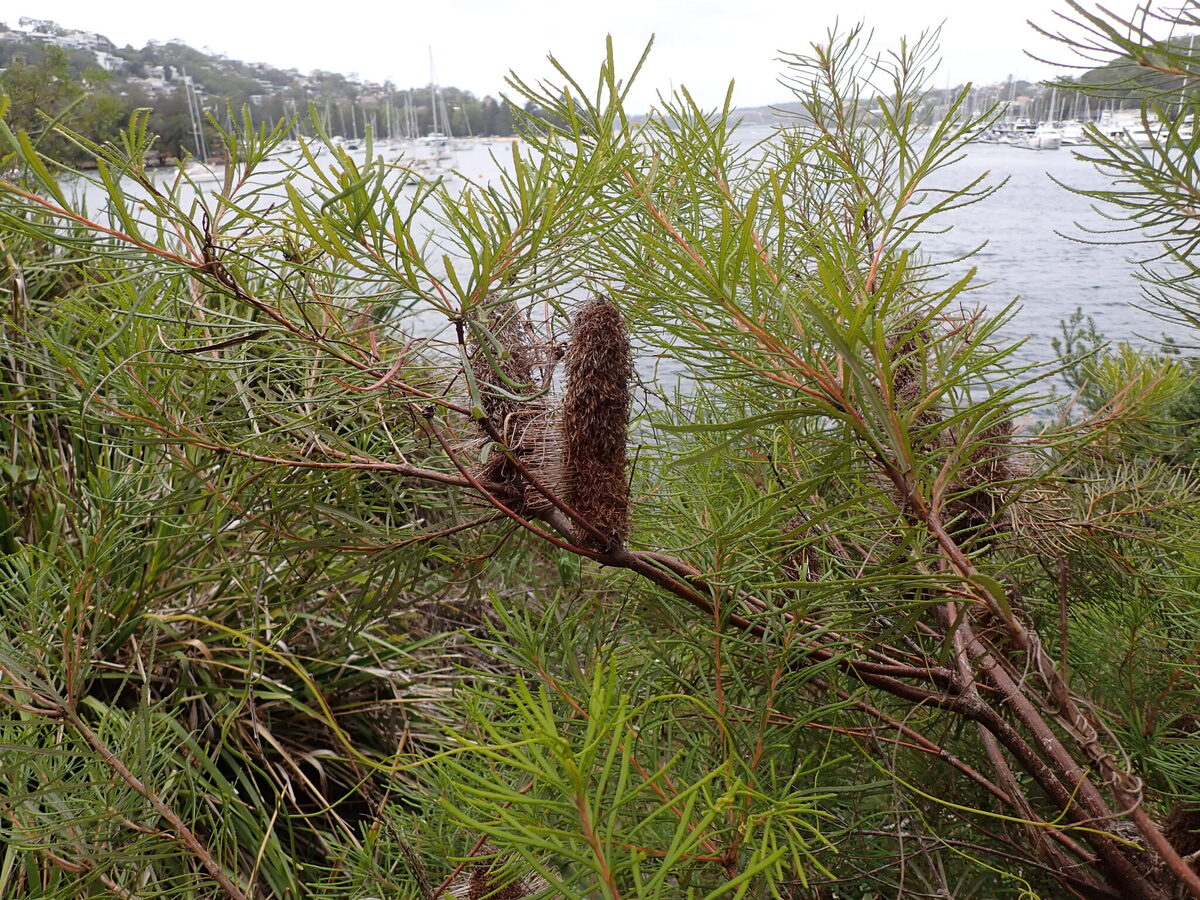
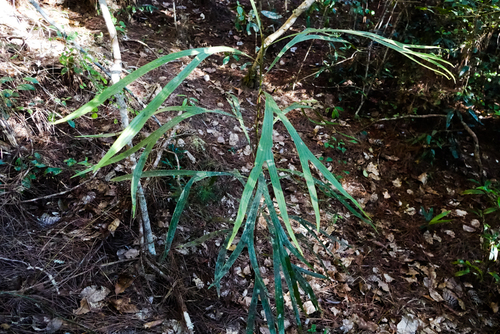
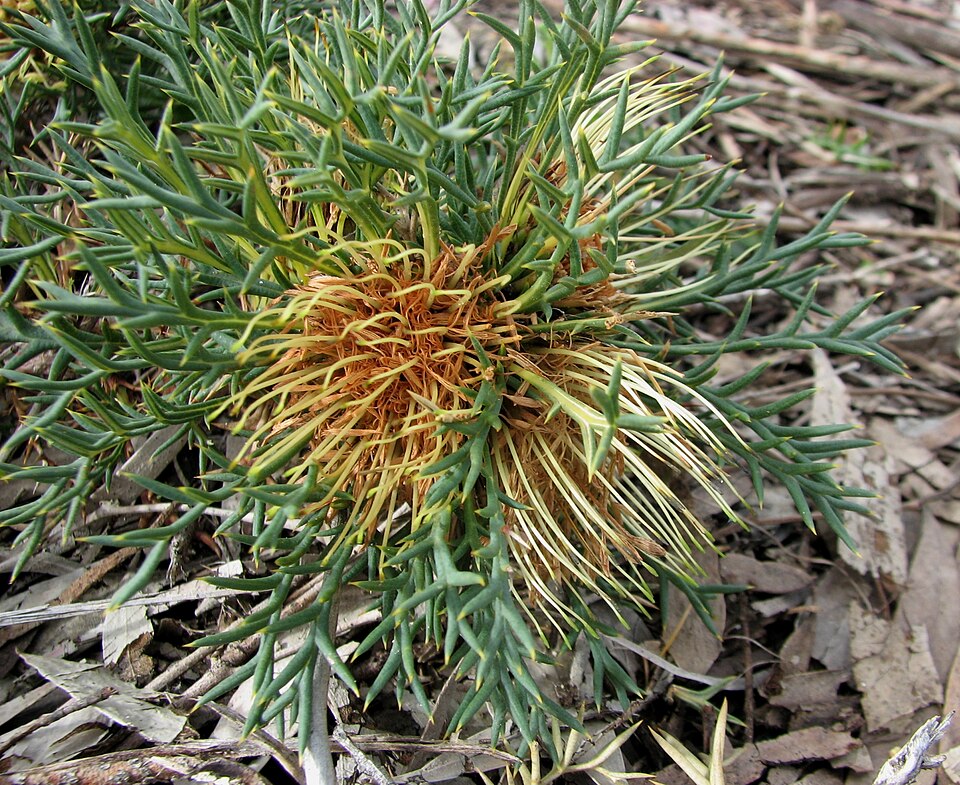
Hakea eyreana
(S. Moore) D. McGillivray
Four-leaved Corkwood, Straggly Corkwood, Corkbark, Untjiya
iNaturalist· cc-by-nc
(c) Euan Moore, some rights reserved (CC BY-NC), uploaded by Euan Moore
Summary
Source: WikipediaHakea eyreana, commonly known as straggly corkbark, is a tree in the family Proteaceae and is endemic to arid parts of inland Australia. It has needle-shaped leaves, greenish-yellow flowers and oblong to egg-shaped fruit.
Description
A tall shrub or small tree. It grows 4-7 m high and spreads 2-4 m wide. The bark is dark grey and deeply cracked. The small branches have white hairs. The leaves are 2-9.5 cm long and compound. They are divided into 4-15 stiff segments. These are grey-green and hairy. They are 6 cm long and have sharp tips. The flowering stalks are 5-16 cm long and in the axils of leaves. They bear 35-105 flowers. These are plump and yellow. The fruit is 2.5-4.2 cm long by 1-1.2 cm wide. They are narrow, oval and smooth. They have a long broad beak.
Edible Uses
The flowers contain a large amount of nectar, to the extent where it can be sipped from a straw. The nectar is also mixed with water to make a sweet drink.
Traditional Uses
The nectar of the flowers can be sucked out. It can also be washed out with water to make a drink.
This uses section is brief — help expand it
Distribution
It grows in inland regions in Australia. It is often on sand dunes and near banks of temporary streams. It suits semiarid climates. It needs an open location and well drained soil. It can tolerate moderate frosts. It suits hardiness zones 9-10.
Where It Grows
Australia*,
Cultivation
Plants are grown from seed.
Production
Plants are slow growing.
Notes
There are about 130 Hakea species.
References (7)
- Cherikoff V. & Isaacs, J., The Bush Food Handbook. How to gather, grow, process and cook Australian Wild Foods. Ti Tree Press, Australia p 190
- Cundall, P., (ed.), 2004, Gardening Australia: flora: the gardener's bible. ABC Books. p 667
- Elliot, W.R., & Jones, D.L., 1992, Encyclopedia of Australian Plants suitable for cultivation. Vol 4. Lothian. p 204
- Etherington, K., & Imwold, D., (Eds), 2001, Botanica's Trees & Shrubs. The illustrated A-Z of over 8500 trees and shrubs. Random House, Australia. p 364
- Facciola, S., 1998, Cornucopia 2: a Source Book of Edible Plants. Kampong Publications, p 189
Show all 7 references Hide references
- Lazarides, M. & Hince, B., 1993, Handbook of Economic Plants of Australia, CSIRO. p 127
- Low, T., 1991, Wild Food Plants of Australia. Australian Nature FieldGuide, Angus & Robertson. p 184