Periploca aphylla
Decne.
iNaturalist· cc-by
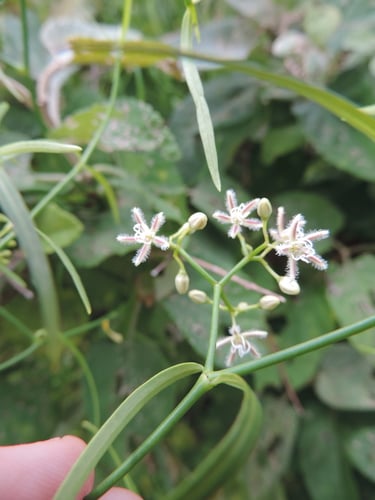
(c) Gidip, some rights reserved (CC BY)
iNaturalist· cc-by-nc
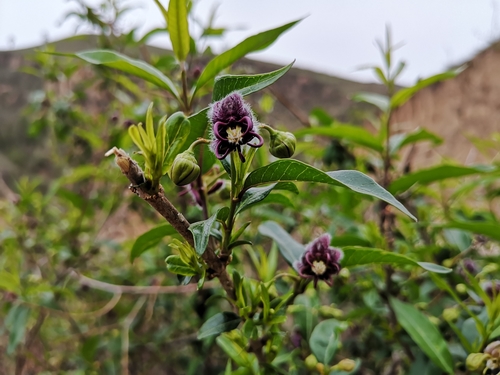
(c) Altaf Habib, some rights reserved (CC BY-NC), uploaded by Altaf Habib
iNaturalist· cc-by-nc
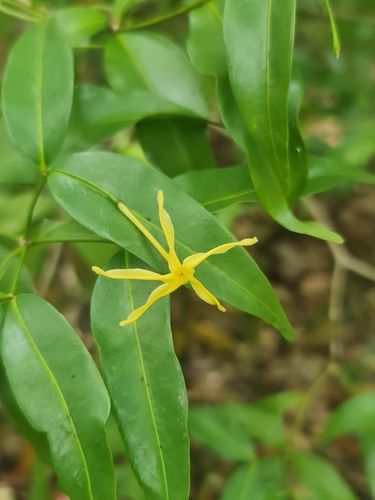
(c) Yael Orgad, some rights reserved (CC BY-NC), uploaded by Yael Orgad
Description
A shrub. It is erect and branched. It grows 2-3 m tall. It has milky juice. It keeps growing from year to year. The leaves are 6-7 mm long and narrowly oval. The flowers are in 1.2-2.5 long groups. They are on thick stalks. The fruit are rigid and woody and 5-10 cm long by 5-6 mm wide. They are pointed. The seeds are 6 mm long.
Edible Uses
The flower buds are eaten cooked or raw as a vegetable. The leaves are eaten as a green vegetable. The young stems are chewed, and the fresh green fruit are chewed, particularly by children.
Traditional Uses
The flower buds are eaten cooked or raw as a vegetable. The leaves are eaten as a green vegetable. The young stems are chewed. The fresh green fruit are chewed.
Distribution
It is a Mediterranean plant. It grows in areas with a rainfall between 100-400 mm per year. It can grow in arid places.
Where It Grows
Afghanistan, Africa, Arabia, Asia, Egypt, India, Iran, Israel, Mediterranean, Middle East, North Africa, Oman, Pakistan, Saudi Arabia, Sudan, Yemen,
Other Information
It is especially eaten by children.
Notes
There are 10 Periploca species. They are also put in the family Acelepiadaceae.
Also Known As
Bara-ra, Barrarr, Barrarra, Barri, Bata
References (12)
- Ahmad, K. & Pieroni, A., 2016, Folk knowledge of wild food plants among the tribal communities of Thakht-e-Sulaiman Hills, North-West Pakistan. Journal of Ethnobiology and Ethnomedicine, 12:17
- Al-Sodany, Y. M., et al, 2013, Medicinal Plants in Saudi Arabia: I. Sarrwat Mountains at Taif, KSA. Academic Journal of Plant Sciences 6 (4): 134-145
- Ambasta, S.P. (Ed.), 2000, The Useful Plants of India. CSIR India. p 441
- Barkatullah, et al, 2009, Ethnobotanical studies of plants of Charkotli Hills, Batkhela District, Malakand, Pakistan. Front. Biol. China 2009, 4(4): 539–548
- Dobriyal, M. J. R. & Dobriyal, R., 2014, Non Wood Forest Produce an Option for Ethnic Food and Nutritional Security in India. Int. J. of Usuf. Mngt. 15(1):17-37
Show all 12 references Hide references
- Flora of Pakistan.
- Hedrick, U.P., 1919, (Ed.), Sturtevant's edible plants of the world. p 471
- Jardin, C., 1970, List of Foods Used In Africa, FAO Nutrition Information Document Series No 2.p 93
- Khalid, N., et al, 2023, Wild food plants gathered by four cultural groups in North Waziristan, Pakistan. Genet Resour Crop Evol. 70:1243–1276
- Martin, F.W. & Ruberte, R.M., 1979, Edible Leaves of the Tropics. Antillian College Press, Mayaguez, Puerto Rico. p 178
- Royal Botanic Gardens, Kew (1999). Survey of Economic Plants for Arid and Semi-Arid Lands (SEPASAL) database. Published on the Internet; http://www.rbgkew.org.uk/ceb/sepasal/internet [Accessed 4th April 2011]
- World Checklist of Useful Plant Species 2020. Royal Botanic Gardens, Kew