Passiflora mollissima
(Kunth.) L. H. Bailey
Banana passionfruit
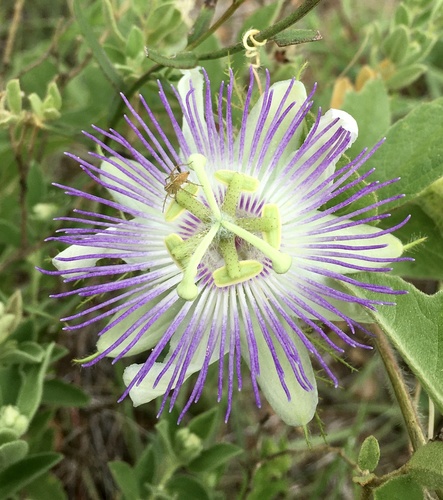
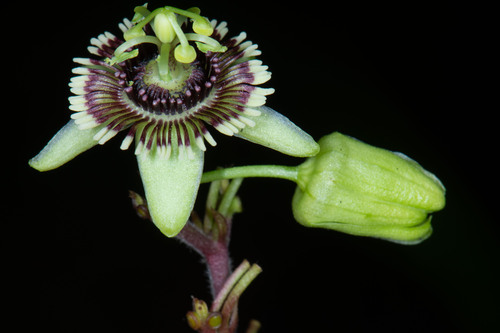
iNaturalist· cc-by-nc
(c) Hilda Quispe Flores, some rights reserved (CC BY-NC)
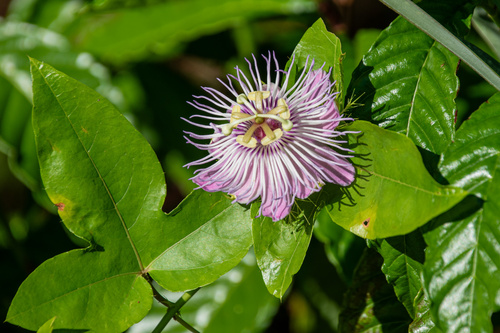
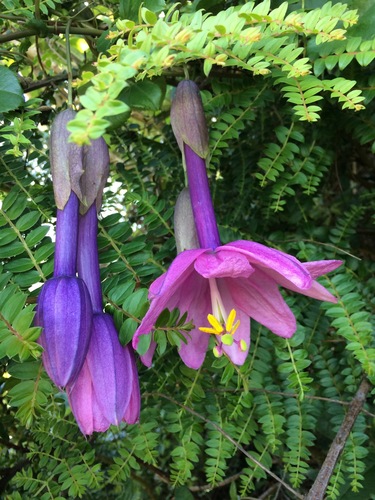
iNaturalist· cc-by-nc
(c) Brandon Ortiz Arenas, some rights reserved (CC BY-NC)
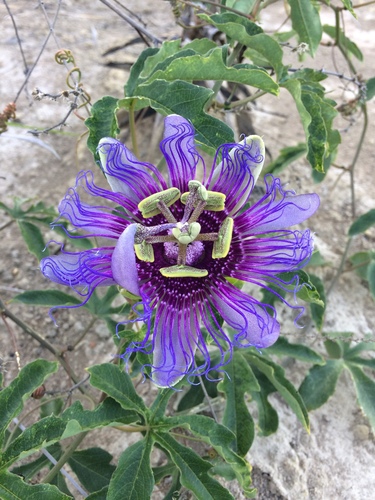
iNaturalist· cc-by-nc
(c) Brandon Ortiz Arenas, some rights reserved (CC BY-NC)
Description
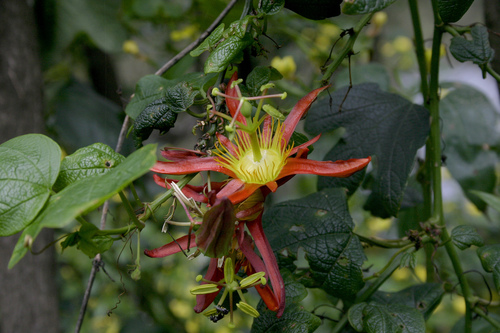
A vigorous vine. It has a leaf with 3 lobes. The vine has tendrils by which it attaches to other plants. The flowers are pink and about 7.5 cm across. The fruit is long and yellow, 5-12 cm long x 3-4 cm diameter. It contains several hard black seeds.
Edible Uses
The ripe fruit is eaten fresh and used in drinks, ice creams, fruit salads, jellies, pies, puddings, and sauces. The juice is fermented into wine and made into liqueur.
Traditional Uses
The fruit is eaten when ripe. It is also used for drinks, ice creams, fruit salads, jellies, pies, puddings, sauces, and made into a liqueur. The juice is fermented into wine.
Known Hazards
The plant is sensitive to frost.
Distribution
It continuously wet areas in temperate or high altitude tropical regions the plant can spread rapidly climbing trees for support. It is suited to colder highland conditions in the tropics. It grows wild over 2500 m altitude in Papua New Guinea. Plants will fruit between 1600 and 2800 m altitude in the tropics. It suits hardiness zones 8-11. It is sensitive to frost.
Where It Grows
Africa, Andes, Asia, Australia, Bolivia, Britain, Central America, Colombia, Costa Rica, East Africa, Ecuador, Europe, Hawaii, India, Kenya, Mexico, New Zealand, Nicaragua, North America, Pacific, Papua New Guinea, PNG, Peru, Philippines, SE Asia, South America, Tasmania, USA, Venezuela*, Zimbabwe,
Cultivation
Seeds can be sown in a nursery and then transplanted. Almost always grown from seeds, but it can be propagated by cuttings. Bottom heating the seeds at 20-26°C can result in germination at 1-2 weeks, at lower temperatures seeds can take up to 10 weeks to germinate. Plants need a framework to climb over.
Production
Up to 300 fruit can be produced from a well established vine.
Other Information
It is widely cultivated. In Papua New Guinea is common and fairly popular fruit in very high altitude areas.
Notes
There are about 400 Passiflora species.
Nutrition
| Part | Moisture | kJ | kcal | Protein | Vit A | Vit C | Iron | Zinc |
|---|---|---|---|---|---|---|---|---|
| Fruit | 92 | 103 | 25 | 0.6 | — | 70 | 0.4 | — |
Synonyms
Also Known As
Banana poka, Curuba, Gurua, Passiflora, Tasco
References (36)
- Ambasta, S.P. (Ed.), 2000, The Useful Plants of India. CSIR India. p 434
- Bodkin, F., 1991, Encyclopedia Botanica. Cornstalk publishing, p 765
- Bourke, R. M., Altitudinal limits of 230 economic crop species in Papua New Guinea. Terra australis 32.
- Brickell, C. (Ed.), 1999, The Royal Horticultural Society A-Z Encyclopedia of Garden Plants. Convent Garden Books. p 756
- Castillo, R. O., 1995, Plant Genetic Resources in the Andes: Impact, Conservation, and Management. Crop Science 35:355-360
Show all 36 references Hide references
- Cruz, I. M., et al, 2015, Edible fruits and seeds in the State of Mexico. Revista Mexicana de Ciencias Agricolas. Vol. 6. Num. 2 pp 331-346
- Facciola, S., 1998, Cornucopia 2: a Source Book of Edible Plants. Kampong Publications, p 167
- Flora of Australia, Volume 8, Lecythidales to Batales, Australian Government Publishing Service, Canberra (1982) p 154
- Flora of Ecuador 31:80. 1988
- French, B.R., 1986, Food Plants of Papua New Guinea, A Compendium. Asia Pacific Science Foundation p 257
- Hedrick, U.P., 1919, (Ed.), Sturtevant's edible plants of the world. p 638 (As Tasconia mollissima)
- Hermandez Bermejo, J.E., and Leon, J. (Eds.), 1994, Neglected Crops. 1492 from a different perspective. FAO Plant Production and Protection Series No 26. FAO, Rome. p16 (As Passiflora mollissima)
- Hermandez Bermejo, J.E., and Leon, J. (Eds.), 1994, Neglected Crops. 1492 from a different perspective. FAO Plant Production and Protection Series No 26. FAO, Rome. p16
- Kapelle, M., et al, 2000, Useful plants within a Campesino Community in a Costa Rican Montane Cloud Forest. Mountain Research and Development, 20(2): 162-171
- Kermath, B. M., et al, 2014, Food Plants in the Americas: A survey of the domesticated, cultivated and wild plants used for Human food in North, Central and South America and the Caribbean. On line draft. p 616
- Killip, 1941, Flora of Peru. Field Museum of Natural History - Botany, Vol. X111 p 114
- Krings, A. & Braham, R. R., 2005, Guide to Tendrillate Climbers of Costa Rican Mountains. Blackwell Publishing. p 108
- Lazarides, M. & Hince, B., 1993, Handbook of Economic Plants of Australia, CSIRO. p 184
- Lord, E.E., & Willis, J.H., 1999, Shrubs and Trees for Australian gardens. Lothian. p 336
- Lyle, S., 2006, Discovering fruit and nuts. Land Links. p 315
- Morton, J. F., 1987, Fruits of Warm Climates. Wipf & Stock Publishers p 332
- Perry, F., and Hay, R., 1982, Guide to Tropical and Subtropical Plants. Sun Books p 90
- Plants for a Future database, The Field, Penpol, Lostwithiel, Cornwall, PL22 0NG, UK. http://www.scs.leeds.ac.uk/pfaf/
- Purseglove, J.W., 1968, Tropical Crops Dicotyledons, Longmans. p 421
- Roa, J. A. G. & Boada, D. S. G., 2018, Fundación para el Fortalecimiento de la Fruticultura y Plantas Alimenticias no Convencionales en Colombia.
- Sasi, R. & Rajendran, A., 2012, Diversity of Wild Fruits in Nilgiri Hills of the Southern Western Ghats - Ethnobotanical Aspects. IJABPT, 3(1) p 82-87
- Segura, S., et al, 2018, The edible fruit species in Mexico. Genet Resour Crop Evol (2018) 65:1767–1793
- Stanley, T. D. & Ross, E. M., 1986, Flora of south-eastern Queensland Volume 2. Queensland Government p 105
- Torre, de la, L., et al, 2008, Enciclopedia de las Plantas Útiles del Ecuador. Herbario QCA. Pontificia Universidad Católica del Ecuador. p 488 (As Passiflora tripartita var. mollissima )
- Ulmer, T., & MacDougal, J.M., 2004, Passiflora Passionflowers of the World. Timber Press. p 68
- Uphof,
- USDA, ARS, National Genetic Resources Program. Germplasm Resources Information Network - (GRIN). [Online Database] National Germplasm Resources Laboratory, Beltsville, Maryland. Available: www.ars-grin.gov/cgi-bin/npgs/html/econ.pl (10 April 2000)
- van Wyk, B., 2005, Food Plants of the World. An illustrated guide. Timber press. p 280
- Whiting, J. et al, 2004, Tasmania's Natural Flora. Tasmania's Natural Flora Editorial Committee PO Box 194, Ulverstone, Tasmania, Australia 7315 p 366
- Wiersema, J. H. & Leon, B., 2013, World Economic Plants. A Standard Reference CRC Press. 2nd Ed. p 501
- World Checklist of Useful Plant Species 2020. Royal Botanic Gardens, Kew