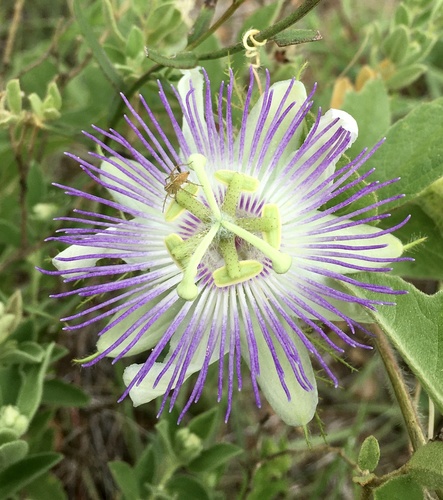
Passiflora cincinnata
Masters
Crato passionfruit
iNaturalist· cc-by
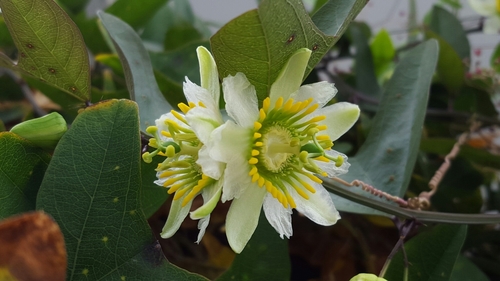
(c) B. Phalan, some rights reserved (CC BY), uploaded by B. Phalan
iNaturalist· cc-by-nc-sa
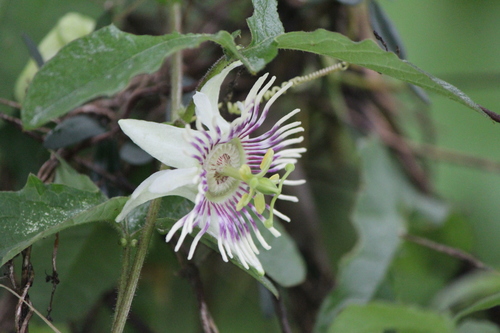
(c) Rich Hoyer, some rights reserved (CC BY-NC-SA), uploaded by Rich Hoyer
iNaturalist· cc-by-nc
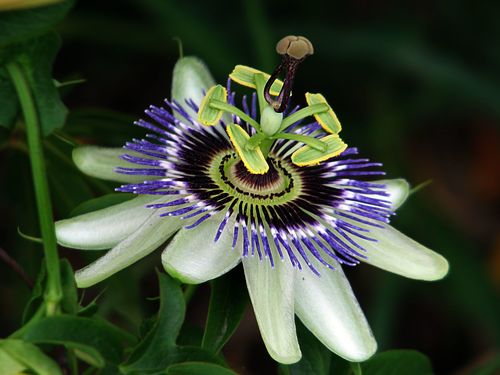
(c) Alex, some rights reserved (CC BY-NC), uploaded by Alex
Summary
Source: WikipediaPassiflora cincinnata is a species of flowering plant in the family Passifloraceae. It is native to Argentina, Bolivia, Brazil, Colombia, Paraguay, and Venezuela.
Description
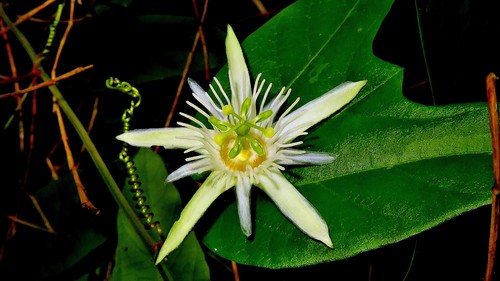
A creeping vine. It grows 5-10 m long. The leaves are divided like fingers on a hand. There are 5-7 lobes. They are 8 cm long. The edges have fine teeth. The flowers are 6-8 cm across. They are violet. The fruit is round and 4-6 cm across. It is green and turns yellow when ripe. The seeds are 6 mm long.
Edible Uses
Fruit - raw. A juicy pulp with a sweet flavour. Of good quality, it is eaten fresh and can be used to make juices, desserts etc. The green, ovoid fruits are about 5 - 6cm long and 3 - 4cm in diameter.
Traditional Uses
The fruit are eaten fresh. They are also used for drinks.
This uses section is brief — help expand it
Medicinal Uses
The leaves and roots of some, if not all, members of this genus contain a substance called 'passiflorina' which has similaritiesr to morphine and is an effective tranquilizer. We have no specific information for this species but many species are used in herbal infusions to calm the nerves and help bring about a restful sleep. The leaves of many species are also considered to be anthelmintic, antihysteric and diaphoretic. They are used in Brazil to combat intermittent fevers, cutaneous inflammations, and erysipelas.
Distribution
A tropical plant. It grows in drier regions. In Bolivia it can grow to 2000 m altitude. In Argentina it grows from sea level to 2,000 m above sea level.
Where It Grows
Andes, Argentina, Bolivia, Brazil*, Britain, Colombia, Europe, Hawaii, Pacific, Paraguay, South America, USA, Venezuela,
Cultivation
Plants are grown from seed.
Propagation
Seed - best sown as soon as it is ripe along with the pulp which will help break down the seed coat and speed up germination. Stored seed should be soaked for 24 hours in warm water and germination time can be reduced if the seed is then mixed with the juice of a fresh passion fruit (of any species). Even so, it can take 12 months for stored seed to germinate. Place the seed tray in a shady position, maintaining a temperature around 19 - 24°c. Prick the seedlings out into individual containers as soon as they are large enough to handle and plant out when large enough. Cuttings of young shoots, taken at the nodes. The cuttings root best in a neutral to slightly acid compost, but 100% sharp sand also produces good results. Cuttings of fully mature wood taken at a node. They can take 3 months. Layering. Very easy. Air layering. Leaf bud cuttings.
Other Uses
An oil obtained from the seeds is used as an ingredient in commercial cosmetic preparations as a skin conditioner.
Other Information
The fruit are popular.
Notes
There are about 400 Passiflora species.
Nutrition
| Part | Moisture | kJ | kcal | Protein | Vit A | Vit C | Iron | Zinc |
|---|---|---|---|---|---|---|---|---|
| Fruit | 86.8 | 209 | 50 | 1.6 | — | 52.2 | — | — |
Synonyms
Also Known As
Anseeta, Maracuja-boi, Maracuja-do-mato, Maracuja-mochila, Mburukuyawasu, Ohja, Pachio del monte, Pachio
References (17)
- Bortolotto, I. M., et al, 2015, Knowledge and use of wild edible plants in rural communities along Paraguay River, Pantanal, Brazil. Journal or Ethnobiology and Ethnomedicine. 11:46
- Bortolotto, I. M., et al, 2018, Lista preliminar das plantas alimenticias nativas de Mato Grosso do Sul, Brasil. Iheringia, Serie Botanica, Porto Alegre, 73 (supl.):101-116
- Brazil: Biodiversity for Food and Nutrition. http://www.b4fn.org/countries/brazil/
- Gard. Chron. 1868:966. 1868
- http://www.ntbg.org/plants/plant details.php
Show all 17 references Hide references
- Hunter, D., et al, 2019, The potential of neglected and underutilized species for improving diets and nutrition. Planta (2019) 250:709-729
- Kermath, B. M., et al, 2014, Food Plants in the Americas: A survey of the domesticated, cultivated and wild plants used for Human food in North, Central and South America and the Caribbean. On line draft. p 612
- Leticia, Z., et al, 2015, Do Socioeconomic characteristics explain the knowledge and use of native food plants in semiarid environments in Northeastern Brazil? Journal of Arid Environments 115:53-61
- Lopez-Diago, D. & Garcia, N., 2021, Wild edible fruits of Colombia. Biota ColomBiana 22 (2) p 46
- Lorenzi, H., Bacher, L., Lacerda, M. & Sartori, S., 2006, Brazilian Fruits & Cultivated Exotics. Sao Paulo, Instituto Plantarum de Estuados da Flora Ltda. p 256
- Montani, M. C. & Scarpa, G. F., 2016, Recursos vegetales y prácticas alimentarias entre indígenas tapiete del noreste de la provincia de Salta, Argentina. Darwiniana, nueva serie vol.4 no.1 San Isidro jul. 2016
- Morley, B. & Everard, B., 1970, Wild Flowers of the World. Ebury press. Plate 173
- Nascimento, V. T. D., et al, 2013, Knowledge and Use of Wild Food Plants in Areas of Dry Seasonal Forests in Brazil. Ecology of Food and Nutrition, 52:317–343
- Polini, G., et al, Useful and edible plants of Paraguay Region of Chaco. p 104
- Scarpa, G. F., 2009, Wild food plants used by the indigenous peoples of South American Gran Chaco: A general synopsis and intercultural comparison. Journal of Applied Botany and Food Quality 83:90-101
- Schmedia-Hirschmann, G., 1994, Plants resources Used by the Ayoreo of the Paraguayan Chaco. Economic Botany Vol. 48. No. 3. pp. 252-258
- Vasquez, Roberto Ch. & Coimbra, German S., 1996, Frutas Silvestres Comestibles de Santa Cruz. p 174