Parkia javanica
(Lam.) Merr.
Drumstick tree, Sataw tree
iNaturalist· cc-by-nc-sa
(c) Drriss, some rights reserved (CC BY-NC-SA)
wikimedia· cc-by-sa
Wikimedia Commons - Yercaud-elango
Summary
Source: WikipediaParkia javanica Lam., syn. Parkia roxburghii G. Don. (Indonesian: kedaung, Javanese: kedhawung, Filipino: cupang) is a plant of the genus Parkia in the family Mimosaceae.
Description
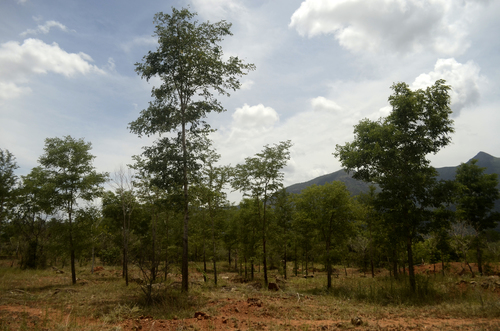
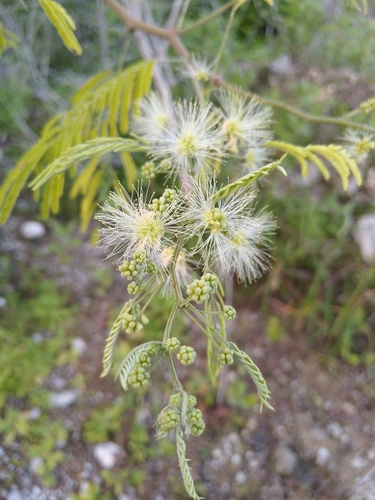
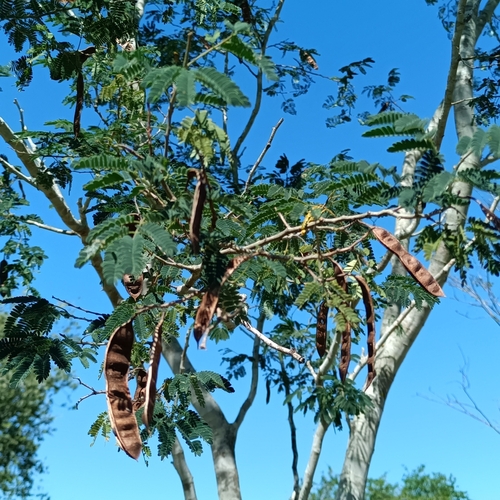
A tall tree. It grows 50 m tall. The trunk is tall, clear and smooth. The leaves are finely divided twice. There are 15-30 pairs of leaflets. The smallest leaflets are 13 mm long. The flowers are showy. They are white with yellow stamens. They are in round fuzzy heads. These hang on long stalks from round knobs. They have the smell of sour milk. These flower heads have 3 types of flowers. There are infertile ones near the stalk, male flowers in the middle and bisexual flowers at the tip. The fruit is a pod. It is 15-30 cm long. They are pale green and in spirals. Many pods hang in groups from the flower heads. The seeds are fleshy and orange-pink. There are 15-20 seeds in each pod. The seeds are garlic flavoured and edible.
Edible Uses
The young seeds are roasted and used for flavoring. Young fruit pods are eaten as a vegetable.
Traditional Uses
The young seeds are roasted and used for flavouring. The young fruit are eaten as a vegetable.
This uses section is brief — help expand it
Medicinal Uses
The young seeds are traditionally roasted and used for flavoring purposes.
Distribution
A tropical plant. It is native from India to Indonesia. It grows in humid lowland forests. In the Cairns Botanical Gardens. It suits hardiness zones 11-12.
Where It Grows
Africa, Asia, Australia, Cuba, East Africa, India, Indonesia, Malaysia, Mozambique, Myanmar, Northeastern India, Pacific, SE Asia*, West Indies,
Cultivation
Plants are grown from seed. Seedlings grow quickly at first. Plants are pollinated by bats.
Notes
Also as Mimosaceae.
Nutrition
| Part | Moisture | kJ | kcal | Protein | Vit A | Vit C | Iron | Zinc |
|---|---|---|---|---|---|---|---|---|
| Fruit | 76 | 380 | 91 | 6 | — | — | 2.2 | 8.2 |
Synonyms
Also Known As
Alai, Beka, Bereksa, Boli, Cupang, Gedayong, Kadaong, Karieng, Kedaung, Kedawang, Kedhawung, Kerayong, Kukitetoi, Peunheuy, Pohon petai kedawung, Pohon petai peundeuy, Pukkatetoi, Tulor, Youngchak
References (14)
- Arora, R. K., 2014, Diversity in Underutilized Plant Species - An Asia-Pacific Perspective. Bioversity International. p 50
- Barwick, M., 2004, Tropical and Subtropical Trees. A Worldwide Encyclopedic Guide. Thames and Hudson p 310
- Burkill, I.H., 1966, A Dictionary of the Economic Products of the Malay Peninsula. Ministry of Agriculture and Cooperatives, Kuala Lumpur, Malaysia. Vol 2 (I-Z) p 1698
- Chai, P. P. K. (Ed), et al, 2000, A checklist of Flora, Fauna, Food and Medicinal Plants. Lanjak Entimau Wildlife Sanctuary, Sarawak. Forestry Malaysia & ITTO. p 168
- Devi, O. S., et al, 2021, Wild edible plants associated with the people of Thoubal Khunou village and its migrated villagers. Int. J. Adv. Res. Biol. Sci. 8(9): 72-90
Show all 14 references Hide references
- Etherington, K., & Imwold, D., (Eds), 2001, Botanica's Trees & Shrubs. The illustrated A-Z of over 8500 trees and shrubs. Random House, Australia. p 511
- Facciola, S., 1998, Cornucopia 2: a Source Book of Edible Plants. Kampong Publications, p 153
- Hoe, V. B. & Siong, K. H., 1999, The nutritional value of indigenous fruit and vegetables in Sarawak. Asia Pacific J. Clin. Nutr. 8(1):24-31
- Majumdar, K and Datta, N., 2009, Traditional wild edible fruits for the forest dwellers of Tripura, India. Pleione 3(2) 167-178
- Miguel, E., et al, 1989, A checklist of the cultivated plants of Cuba. Kulturpflanze 37. 1989, 211-357
- Ochse, J.J. et al, 1931, Vegetables of the Dutch East Indies. Asher reprint. p 403
- Sp. blancoan. 169. 1918
- Sukarya, D. G., (Ed.) 2013, 3,500 Plant Species of the Botanic Gardens of Indonesia. LIPI p 433
- Terra, G.J.A., 1973, Tropical Vegetables. Communication 54e Royal Tropical Institute, Amsterdam, p 64