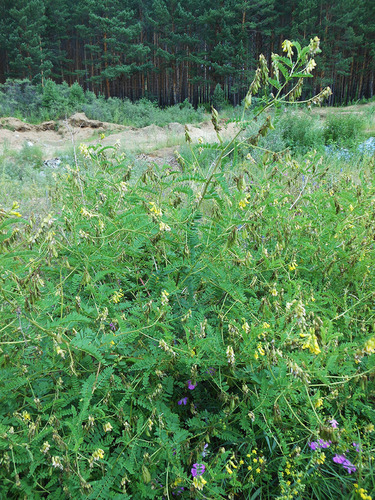
Crotalaria cunninghamii
R. Br.
Parrot Pea, Green Birdflower, Dwarf birdflower, Rattlepod birdflower
iNaturalist· cc-by-nc
(c) Ray Turnbull, some rights reserved (CC BY-NC), uploaded by Ray Turnbull
iNaturalist· cc-by-nc
(c) Ray Turnbull, some rights reserved (CC BY-NC)
iNaturalist· cc-by-nc-nd
(c) Bill Higham, some rights reserved (CC BY-NC-ND)
Summary
Source: WikipediaCrotalaria cunninghamii, also known as green bird flower, bird flower ratulpo, parrot pea, or regal bird flower, is a plant of the legume family Fabaceae, named Crotalaria after the Greek word for rattle because their seeds rattle, and cunninghamii after early 19th-century botanist Allan Cunningham. Crotalaria cunninghamii is known as Mangarr to the Nyangumarta Warrarn Indigenous group. Crotalaria cunninghamii is a short-lived perennial plant native to Australia, and its habitat is the deserts, coastlands, drainage lines, and sand dunes of the northern half of Western Australia and the Northern Territory. This habitat is semi-arid to temperate regions in well-drained soils. Crotalaria cunninghamii blooms from January to April. It is pollinated by large bees and by honeyeaters.
Description
A small to medium sized shrub. It grows 1-2.5 m high and spreads 0.5-2 m across. The leaves are soft and hairy. They are 3-8 cm long by 1-4 cm wide. The flowers are 2.5-3 cm long. The flowers are long and yellow green. They are streaked with fine black lines. They are like a bird. The fruit are hairy pods. They are 2-4 cm long.
Edible Uses
The flower nectar and seeds are eaten.
Medicinal Uses
Crotalaria cunninghamii can also be used to provide medicinal support to humans; through a process of heating and boiling, the leaves can be used to treat eye infections, and the bark can be used to treat swelling of the limbs. Aboriginal Australians used Crotalaria cunninghamii to treat eye infections and pain. The use of Crotalaria cunninghamii as a medicine is not widespread today, but it has historically been proposed to potentially have use in homeopathy.
Known Hazards
There have been no reports of Crotalaria cunninghamii being toxic to humans; however, human toxicity has been seen in the Crotalaria genus. Many members of the Crotalaria genus are known to contain pyrrolizidine alkaloids, the most potent of which are monocrotaline, retrorsine, and retronecine. Pyrrolizidine alkaloids are found in 3% of plants globally. These alkaloids have a cumulative effect on the body and, thus, are entirely safe if only small amounts are consumed. Many of these alkaloids have pronounced toxicity known to decrease brain function, but the lungs and other organs may be affected as well. Mutagenic and carcinogenic properties of pyrrolizidine alkaloids have also been reported. Pyrrolizidine alkaloids are known to alter vitamin A metabolism in rats, depressing plasma levels in livestock livers, which can be fatal in some cases for animals.
Distribution
It grows in warm temperate regions and suits arid and semiarid places. It needs well drained soil. It can grow in dry soil and full sunlight. It suits hardiness zones 9-11.
Where It Grows
Australia*,
Cultivation
Plants can be grown by seed or stem cuttings.
Propagation
Seed - it has a hard seedcoat and benefits from scarification before sowing in order to speed up and improve germination. This can usually be done by pouring a small amount of nearly boiling water on the seeds (being careful not to cook them!) and then soaking them for 12 - 24 hours in warm water. By this time they should have imbibed moisture and swollen - if they have not, then carefully make a nick in the seedcoat (being careful not to damage the embryo) and soak for a further 12 hours before sowing. Cuttings
Other Uses
The stems are a source of fibre. This was used traditionally by the Aboriginal Australians for cords and for making sandals to protect them from the hot desert sand. The fibre is similar in quality to that obtained from Crotalaria juncea, which is a valuable, high quality, strong fibre that is grown on a commercial basis and used to make twine and cord; canvas and fishing nets; and paper and pulp.
Notes
There are about 550 Crotalaria species. They are mostly tropical.
Also Known As
Urlg
References (15)
- Bodkin, F., 1991, Encyclopedia Botanica. Cornstalk publishing, p 301
- Bot. Sturt's exped. Australia 8. 1849
- Cribb, A.B. & J.W., 1976, Wild Food in Australia, Fontana. p 103
- Cundall, P., (ed.), 2004, Gardening Australia: flora: the gardener's bible. ABC Books. p 437
- Elliot, W.R., & Jones, D.L., 1984, Encyclopedia of Australian Plants suitable for cultivation. Vol 3. Lothian. p 112
Show all 15 references Hide references
- Etherington, K., & Imwold, D., (Eds), 2001, Botanica's Trees & Shrubs. The illustrated A-Z of over 8500 trees and shrubs. Random House, Australia. p 242
- Kenneally, K.E., Edinger, D. C., and Willing T., 1996, Broome and Beyond, Plants and People of the Dampier Peninsula, Kimberley, Western Australia. Department of Conservation and Land Management. p 154
- Lazarides, M. & Hince, B., 1993, Handbook of Economic Plants of Australia, CSIRO. p 68
- Lord, E.E., & Willis, J.H., 1999, Shrubs and Trees for Australian gardens. Lothian. p 159
- Molyneux, B & Forrester, S., 1997, The Austraflora A-Z of Australian Plants. Reed. p 70
- Paczkowska, G . & Chapman, A.R., 2000, The Western Australian Flora. A Descriptive Catalogue. Western Australian Herbarium. p 421
- Petheram, R.J. and Kok, B., 2003, Plants of the Kimberley Region of Western Australia. UWA Press p 301
- Smith, M & Kalotas, A. C., 1985, Bardi Plants: An Annotated List of Plants and Their Use by the Bardi Aborigines of Dampierland, in North-western Australia. Rec. West Aust. Mus. 1985, 12(3): 317-359
- Wheeler, J.R.(ed.), 1992, Flora of the Kimberley Region. CALM, Western Australian Herbarium, p 382
- World Checklist of Useful Plant Species 2020. Royal Botanic Gardens, Kew