Benstonea lauterbachii
(K. Schum. & Warb.) Callm. & Buerki
Lauterbach's pandan
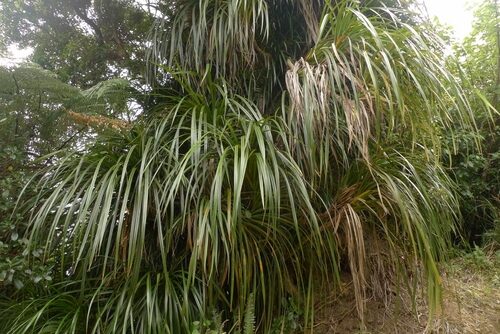
iNaturalist· cc-by
(c) coenobita, some rights reserved (CC BY), uploaded by coenobita
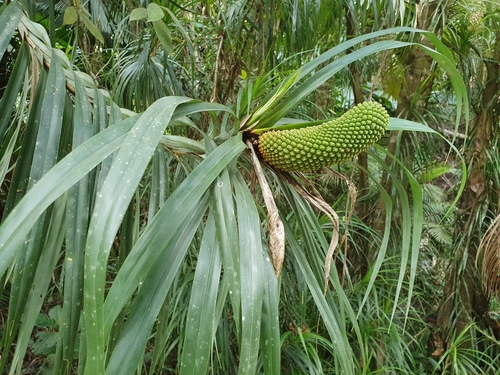
iNaturalist· cc-by
(c) coenobita, some rights reserved (CC BY), uploaded by coenobita
Summary
Source: WikipediaBenstonea lauterbachii, commonly known as Lauterbach's pandan, is a shrub or small tree to 15 m (49 ft) in the family Pandanaceae endemic to Cape York Peninsula in Queensland, Australia. It was first described as Pandanus lauterbachii in 1900, but was revised in 2012 by Martin Callmander and Sven Buerki who placed it in the newly created genus Benstonea. In Australia it is found from the tip of Cape York to Iron Range, with an isolated occurrence at the Hull River near Tully.
Description
A shrub or small tree up to 5 m tall. It spreads 2-3 m across the crown. It does not have prop roots. The leaves are simple and 1-2 m long. Leaves are 4-6 cm wide and strap shaped. They are dark green and shiny above and paler underneath. The edges of the leaves and the underside on the midrib have teeth. Trees are separately male and female. The male flower is 50-90 cm long. It hangs down and has broad white bracts. The female flowering stalk is 70-90 cm long. It is branched and has 7-9 spikes. The fruit is up to 10-17 cm long by 8-12 cm wide. They hang in bunches of 7-9 heads. They contain several seeds. Each segment is tipped with a prickly point. The seeds are about 1.5 cm long. The flesh is edible. Now Benstonea lauterbachii (K. Schum. & Warb.) Callm. & Buerki;
Edible Uses
The flesh of the fruit is edible, though it can sting the mouth.
Traditional Uses
The flesh is edible but it can sting the mouth.
This uses section is brief — help expand it
Distribution
A tropical plant. They grow naturally in rainforests in NE Queensland in Australia, usually near streams. It is also in PNG. It grows in rainforest near mangroves.
Where It Grows
Australia*, Indonesia, Pacific, Papua New Guinea, PNG, SE Asia,
Cultivation
Plants can be grown from seed. They can also be grown from young plantlets near the base of other plants.
Other Uses
The leaves are used for making mats.
Notes
There are about 600 Pandanus species. They grow in the tropics.
Synonyms
References (6)
- Cooper W & Cooper W T, 1994, Fruits of the Rain Forest. RD Press p 212
- Cooper, W. and Cooper, W., 2004, Fruits of the Australian Tropical Rainforest. Nokomis Editions, Victoria, Australia. p 386
- Elliot, W.R., & Jones, D.L., 1997, Encyclopedia of Australian Plants suitable for cultivation. Vol 7. Lothian. p 154
- Pflanzenr. IV, 9:81, 1900
- World Checklist of Useful Plant Species 2020. Royal Botanic Gardens, Kew
Show all 6 references Hide references
- www.pngplants.org