Freycinetia percostata
Merr. & Perry
Veiny Climbing Pandan
iNaturalist· cc-by-nc
(c) sworboys, some rights reserved (CC BY-NC), uploaded by sworboys
iNaturalist· cc-by-nc
(c) sworboys, some rights reserved (CC BY-NC), uploaded by sworboys
iNaturalist· cc-by-nc
(c) sworboys, some rights reserved (CC BY-NC), uploaded by sworboys
Summary
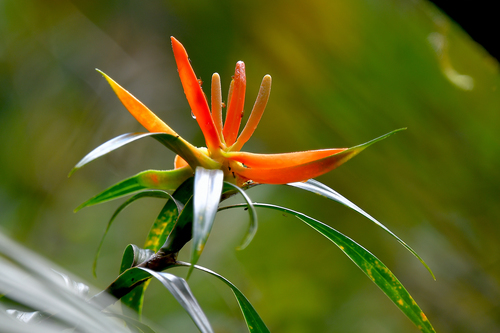
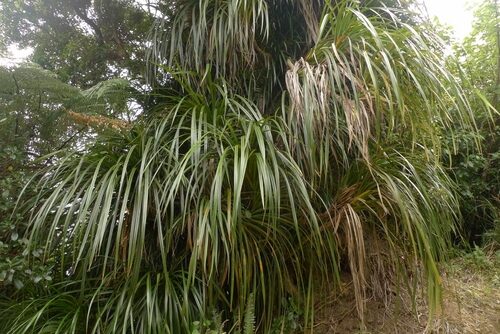
Source: WikipediaFreycinetia percostata, commonly known as climbing pandan, is a plant in the family Pandanaceae native to New Guinea, the Solomon Islands and the Northern Territory and Queensland in Australia. It is a root climber with stems up to a maximum of 3 cm (1.2 in) diameter. Leaves are long and narrow with parallel venation, and are arranged in closely packed spirals. Auricles are present at the leaf base and the margins are finely toothed. The species is dioecious, meaning that pistillate (functionally female) and staminate (functionally male) flowers are borne on separate plants. Inflorescences consist of spadices and are surrounded by orange bracts. Fruit are a multiple fruit consisting of numerous red berries about 1 cm (0.39 in) wide.
Description
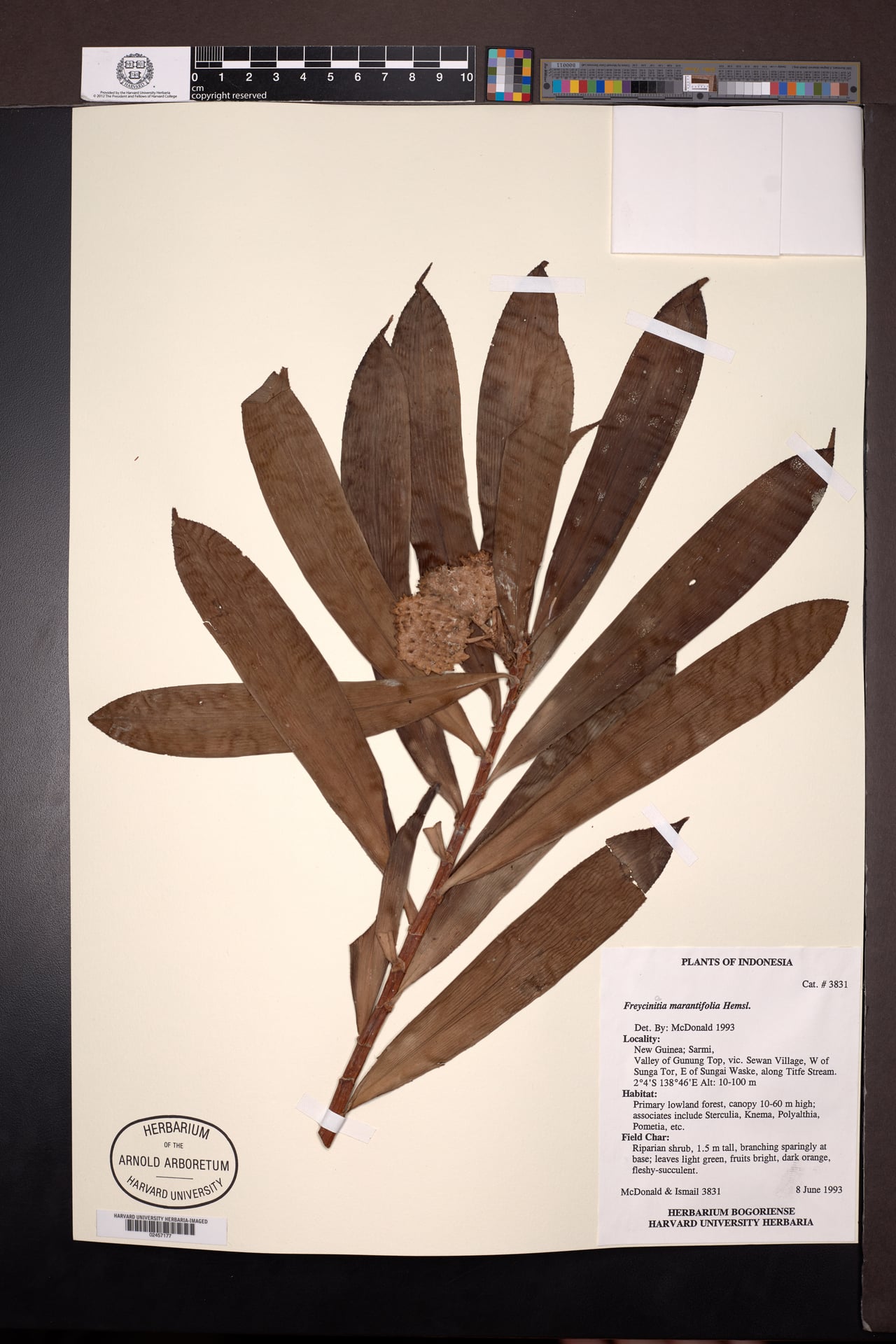
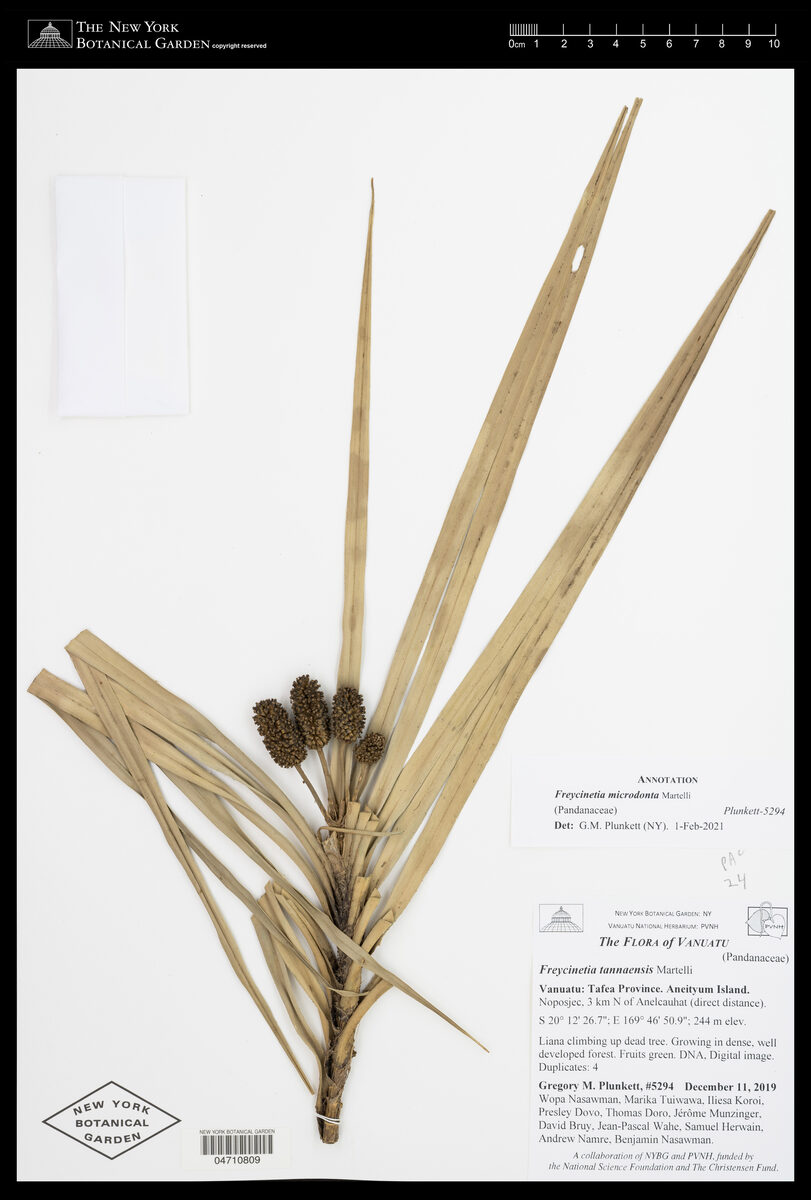
A root climber. It is woody and bushy. The stems are 2 cm across. The leaves are simple and 38-52 cm long by 2-3 cm wide. They are organised in spirals around the stem. The edges of the leaves on the underside have teeth. The flowering cluster has bright orange to pink bracts underneath it. These are 20 cm long. There are 3-4 female heads which are 5-6.5 cm long by 0.8-0.9 cm wide. They are like a cylinder. The male spikes are 9-13 cm long by 0.6-0.8 cm wide. They are pale orange. The fruit are 14-30 cm long by 2.5-4.5 cm wide and occur singly or in twos. They have many small seeds. The flesh is edible.
Edible Uses
The flesh of the fruit is edible and can be eaten in small amounts, though it may cause stinging in the mouth and throat.
Traditional Uses
The flesh is edible in small amounts but it may sting the mouth and throat.
This uses section is brief — help expand it
Known Hazards
The fruit flesh may sting the mouth and throat when consumed.
Distribution
It is a tropical plant. It needs a shady location. It needs a sturdy tree trunk to climb. It grows naturally in rainforests in NE Queensland in Australia. It grows from sea level to 450 m altitude.
Where It Grows
Australia*, Pacific, Papua New Guinea, PNG, Solomon Islands,
Cultivation
Plants can be grown from cuttings.
Notes
There are about 100-175 Freycinetia species.
References (5)
- Cooper W & Cooper W T, 1994, Fruits of the Rain Forest. RD Press p 144
- Cooper, W. and Cooper, W., 2004, Fruits of the Australian Tropical Rainforest. Nokomis Editions, Victoria, Australia. p 382
- Elliot, W.R., & Jones, D.L., 1992, Encyclopedia of Australian Plants suitable for cultivation. Vol 4. Lothian. p 318
- French, B.R., 2010, Food Plants of Solomon Islands. A Compendium. Food Plants International Inc. p 330
- Townsend, K., 1994, Across the Top. Gardening with Australian Plants in the tropics. Society for Growing Australian Plants, Townsville Branch Inc. p 220