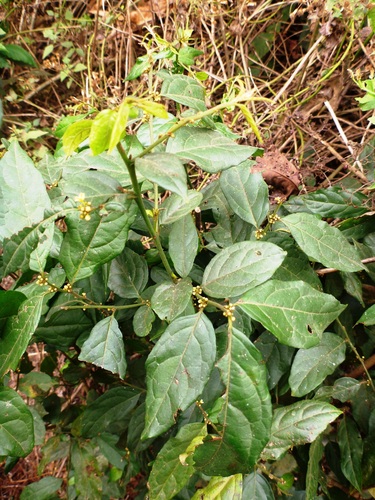
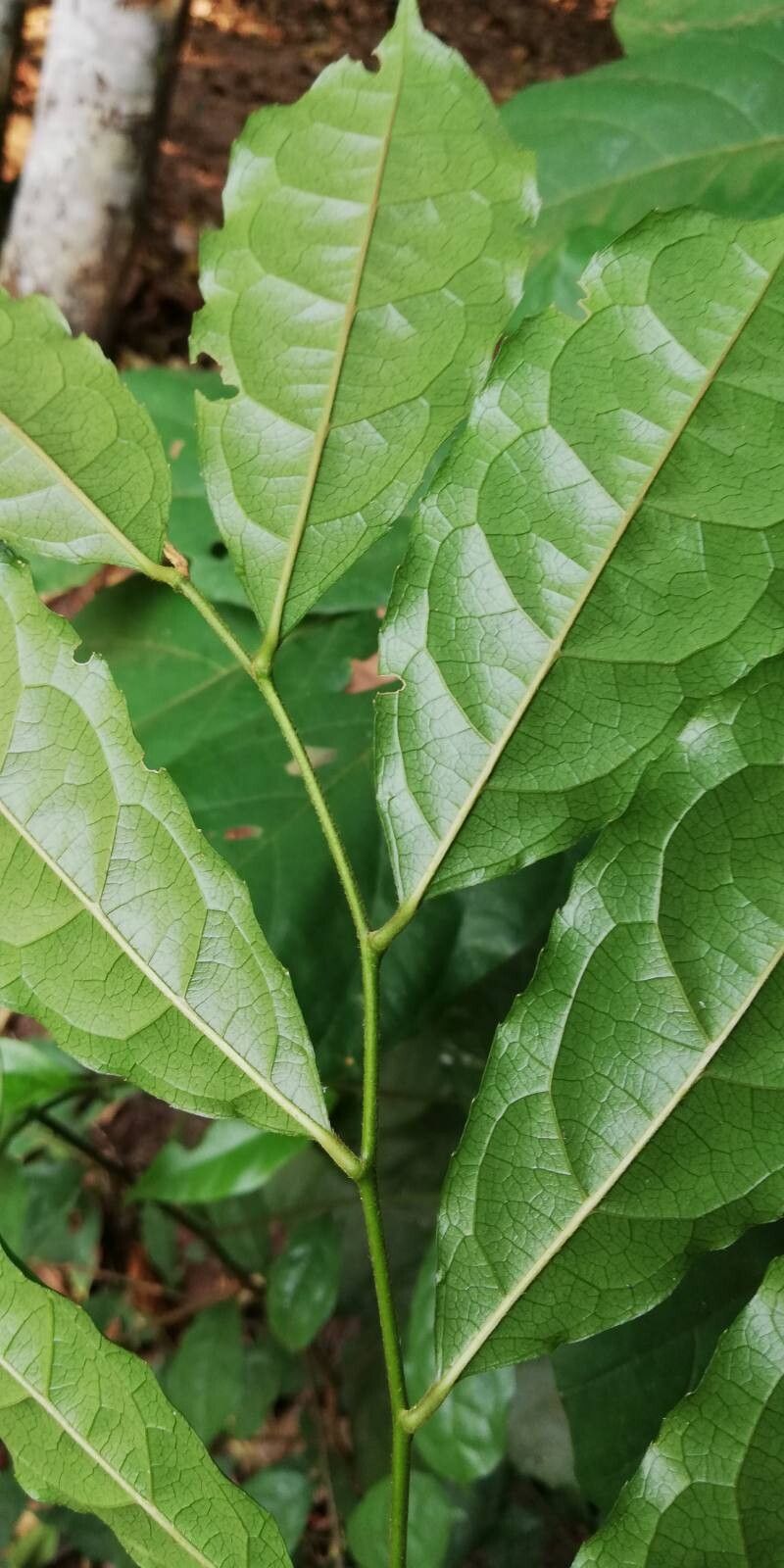
Panda oleosa
Pierre
Panda
iNaturalist· cc-by-nc
(c) Gwili Gibbon, some rights reserved (CC BY-NC), uploaded by Gwili Gibbon
iNaturalist· cc-by-nc
(c) Carel Jongkind, some rights reserved (CC BY-NC), uploaded by Carel Jongkind
iNaturalist· pd
Adolf Engler, no known copyright restrictions (public domain)
Summary
Source: WikipediaPanda is a plant genus of the family Pandaceae. It contains only one known species, Panda oleosa, native to western and central Africa (Liberia, Ghana, Guinea, Ivory Coast, Nigeria, Cabinda, Gabon, Central African Republic, Congo-Brazzaville, Cameroon, Zaire). Chimpanzees have been observed to hammer on the nuts of Panda oleosa, which are particularly hard to open. Humans cook and eat the seeds and also use an oil produced by the seeds in food preparation, the wood is used to make canoes and for carpentry.
Description
A tree. It grows 15-30 m high. The trunk is 80 cm across. It can have short buttresses. The leaves are alternate and simple. They are 10-20 cm long by 5-9 cm wide. The flowers are red. The fruit are 4-5 cm across. They are green to pale yellow. The flesh is a reddish-orange. The seeds are encased in a hard shell. There are 3 openings each with a seed bent at right angles.
Edible Uses
The oil extracted from seeds is used in cooking. Seeds are crushed and used as a spice, cooked and eaten whole, or pounded and added to soups, sauces, and stews. The fruit is also eaten.
Traditional Uses
The oil from the seeds is used in cooking. The seeds are crushed and used as a spice. The seeds are cooked and eaten and pounded and added to soups, sauces and stews.
Medicinal Uses
Seeds are pounded and added to traditional soups and sauces for culinary and medicinal purposes.
Distribution
A tropical plant. It grows in the rain-forest as an under-storey tree. It is also along rivers and in seasonally flooded land.
Where It Grows
Africa, Benin, Cameroon, Central Africa, Central African Republic, CAR, Congo DR, Congo R, Côte d'Ivoire, Gabon, Ghana, Ivory Coast, Liberia, Nigeria, Togo, West Africa,
Cultivation
Plants are grown from seed. They do not germinate easily. They may take 10 months to 4 years to germinate.
Propagation
Seed - germinates slowly, taking from 10 months to 4 years. Seedlings survive in the shade of the forest, but they are most common in openings in the forest canopy.
Other Uses
The brownish yellow to pinkish red wood is moderately hard, has an irregular grain and fine texture. It is used for carpentry and making canoes.
Production
It grows slowly. The stones of the fruit are difficult to open. In Central African Republic flowers have been observed in February.
Notes
There is only one Panda species.
Nutrition
| Part | Moisture | kJ | kcal | Protein | Vit A | Vit C | Iron | Zinc |
|---|---|---|---|---|---|---|---|---|
| Seeds dried | 4.8 | 2312 | 553 | 23.4 | — | — | — | — |
Also Known As
Afane, Angele, Awua, Bakale, Binigogongbia, Kana, Kokroboba, Kone, Leteko, Likale, Likele, Lopha, Makamu, Mbando, Mfanda, Nkana, Okale, Pendo
References (27)
- Abbiw, D.K., 1990, Useful Plants of Ghana. West African uses of wild and cultivated plants. Intermediate Technology Publications and the Royal Botanic Gardens, Kew. p 49
- Billong Fils, P. E., et al, 2020, Ethnobotanical survey of wild edible plants used by Baka people in southeastern Cameroon. Journal or Ethnobiology and Ethnomedicine. 16:64 p 9
- Bull. Mens. Soc. Linn. Paris 2:1255. 1896
- Burkill, H. M., 1985, The useful plants of west tropical Africa, Vol. 4. Kew.
- Busson, 1965,
Show all 27 references Hide references
- Dalziel, J. M., 1937, The Useful plants of west tropical Africa. Crown Agents for the Colonies London.
- Danforth, R.M., & Boren, P.D., 1997, Congo Native fruits. Twenty-five of the best. Privately published. p 69
- Davis, S.D., Heywood, V.H., & Hamilton, A.C. (eds), 1994, Centres of plant Diversity. WWF. Vol 1. p 172
- Facciola, S., 1998, Cornucopia 2: a Source Book of Edible Plants. Kampong Publications, p 165
- Food Composition Tables for use in Africa FAO http://www.fao.org/infoods/directory No. 446
- Fongnzossie Fedoung, E., et al, 2014, Density and Natural Regeneration Potential of Selected Non-timber Forest Products Species in the Semi-deciduous Rainforest of Southeastern Cameroon. African Study Monographs, Suppl. 49:69-90.
- Gallois, S., et al, 2020, Methodological priorities in assessing wild edible plant knowledge and use – a case study among the Baka in Cameroon.
- Heywood, V.H., Brummitt, R.K., Culham, A., and Seberg, O. 2007, Flowering Plant Families of the World. Royal Botanical Gardens, Kew. p 241
- Jardin, C., 1970, List of Foods Used In Africa, FAO Nutrition Information Document Series No 2.p 46
- Latham, P & Mbuta, A., 2017, Useful Plants of Central Province, Democratic Republic of Congo. Volume 2. Salvation Army p 81
- Lemmens, R.H.M.J., 2007. Panda oleosa Pierre. [Internet] Record from Protabase. van der Vossen, H.A.M. & Mkamilo, G.S. (Editors). PROTA (Plant Resources of Tropical Africa), Wageningen, Netherlands. < http://database.prota.org/search.htm>. Accessed 20 October 200919 October 2009.
- Liengola, I. B., 2001, A contribution to the study of native edible plants by the Turumbu and Lokele of the Tshopo District, Province Orientale, D. R. Congo. Syst. Geogr. Pl. 71:687-698
- Menninger, E.A., 1977, Edible Nuts of the World. Horticultural Books. Florida p 119
- Mosango, M., Szafranski, F., 1985, Plantes sauvages à fruits comestibles dans les environs de Kisangani (Zaïre). In: Journal d'agriculture traditionnelle et de botanique appliquée, 32e année, pp. 177-190
- Moutsambote, J., 1996, Vegetation forestiere et plantes alimentaires de la region de la Sangha. Chp. 11 of Bien Manger et Bien Vivre. ORSTOM p 119
- Nkeoua, G. & Boundzanga, G. C., 1999, Donnees sur les produits forestieres non ligneux en Republique du Congo. FAO. p 33
- Peters, C. R., O'Brien, E. M., and Drummond, R.B., 1992, Edible Wild plants of Sub-saharan Africa. Kew. p 159
- Termote, C., et al, 2011, Eating from the wild: Turumbu, Mbole and Bali traditional knowledge of non-cultivated edible plants, District Tshopo, DRCongo, Gen Resourc Crop Evol. 58:585-618
- Vivien, J. & Faure, J.J., 1985, Abres des forets dense d'Afrique Centrale. Agence de Cooperation Culturelle et Technique. Paris. p 344
- Vivien, J., & Faure, J.J., 1996, Fruitiers Sauvages d'Afrique. Especes du Cameroun. CTA p 255
- World Checklist of Useful Plant Species 2020. Royal Botanic Gardens, Kew
- Yasuoka, H., 2006, Long-Term Foraging Expeditions (Molongo) among the Baka Hunter-Gatherers in the Northwestern Congo Basin, with Special Reference to the "Wild Yam Question". Human Ecology, Vol. 34, No. 2, April 2006, pp 275 ff