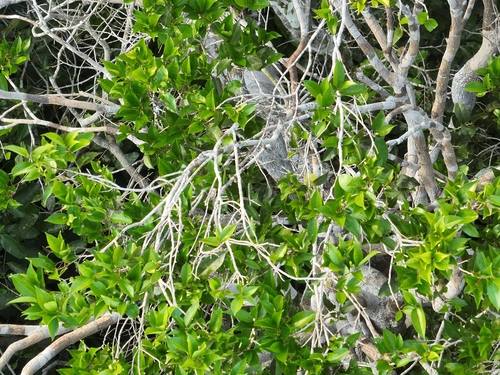
Synsepalum brevipes
(Baker) T. D. Penn.
Stem-fruit miraculous berry
iNaturalist· cc-by-nc
(c) Bart Wursten, some rights reserved (CC BY-NC)
iNaturalist· cc-by-nc
(c) Bart Wursten, some rights reserved (CC BY-NC)
iNaturalist· cc-by-nc
(c) Bart Wursten, some rights reserved (CC BY-NC)
Summary
Source: WikipediaSynsepalum brevipes is a shrub or medium-sized to large tree in the family Sapotaceae, that is native to the African tropics and subtropics.
Description
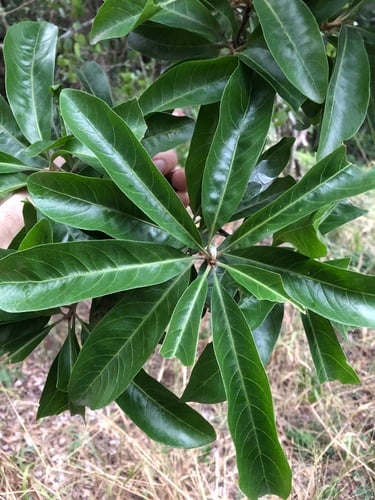
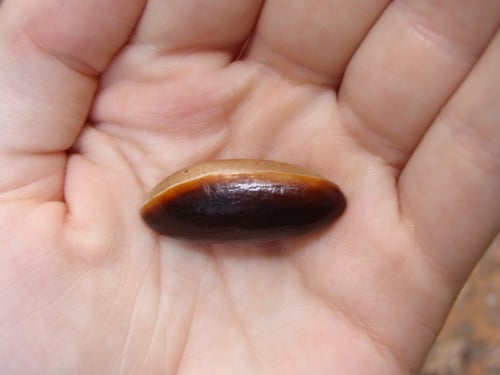
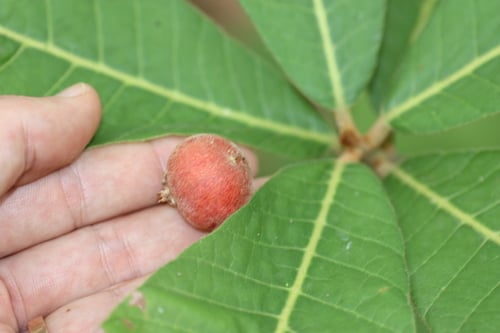
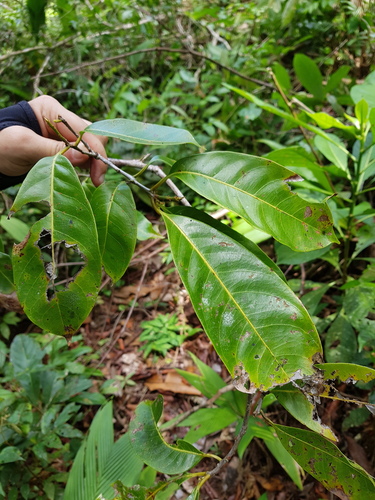
A small to large evergreen tree. It can grow from 3 to 35 m tall. It has a dense crown and fluted trunk. There are often buttresses at the base. The bark is grey and rough and flakes into rectangular scales. It secretes a white sap. The leaves are dark green and oval but tapering to the base. They are shiny on the upper surface and slightly hairy on the lower surface. The young leaves and stalks are densely hairy. There are 8-14 side veins on each side. Leaves vary from 9 to 20 cm long and 3.5 to 8 cm wide. The leaf stalk can be 1 cm long. A pair of 1 cm long leaf like stipules persist at the base of the leaf stalk. The flowers are yellowish white and have a smell. They are in thick clusters below the leaves in small cushions on bar branches. The fruit are small and rusty green. They are hairy berries 3 cm long and 2.4 cm across. The fruit have a thick skin but are soft and acid sweet. They are edible. The one seed is shiny brown with a large scar on one side.
Edible Uses
The pulp of ripe fruit is eaten raw. Ripe fruit can be soaked in water, squeezed, filtered, and combined with sugar to make a drink. The seeds are eaten raw.
Traditional Uses
The pulp of the fruit is eaten raw. The ripe fruit are soaked in water, squeezed and filtered and sugar added then used as a drink. The seeds are eaten raw.
Medicinal Uses
A root decoction is taken to treat malaria and as an aphrodisiac. Sap from the roots and bark is drunk to treat coughs, colds, hernia and stomach complaints. A bark decoction is drunk to treat swellings. The leaves are used against hookworm infection of the small intestine. The fruit pulp is used to treat jaundice and nausea. The latex from the fruit is applied as a galactagogue.
Distribution
A tropical plant. It occurs in lowland rainforests in East Africa. It suits humid locations. It occurs from sea level to 1,500 m altitude. Occasionally it grows to 1,600 m. It grows in areas with rainfalls from 1,000 mm to 2,000 mm. It grows in areas with temperatures between 16°C and 30°C. It occurs in areas where there is a high permanent water table. It can be in seasonally flooded forest.
Where It Grows
Africa, Angola, Benin, Burkina Faso, Cameroon, Central Africa, Central African Republic, CAR, Congo DR, Congo R, Côte d'Ivoire, East Africa, Gabon, Ghana, Guinea, Guinée, Guinea-Bissau, Ivory Coast, Kenya, Malawi, Mozambique, Nigeria, Senegal, Sierra Leone, Southern Africa, Sudan, Tanzania, Togo, Uganda, West Africa, Zambia, Zimbabwe,
Cultivation
Plants grow naturally from seed. To extract the seed the ripe berries should be crushed and the seed removed. The seed should be soaked in cold water for 12 hours before planting.
Propagation
Seed - pre-soak in warm water for 12 hours or scarify by lightly abrading the seedcoat, being careful not to damage the embryo. In tests, germination started after 8 - 25 days, and the germination percentage was high. Seeds can be stored for some time in sealed containers in a cool place.
Other Uses
The heartwood is reddish brown, the sapwood pale brown to reddish yellow. The wood is hard, heavy and durable. It planes easily and smoothly; splits easily and does not take nails; and is not well suited for turning. It is used for pestles, tool handles, stakes, seats, canoes and domestic utensils. The wood is used for fuel and making charcoal.
Production
Trees are slow growing. Ripe fruit are harvested from the tree. Fruiting is seasonal. Flowering occurs in May, August and December. Ripe fruit are available October to February. The flowering and fruiting period is therefore long.
Synonyms
Also Known As
Abam sanaga goyoum, Aframsua, Amabiama, Bokokolo, Ikokolo, Koolo, Maambia, Maambwa, Mchamvia, Mchocha, Mchocha mke, Mgelezi, Miriaculo, Mkarati, Mpimbi, Mpimbinyolo, Mpuso, Msambia, Msambicho, Msamvia, Msuwi, Mumbu, Munoa, Nampilidji, Ndobilobe, Okokoolo, Pachystela, Peliche, Tokokoolo, Umpudo
References (37)
- Abbiw, D.K., 1990, Useful Plants of Ghana. West African uses of wild and cultivated plants. Intermediate Technology Publications and the Royal Botanic Gardens, Kew. p 48
- Atato, A., et al, 2010, Diversity of Edible Wild Fruit Tree Species of Togo. Global Science Books. (As Pachystela brevipes)
- Burkill, H. M., 1985, The useful plants of west tropical Africa, Vol. 5. Kew. (As Synsepalum brevipes (Bak.) Pennington)
- Chapman, J. D. & Chapman, H. M., 2001, The Forest Flora of Taraba and Andamawa States, Nigeria. WWF & University of Canterbury. p 203
- Codjia, J. T. C., et al, 2003, Diversity and local valorisation of vegetal edible products in Benin. Cahiers Agricultures 12:1-12 (As Pachystela brevipes)
Show all 37 references Hide references
- Dale, I. R. and Greenway, P. J., 1961, Kenya Trees and Shrubs. Nairobi. p 529 (As Pachystela brevipes)
- Dalziel, J. M., 1937, The Useful plants of west tropical Africa. Crown Agents for the Colonies London.
- Davis, S.D., Heywood, V.H., & Hamilton, A.C. (eds), 1994, Centres of plant Diversity. WWF. Vol 1. p 244
- Diop, A. l., et al, 2021, Cultural importance of wild edible plants in three sympatric communities: Agni, Akyé and Gwa in the Department of Alépé (Southeast of Côte d’Ivoire). Ethnobotany Research and Applications 22:35. p 7
- Djihounouck, Y., et al, 2018, Diversité Et Importance Socio-Economique Des Espèces Fruitières Sauvages Comestibles En Zone Kasa (Sud-Ouest Du Sénégal). European Scientific Journal December 2018 edition Vol.14, No.36 ISSN: 1857 – 7881
- FAO. 1983, Food and fruit-bearing forest species 1: Examples from Eastern Africa. FAO Food and Forestry Paper 44/1 p 75
- Fowler, D. G., 2007, Zambian Plants: Their Vernacular Names and Uses. Kew. p 60
- Fox, F. W. & Young, M. E. N., 1982, Food from the Veld. Delta Books. p 339 (As Pachystela brevipes)
- Grivetti, L. E., 1980, Agricultural development: present and potential role of edible wild plants. Part 2: Sub-Saharan Africa, Report to the Department of State Agency for International Development. p 66 (As Pachystela brevipes)
- http://www.fao.org/forestry/25323-096344a3de335832e8f363c3ac5184a66.pdf (As Pachystela brevipes)
- Jardin, C., 1970, List of Foods Used In Africa, FAO Nutrition Information Document Series No 2.p 152
- JSTOR Global Plants edible
- Katende, A.B., Birnie, A & Tengnas B., 1995, Useful Trees and Shrubs for Uganda. Identification, Propagation and Management for Agricultural and Pastoral Communities. Technical handbook No 10. Regional Soil Conservation Unit, Nairobi, Kenya. p 472
- Keay, R.W.J., 1989, Trees of Nigeria. Clarendon Press, Oxford. p 397
- Kokwaro, J. O. and Johns. T., Luo Biological Dictionary. p 43 (As Pachystela brevipes)
- Liengola, I. B., 2001, A contribution to the study of native edible plants by the Turumbu and Lokele of the Tshopo District, Province Orientale, D. R. Congo. Syst. Geogr. Pl. 71:687-698
- Lovett, J. C. et al, Field Guide to the Moist Forest Trees of Tanzania. p 167
- Maundu, P. et al, 1999, Traditional Food Plants of Kenya. National Museum of Kenya. 288p
- Mosango, M., Szafranski, F., 1985, Plantes sauvages à fruits comestibles dans les environs de Kisangani (Zaïre). In: Journal d'agriculture traditionnelle et de botanique appliquée, 32e année, pp. 177-190 (As Pachystela brevipes)
- Mutie, F. M., et al, 2023, Important Medicinal and Food Taxa (Orders and Families) in Kenya, Based on Three Quantitative Approaches. Plants 2023, 12, 1145
- Nkeoua, G. & Boundzanga, G. C., 1999, Donnees sur les produits forestieres non ligneux en Republique du Congo. FAO. p 33 (As Pachystela brevipes)
- Palgrave, K.C., 1996, Trees of Southern Africa. Struik Publishers. p 723
- Peters, C. R., O'Brien, E. M., and Drummond, R.B., 1992, Edible Wild plants of Sub-saharan Africa. Kew. p 184
- Ruffo, C. K., Birnie, A. & Tengnas, B., 2002, Edible Wild Plants of Tanzania. RELMA p 644
- Termote, C., et al, 2011, Eating from the wild: Turumbu, Mbole and Bali traditional knowledge of non-cultivated edible plants, District Tshopo, DRCongo, Gen Resourc Crop Evol. 58:585-618
- Tredgold, M.H., 1986, Food Plants of Zimbabwe. Mambo Press. p 112
- Unwin, A. H., 1920, West African Forests and Forestry. Fisher Unwin Ltd. pdf on Internet p 90 (As Sideroxylon longistylum)
- Vivien, J., & Faure, J.J., 1996, Fruitiers Sauvages d'Afrique. Especes du Cameroun. CTA p 321
- Walsh, M., 2009, The Use of Wild and Cultivated Plants as famine Foods on Pemba Island, Zanzibar. Études océan Indien. 42-43
- White, F., Dowsett-Lemaire, F. and Chapman, J. D., 2001, Evergreen Forest Flora of Malawi. Kew. p 543
- Williamson, 1972,
- World Checklist of Useful Plant Species 2020. Royal Botanic Gardens, Kew